
What the First Two Posts Were Really Building Toward
Craig’s post made the case for one CAD standard across every architect you hire, so the construction document layer stays consistent no matter who designed the plan. My last post traced what happens when a gap slips through anyway: a mislabeled layer, an uncalled material, a dimension close enough to pass permitting but not clean enough to survive on-site construction. That gap becomes a guess someone downstream has to make under deadline, and the guess eventually shows up as two versions of the truth: the home the buyer saw in the rendering, and the home the crew framed.
Both posts were really circling the same question from different angles: what does a CAD mistake cost, and who pays for it. Neither post asked the question that decides the answer.
How many times does the house get built?
The Question Nobody’s Asking
Ask any builder to explain the difference between production and custom, and you’ll get an answer about the buyer’s experience: more choices here, fewer there, a faster timeline on one side and more freedom on the other. That’s true, and it’s also the wrong place to be looking if you’re trying to understand what a CAD error costs you.
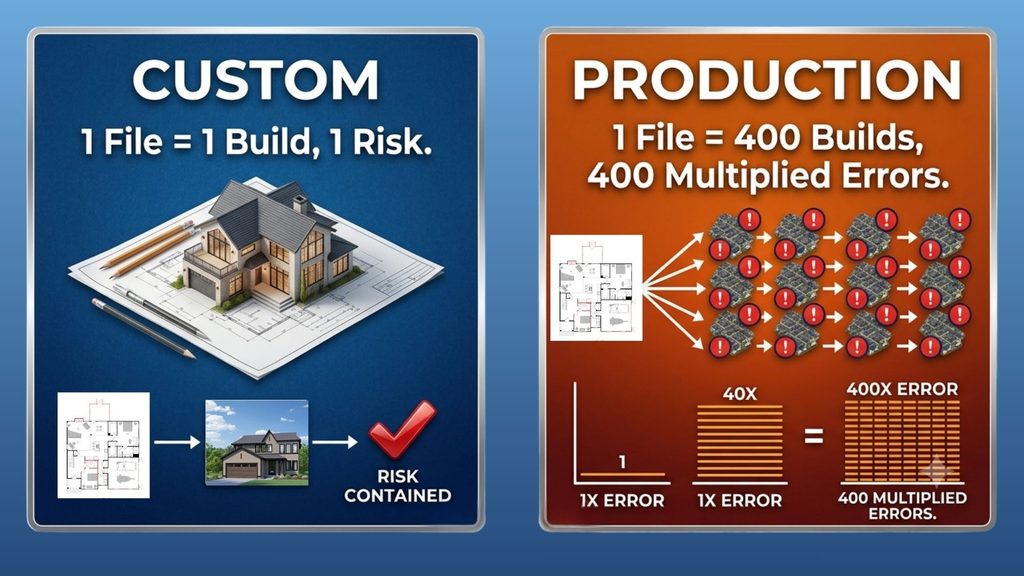
Here’s the question that matters instead. When a custom home’s construction documents carry a mistake, one house absorbs it. The framing crew builds it once, the buyer lives with it once, and when the project closes, so does the exposure. When a production plan carries the same mistake, the file doesn’t get built once. It gets built fifty times, a hundred times, sometimes closer to four hundred, across however many lots that plan is assigned to before several communities sell out. The mistake isn’t corrected between builds. It’s replicated, over and over
The Multiplication Nobody’s Pricing
I’ve watched builders price CAD accuracy like it’s a single-project risk. Get the drawing right, get the permit through, move on. That math works fine for a custom builder, whose entire exposure to any given plan begins and ends with one house. It stops working the moment the same plan becomes the template for a subdivision.
Think about what actually gets multiplied. A visualization asset built from a flawed source file doesn’t just misrepresent one buyer’s future home. It’s the same rendering, the same marketing floor plan, shown to every buyer who tours that model or clicks that listing, all of them forming an expectation from the identical inaccuracy. A field detail that got interpreted wrong once because the CAD file left a gap doesn’t get corrected on lot two. It gets interpreted the same way by whichever crew is running that plan, lot after lot, until someone finally notices the pattern, usually because a buyer noticed it first.
That’s the part the customer-experience framing misses entirely. Production and custom aren’t just different buying experiences. They’re different exposure models built on the exact same kind of underlying CAD mistake, and the production side is carrying a multiplier the custom side never sees.
Where the Multiplier Lives
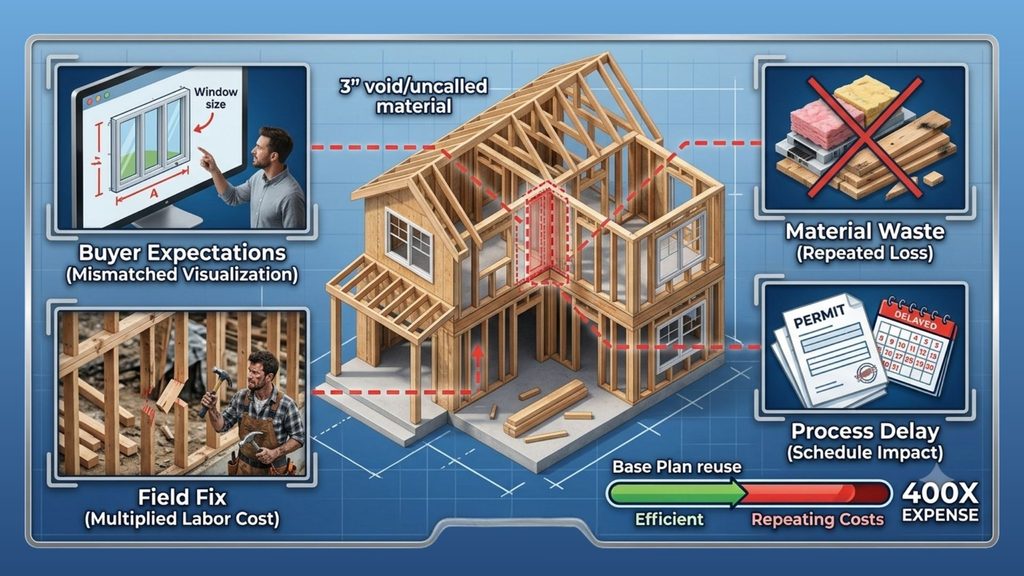
The mechanism is worth discussing here, because it’s not abstract. A production builder’s plan library exists precisely because a single clean file gets reused: the same structural drawing, the same rendering asset, the same marketing floor plan, distributed across every sale that plan touches. That reuse is the entire economic logic of production building. It’s also exactly why a CAD mistake in that file doesn’t stay small. The same efficiency that makes production building profitable is the mechanism that turns a one-time drafting error into a repeating cost.
Semi-custom sits in an uncomfortable middle. The base plan still repeats, so the multiplier is still live, but every structural option a buyer selects forks the file into a new variant that has to be accurate on its own terms. A mistake in the base plan multiplies across every home built from it. A mistake in an option package multiplies across every buyer who chose that specific configuration. Neither is contained the way a custom project’s exposure is contained.
Custom home builders, by comparison, are working with the lowest-stakes version of a CAD mistake in this entire equation, and it’s worth pointing to directly instead of implying it. One house. One crew. One buyer. When the project closes, so does the risk. That’s not a knock on the diligence custom builders bring to their drawings. It’s just math. The same drafting error that costs a custom builder one difficult conversation costs a production builder however many lots that plan touches, multiplied by however long it takes someone to notice the pattern.
What This Means for How You Treat the File
None of this changes what Craig argued or what I argued last time. Standardize your CAD process. Catch the gaps before they become someone else’s guess. What it changes is how much attention that standard deserves before the first house on a plan ever breaks ground, because the cost of getting it wrong isn’t fixed. It scales with every lot that plan is assigned to.
A custom builder can afford to treat CAD accuracy as due diligence on one project. A production builder is making a bet on every future sale that plan will ever generate, and the file is either accurate before the first foundation gets poured, or the mistake is already planned for repetition.
What Will You Choose?
You can treat CAD accuracy as a per-project concern, regardless of whether you’re building one home or four hundred from the same file. Or you can recognize that the moment a plan enters your rotation, every drafting error in it stops being a single mistake and starts being a decision you’re making on behalf of every buyer who hasn’t signed a contract yet.
Outhouse has spent thirty years watching that multiplier play out, on both sides of the equation. What will you choose?
Want to know more about CAD?