• Skip to primary navigation
  • Skip to main content
Outhouse logo

Outhouse

The Outsource Hub for Home Builders

  • Home
  • Products & Services
    • Architectural/CAD
    • Rendering
    • Virtual Reality
    • Interactive Floor Plans
    • Interactive Site Maps
    • Interactive Kiosks
    • Print Marketing
    • Sales Office Displays
  • Partners
  • News
    • Events
    • Blog
    • Podcast
  • About Us
  • Contact Us
  • Show Search
Hide Search

Bill Gelbaugh

What’s Really Blocking Housing Attainability? The Data Just Got Clearer.

Bill Gelbaugh · 03/30/2026 ·

Reports on housing attainability house keys and a cup of coffee.

Back in January, I wrote about something that’s been bothering me: the gap between “affordability” and “attainability” in housing. I argued we need to stop building for the market we wish existed and start designing for the one that’s actually out there. Smaller footprints. Smarter products. Real solutions for young families and folks like me who are looking to downsize. But I left something out. A big piece of the puzzle I should have explored more deeply: Who’s competing for these homes before first-time buyers even get a shot

Turns out, three-quarters of Americans already know the answer.¹

Here’s What the Research Shows

A colleague of ours, Paul Fallon at Fallon Research & Communications, just completed a national survey on this exact question. The numbers are striking: 75% of Americans say investor and corporate homebuying has affected housing prices in their communities, and 41% say the impact has been “a lot.”²

But what really caught my attention was the sentiment behind those numbers. When people were asked whether investor buying is good or bad for homebuyers trying to afford homes, 65% said bad. Only 4% said good.³ That’s not a split opinion; that’s a verdict!

Here’s the part that surprised me: even homeowners who could theoretically cash in when investors drive up prices aren’t comfortable with it. While you’d think they’d welcome higher sale prices, 51% of homeowners still view investor buying negatively.⁴ Something deeper than dollars is at work here.

Why This Hits Home

You know about my daughter: 26, working hard, raising two kids, doing everything right. She’s still shut out of homeownership. And here’s what I’m realizing: she’s not losing out to other young families in bidding wars. She’s losing to institutional buyers with cash offers and algorithms that optimize for investment returns, not building lives.

Paul’s survey confirms what a lot of us are already feeling: investor buying is becoming the villain in this story. Politicians love a villain, especially one that doesn’t have much public sympathy. When 51% of Americans want to ban corporate homebuying outright, that tells you something.⁵ This issue has legs politically, whether we like it or not.

Politicians Are Starting to Notice

Look, I don’t care whether it’s past, current, or future administrations. They all need to pay real attention to this beyond just lip service. The current administration started exploring steps to address investor homebuying in January,⁶ which tells you it’s crossed the threshold from market quirk to political necessity.

But here’s my concern: politicians talk a good game, then move on to the next headline. Housing affordability and corporate buyers’ needs sustained focus, not another task force that issues a report nobody reads.

What This Means for Us

The investor question connects directly to the attainability challenge I wrote about in January. If investors are scooping up starter-home inventory before families can compete, then just building “attainable” homes isn’t enough. We need to think about how we’re building them and who we’re building them for.

I’m not interested in vilifying investors. That’s too easy. What I am interested in is recognizing that markets respond to incentives, and right now, the incentive structure favors Wall Street over Main Street. That’s a design problem we can actually address.

Home for sale sign, Home sold to corporate America.

Three Questions Worth Asking

The survey data raises some uncomfortable questions for our industry:

First, are we building homes that institutional investors want, or homes that families need? There’s overlap, sure, but they’re not the same market. One wants scalable portfolios with predictable returns. The other wants a place to raise kids and build equity.

Second, should we, as local builders, support policies that prioritize owner-occupants? Some markets are already experimenting with purchase preferences for primary residences. Is that something we want to get behind, or resist?

Third, can we design products that make our homes more accessible to actual families rather than appealing more to investment portfolios? I don’t have all the answers here, but I wonder if things like new partnerships with communities, phased purchase programs, or even just designing homes that appeal to owner-occupants rather than rental portfolios might change the
equation.

The Real Challenge

In January, I said attainability is about creating paths between where someone is and where they need to be. I asked whether we’re actually building those paths or just repeating what’s always been done.

The new data adds a harder edge to that question: it’s not just about creating paths. It’s about keeping them open against well-funded competition that doesn’t need the home to live in. My daughter still doesn’t have a path to ownership. Neither do millions like her. But at least now we can see more clearly what’s blocking the way.

Three-quarters of Americans already know investors are affecting attainability. The question for us as builders is whether we’re going to design around this reality or keep building for a market increasingly dominated by portfolios rather than people.
What will you choose?

If you would like to talk about housing attainability and how to help your potential customers.

Contact us

Did you miss part one of our attainability series? If so you can read it here: Affordability vs Attainability: A Question We Cant Keep Avoiding

Footnotes
¹ Fallon Research & Communications, Inc., National Public Opinion Research Results Overview: Views on Investors & Corporations Buying Housing (January 2026). Survey of 1,144 U.S. adults, conducted January 22-27, 2026, margin of error ±2.89%. Permission granted for distribution. ² Ibid., p. 4. Combined total of respondents who said investor buying “affected housing prices a lot” (41%) and “affected housing prices somewhat” (34%).
³ Ibid., p. 5. When asked if investor homebuying has been “good or bad for home buyers who are trying to buy homes they can afford.”
⁴ Ibid., p. 5. Survey employed split-sample testing to measure attitudes among both buyers and sellers.
⁵ Ibid., p. 6. Response to question about whether investors “should be prohibited” versus “should be allowed” to buy housing for investment purposes.
⁶ The New York Times, “Administration Explores Steps to Address Wall Street Investors in Housing Market,” January 7, 2026, https://www.nytimes.com/2026/01/07/business/trump-wallstreet-
investors-homes.html.

Affordability vs. Attainability: A Question We Can’t Keep Avoiding

Bill Gelbaugh · 02/02/2026 ·

A stylized white house and a stylized white Apartment and a cross roads of affordability and attainability between them

I’ve watched my 26-year-old daughter work, raise two children, do everything right, and struggle to find any realistic path toward owning her own home. And as I prepare for my own retirement on a fixed income, I’m facing a similar equation from the other end: downsizing options that either don’t exist or cost more than staying put.

That’s when it hit me; we’re not dealing with a fringe problem.

Across Phoenix, young families and retirees are running into the same wall: prices that feel out of reach, interest rates that sting, and monthly payments that simply don’t leave room to breathe.

The usual response is to cite market forces. All true. Much of it is outside any single builder’s control. But here’s the question that won’t let go:

What if we’re asking the wrong question?

We keep asking how to make housing affordable, a math problem with unforgiving precision. But maybe the better question is how to make housing attainable.

Affordability measures price against income. Attainability asks something more human: What paths actually exist between where people are and where they’re trying to go?

The market, by the way, is already answering us.

Inventory across Phoenix has risen. Homes are sitting longer. Buyers finally have leverage after years of bidding wars. The housing market isn’t a crisis; it’s a clarification.

And yet, much of what we continue to build assumes yesterday’s household, yesterday’s income curve, and yesterday’s dream. Larger homes, higher price points, fewer entry paths, even as demand quietly shifts toward smaller, simpler, more flexible living.

Here’s the uncomfortable truth: innovation isn’t the problem.

Builders are already delivering homes well below the metro median. Modular construction is shortening timelines while maintaining quality. ADUs are proving that smaller footprints can still feel complete and dignified. These aren’t experiments. They’re working right now.

What’s often missing isn’t capability. It’s commitment.

I understand margins matter. I’ve spent decades in this business. But I’ve also learned this: the companies that endure are the ones willing to see opportunity where others see constraint.

Yes, land is expensive. Yes, construction costs are real. Yes, regulation is complex. But those are trade-offs–and trade-offs are choices.

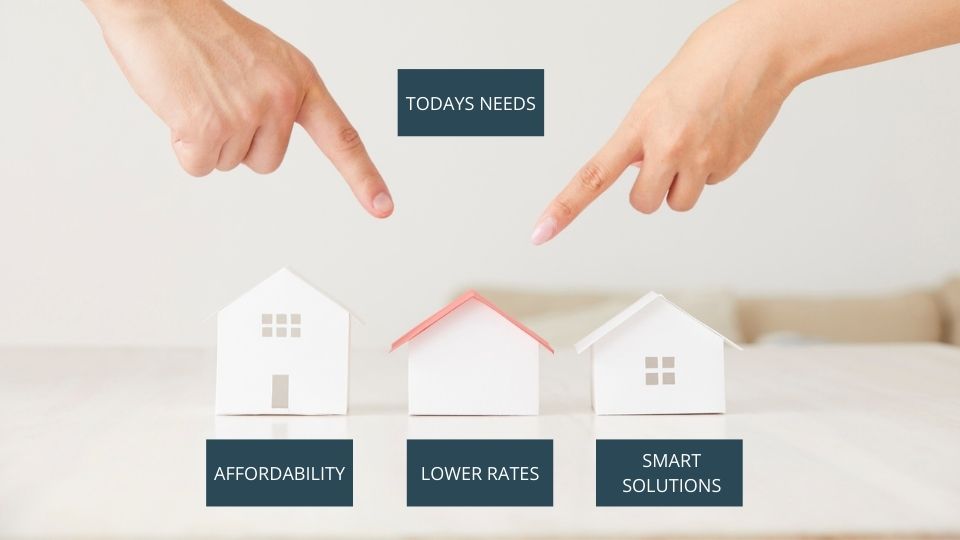
Hands Pointing at miniature houses

Three Paths Forward

Steve Jobs once laid out three options to a hesitant executive:

1. Join us in trying something new at a price point we believe can work

2. Keep doing what you’re doing, but understand where that leads

3. Hold back entirely, and watch the market move on

He ended with: “Maybe I’m missing something, but I don’t see any other alternatives. Do you?”

For homebuilders heading into 2026, the same choices apply.

Path One: Make attainable housing a core strategy. Smaller, smarter homes. Real attention to first-time buyers and downsizing retirees. Different margins, yes, but relevance, volume, and resilience in return.

Path Two: Continue focusing primarily on higher-end buyers while inventory grows and entire market segments are priced out of participation.

Path Three: Wait and let someone else claim the ground you chose not to.

This issue is personal for me. My daughter isn’t a statistic. And as I look toward my own retirement, I see clearly that this challenge spans generations.

Hope, in this moment, is a decision.

Not whether housing can be affordable, but whether we will make it attainable.

2026 can be the year we choose to build for the market that actually exists.

The solutions are already here.

The question is whether we’ll choose to use them.

The solutions are already here. Let’s help you sell them. Contact Outhouse to start building the future of housing today. (contact button)

Link to one of these articles for suggest further reading:
Recommended Internal Links (from outhouse.net/)

You should link to Outhouse posts that provide the tactical solution to the strategic problems you raised in the article.

1. A post about Interactive Floor Plans (IFPs)

  • The Connection: Your article mentions “smaller, smarter homes” and “downsizing options.” The biggest barrier for buyers considering a smaller footprint (e.g., 1,200 sq. ft vs 2,000 sq. ft) is the fear that their furniture won’t fit.
  • Suggested Link: Look for a post on your blog titled something like “Why Interactive Floor Plans are Essential for Modern Builders” or “How IFPs Help Buyers Visualize Space.”
  • Why: It reinforces that “attainability” is possible if you give buyers the tools to verify the space works for them.

2. A post about Photorealistic Renderings/Animations

  • The Connection: You discuss “innovation” and “Path One” (trying something new). When builders launch new product lines (like ADUs or modular homes), buyers are often skeptical because they haven’t seen them before.
  • Suggested Link: Link to a post such as “The Power of Architectural Renderings” or “Bringing Blueprints to Life.”
  • Why: It supports your argument that “Hope is a decision”—showing the finished product before it’s built is how you generate that hope.

3. A post about Generational Marketing (Millennials/Gen Z)

  • The Connection: You explicitly mention your “26-year-old daughter” and “young families.”
  • Suggested Link: Link to a post regarding “Marketing to Millennials” or “Digital Trends for the Next Generation of Homebuyers.”
  • Why: It proves Outhouse understands the specific demographic “crush” you described in the opening paragraphs.

The market is changing. Is your marketing keeping up?  To start building the future of housing today.

Contact Outhouse

If you want to learn more on attainability, read this article on “Why Interactive Floor Plans are Essential for Modern Builders.”

Managing Effectively with OKRs

Bill Gelbaugh · 12/30/2024 ·

Professional team looking at white board
Image Courtesy of Adobe Stock: AdobeStock_102205126

After going through the process of creating OKRs, it’s essential not to fall into the trap of “setting and forgetting.” Creating OKRs without regularly sharing and reviewing results is like hoping to win the lottery without buying a ticket. The modern business environment offers countless distractions, each vying for your attention. However, to execute successfully and elevate your performance, regular and disciplined reviews of OKR results must become part of your operating rhythm—a cadence embedded in your corporate culture.

Weekly Meetings

Let’s start with the basics: Weekly Meetings. The purpose of these sessions is threefold: assess progress, identify potential issues before they escalate, and, especially as you begin using OKRs, ensure your team stays focused on what truly matters. Here are some key topics to cover in your weekly meetings:

  • Logistics: Begin by determining who should attend the meeting, what time works best for everyone, and where the meeting will be held.
  • Priorities: What are the key priorities—the tasks that must be accomplished this week to move closer to achieving your OKRs? It’s easy to get caught up in the whirlwind of urgent issues, but it’s crucial to ensure the priorities discussed are directly tied to the achievement of your OKRs.
  • Status: During the meeting, gauge the team’s current level of confidence. Has it increased or decreased? More importantly, why? If progress is on track, implement mechanisms to maintain momentum. If confidence is waning, it’s time to discuss how to shift resources strategically to get back on course.
  • Engagement: OKRs should challenge and motivate people to engage in the breakthrough thinking necessary to reach new heights. Use the weekly session to assess the team’s mood. Are they still actively engaged, or are they simply going through the motions without genuine commitment?
  • The Big Picture: Earlier, we defined a health metric as something the company monitors frequently because it represents successful strategy execution. Well-designed OKRs should ultimately drive the success of your overall health metrics, so ensure you’re keeping an eye on the bigger picture.

Weekly Quadrant Focus

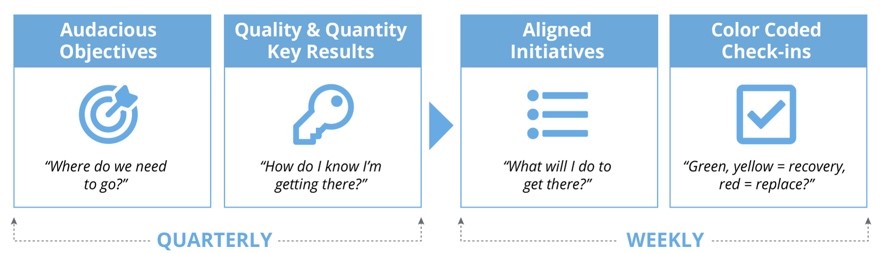
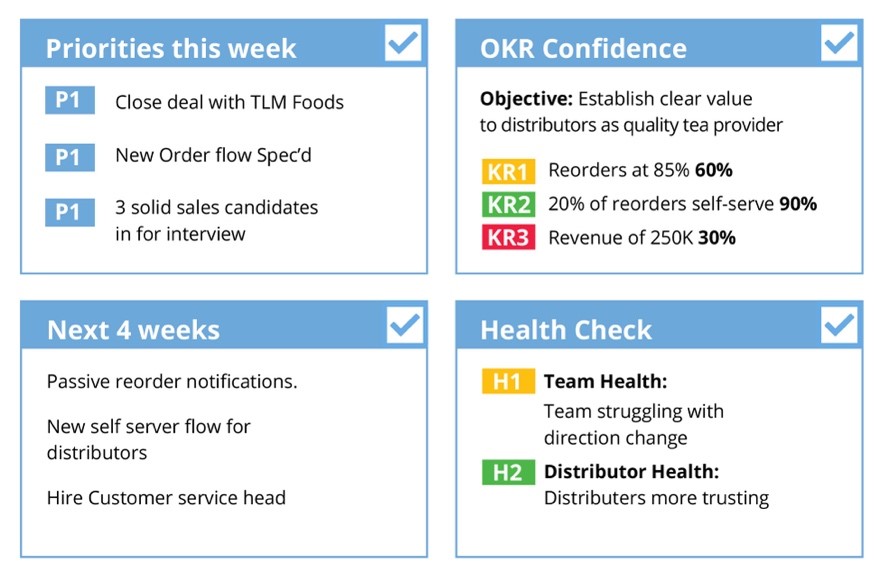
One way of managing your OKRs effectively is to break down your weekly focus using a quadrant approach. This method ensures that your team stays aligned with the goals that matter most, while also keeping an eye on the broader picture.

Upper Right | Setting Bold Objectives and Quantitative Results

At the start of each quarter, we set a bold, qualitative Objective along with three quantitative Key Results. The Objective serves as the inspiration for the quarter, guiding our efforts and providing a clear direction. The Key Results are the measurable outcomes we expect if we focus on the right activities.

Each week, we revisit these Key Results and ask ourselves: Are we getting closer to achieving them, or are we falling behind? At the beginning of the quarter, we start with a 50% confidence level—a 50/50 (0.5) chance of hitting the target. As the weeks progress, this confidence level may fluctuate. If it drops from, say, 80% (0.8) to 20% (0.2), it’s a signal that something has changed. The critical question then becomes: What happened, and how can we address and improve this Key Result?

Lower Right | Monitoring Health Metrics

While we aim high with our Objectives, we can’t afford to ignore the fundamentals—our “health metrics.” This lower-right quadrant is where we track these vital signs of our business, ensuring that while we reach for ambitious goals, we don’t lose sight of what’s already working well.

For example, if our Objective is radical revenue growth, it’s easy to get caught up in the pursuit of new clients. However, we must also protect our relationships with current clients. In this quadrant, we might monitor Customer Satisfaction, rating it green, yellow, or red. This helps us ensure that our drive for growth doesn’t come at the expense of the clients who have already invested in us.

Upper Left | Weekly Initiatives to Advance OKRs

In the upper-left quadrant, we focus on the specific initiatives we need to tackle this week to advance our OKRs. These are the three to five critical actions that will move the needle.

We don’t list every task here—just the ones that must happen for us to achieve our Objectives. Life always throws plenty of distractions our way, but the secret to success lies in focusing on what truly matters. By sharing these initiatives, we can challenge ourselves to ensure we’re investing our time in activities that directly contribute to our Key Results.

Lower Left | Heads Up for the Month Ahead

Finally, the lower-left quadrant is our “heads up” space—a pipeline of important activities expected in the coming month. This area is crucial for keeping the entire team, including Marketing, Sales, Operations, and Admin, prepared and aligned.

By anticipating what’s coming down the road, we avoid being caught off guard. This forward-looking approach ensures that everyone is ready to support key initiatives when the time comes.

A house with graph showing value over time
Image Courtesy of Adobe Stock: AdobeStock_668453216

End of Quarter Reviews

At the end of each quarter, it’s time to move beyond subjective assessments and grade your performance. The two primary components of the quarterly review meeting are the “what” and the “how.”

  • The “What”: This involves assigning grades (scores) to each of your key results based on performance throughout the quarter. Each team (or individual, if your OKRs are connected that far into the organization) will determine their final score and provide the rationale to peers, colleagues, and superiors. This transparency offers a valuable opportunity for teams to learn from each other’s objectives, key results, triumphs, and challenges—showing what’s possible when the entire organization is aligned.
  • The “How”: While the grades are important, the real value lies in the discussions that follow. These conversations should challenge conventional views, uncover assumptions, and test hypotheses. In our experience, many organizations struggle with these meetings, where honesty and candor should take center stage. Some companies are able to engage in passionate, no-holds-barred discussions, while others are hampered by an overly polite culture that stifles genuine debate. Recent research into effective teams highlights the importance of psychological safety as a critical enabler of group success. To make the most of your OKR data, you need to carefully structure your meetings to maximize learning and drive meaningful change.

Updating OKRs at the End of a Quarter

The mechanics of OKR creation are straightforward. At the beginning of each year, the company establishes its highest-level set of OKRs, which may include both strategic annual OKRs and more tactical quarterly OKRs. These “corporate” OKRs provide the context for the connecting process, where business units, teams, and possibly even individuals create their own OKRs to demonstrate their contribution to the overall strategy.

At the end of each quarter, OKRs are graded, and new OKRs are developed throughout the organization. Some OKRs may remain the same for several quarters, especially those that are critical given current strategic or operational challenges. You may also carry forward OKRs that weren’t fully achieved but remain strategically important. Any OKRs that were successfully completed will likely be replaced with new ones that once again stretch the team to deliver their best.

Scoring the Results

Here’s a quick guide to interpreting OKR scores:

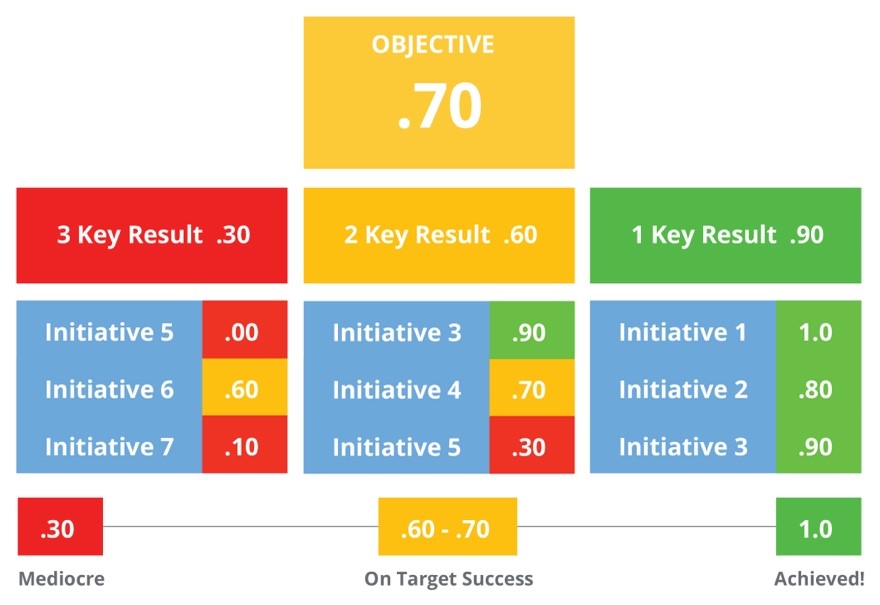
  • 1.0 Score: This represents an extremely ambitious outcome—one that may have seemed nearly impossible at the outset. All key results should be written as a 1.0 to foster breakthrough thinking. It might feel like a “moonshot” if the company has never approached that level of performance before.
  • 0.6 – 0.7 Score: This level signifies difficult but attainable progress, and it’s what you hope to achieve at a minimum. It’s a lofty target—challenging but achievable based on past results.
  • 0.3 Score: This is the “business as usual” target, representing performance that can be achieved with standard effort and little or no assistance from other teams. It’s considered mediocre—precisely what OKRs are designed to eliminate. If a team only reaches a 0.3 on a key result, it’s crucial to understand why.

In our experience, those new to OKRs often encounter one of two outcomes: either they score all ones, or they find themselves scratching their heads because despite their best efforts, their reports are filled with zeros.

After a few quarters, your key result scores should average around 0.6 to 0.7. If your scores are consistently higher, it may indicate that your targets aren’t aggressive enough, and you’re not fully leveraging the talent and potential of your teams.


By following these practices, you can ensure that your OKRs aren’t just another set of goals but a powerful tool for driving strategic execution and achieving your company’s most ambitious objectives.

And with that, we conclude our five-part series on OKRs. We hope these insights help you harness the full potential of OKRs in your organization. Here’s to your success!

CONTACT INFO NEEDED

Bill Gelbaugh

Bill Gelbaugh is one of our Senior Partners here at Outhouse and champions our OKR efforts.

Summarized by Bill Gelbaugh from: Objectives and Key Results by Paul R. Niven and Ben Lamorte

With additional material from Measure What Matters, Lattice OKR 101 and Perdoo

Driving OKR Alignment to Create Employee Engagement

Bill Gelbaugh · 12/16/2024 ·

OKR target with bullseye arrow
Image Courtesy of Adobe Stock: AdobeStock_1012677617

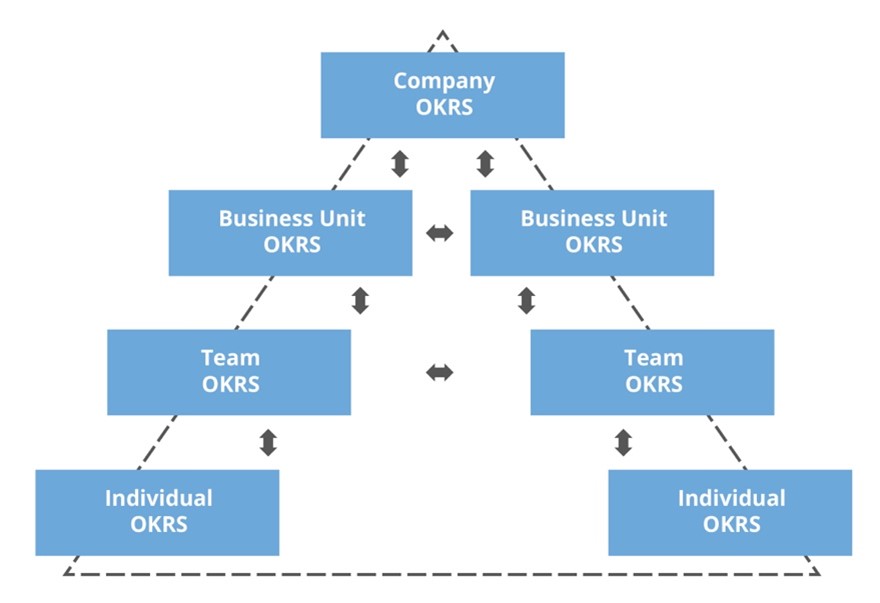
Now that we’ve crafted our OKRs, it’s time to focus on how teams within your company can work together to accomplish these goals. While OKRs empower teams with a significant amount of autonomy, the key to overall corporate success lies in connection and alignment. As you communicate your corporate OKRs, it’s crucial that everyone in the organization not only understands them but also recognizes their importance and how they contribute to the company’s success. A well-executed alignment process creates a direct line of sight from every individual employee back to the corporate OKRs.

Connecting OKRs from top to bottom within your organization helps illuminate the relationship between what employees do and how those actions lead to overall strategy execution. This connection fosters learning in two directions. First, as business units, departments, and individuals develop their OKRs, they showcase their unique roles in creating value for the company. To do this effectively, they must understand the business’s strategy, which deepens their grasp of the organization’s purpose. Second, as leaders analyze OKR scores across the company, they gain valuable insights into how different parts of the business are contributing to the overall strategy.

How Deep to Connect

Ultimately, your goal should be to extend the use of OKRs throughout the entire company. But how quickly should this be done? Should you rush to connect all levels within the first year, or take a more measured approach over several years?

OKRs have the potential to be a transformative tool for your business, sparking new thinking that leads to previously unimagined levels of success. To realize this potential, the framework must be embraced and utilized at all levels of the company, helping you foster fluency in a new corporate language: strategy execution. The faster you connect, the faster your employees will master this new approach, and the sooner you’ll see results.

We believe in the power of momentum and recommend moving aggressively but thoughtfully when connecting OKRs. Aggressively means connecting quickly and deeply across all levels of the company. Thoughtfully means ensuring you can answer these critical questions affirmatively before proceeding:

  • Do we have executive support for OKRs?
  • Do we have a clearly documented strategy reflected in our top-level corporate OKRs?
  • Are we committed to using OKRs to manage the business, regardless of the initial results?

If you can overcome these hurdles, a rapid rollout may be appropriate.

Preparing Your Groups for Connecting

Young people putting their fists together as symbol of unity and achievement, top view. Group of people fist bump assemble together over workplace. Teamwork concept, copy space in middle
Image Courtesy of Adobe Stock: AdobeStock_909279080

In a previous post, we discussed the importance of a mission statement, which conveys your core purpose as an organization. Every business group that will create connected OKRs should develop a mission statement that clearly outlines why they exist and how they add value to the organization.

Armed with their mission statements, each group must then answer a fundamental question: “How do we support the organization’s mission and strategy?” This question primes groups for the task of connecting by having them enumerate in advance how they are going to support the company’s overall strategic goals.

The Key to Connecting Is Influence

The purpose of the connecting exercise is to allow all groups—even individuals—to show how they influence the overall corporate OKRs. This process begins with the top-level set of OKRs. These are the critical levers of your success, and everyone in the company must deeply understand them before you begin connecting. Let’s assume you’re starting from the corporate level. The first real connection occurs when business units study the corporate OKRs and ask, “Which of these OKRs can we influence the most, and how?”

The goal of a well-executed connection process is to provide a direct line of sight from every individual employee all the way back to the corporate OKRs.

Creating Alignment

Ensuring your people are aligned around a common purpose is the number one job for any successful corporation. Connecting OKRs provides an outstanding opportunity to drive that alignment through every job and function in your firm. There are two types of alignment you’ll be fostering during the alignment process: vertical and horizontal.

Vertical Alignment

This is the type of alignment most people think of when considering connecting goals across an enterprise. Vertical alignment creates OKRs that flow downward, eventually reaching the individual employee level. However, as we’ve previously noted, this does not mean the executive team dictates a number of obligatory goals that are forced upon lower-level groups regardless of fit or necessity. Instead, vertical alignment is facilitated when teams, departments, or individuals look to the OKRs of the group to whom they report and ask: “How can we influence those OKRs? What can we do and measure at our level to drive both our success and theirs?”

Here’s an example of driving vertical alignment: The CEO of a mid-sized company declared that customer retention was the top priority. Traditionally, customer retention had been the sole domain of the customer success team, which managed ongoing client interactions and renewals. After the CEO’s announcement, everyone assumed that the customer success team would simply work harder to drive retention while other departments would continue focusing on their current priorities. However, with OKRs in place, the company could create a culture of alignment across all teams.

The product team, for instance, had typically focused on features that would attract new customers or differentiate the company from the competition. With the new focus on customer retention, they began asking, “How does this product improvement drive customer retention?” The marketing team also shifted its outlook, taking time at their user conference to interview customers and gather valuable survey data on retention. Even the sales team adjusted its approach, now taking time to call on their installed base to ask how they could add more value and emphasize long-term relationships.

Each of these teams did something different—something relevant to their specific function—but the common denominator was identifying actions that supported the corporate strategy of increasing customer retention. That’s vertical alignment in action.

Horizontal Alignment

While most companies are familiar with the concept of vertical alignment, horizontal alignment is equally important but often overlooked. In the modern enterprise, much of the work involves disparate teams coming together to solve customer issues or create new value. When one unit can’t depend on another, damaging consequences such as duplication of effort, missed opportunities, and escalating conflicts can occur. OKRs can help fill this gap.

Creating horizontal alignment isn’t complicated. It simply requires having the discipline to hold detailed conversations with other units throughout the company to discover mutual dependencies. Both teams then create OKRs that reflect these dependencies. The resulting OKRs may be unique to each unit, or in some cases, they may decide to use “shared OKRs.” Shared OKRs are particularly useful when multiple teams work closely together to achieve a result, ensuring that everyone is aligned and contributing to the overarching goal.

Dividing line down road painted as an arrow in Autumn scene.
Image Courtesy of Adobe Stock: AdobeStock_894649161

Confirming Alignment of Connected OKRs

Creating a set of corporate OKRs that improves focus on what really matters is one thing. However, the value of an OKR implementation increases exponentially when you connect, allowing all participants to announce their contribution to the bigger picture. Connecting may be the most essential part of your OKR process, so it’s critical to ensure it’s done well. Once you begin rolling out the program and having lower-level groups develop their OKRs, you can’t assume that those OKRs are aligned. You must check each set to ensure they draw a clear line of sight back to your strategic goals.

Next up… Managing Effectively with OKRs.

Bill Gelbaugh

Bill Gelbaugh is one of our Senior Partners here at Outhouse and champions our OKR efforts.

Crafting Great OKRs Part Two

Bill Gelbaugh · 11/18/2024 ·

Stock Image of happy group of people using sticky notes on glass board for planning OKRs.
Photo Courtesy of Adobe Stock: OKR3-1-AdobeStock_275135207

In our previous post, we discussed the characteristics and tips for creating effective OKRs. Now, it’s time to dive into the actual process of crafting OKRs that can drive your business forward. This post will guide you through each step, from creating and refining OKRs to aligning them across your organization and finalizing them for action.

The Process to Create Great OKRs

Create

The first step in crafting OKRs is to start small. Rather than using a large brainstorming group, which can lead to chaos and diluted focus, we recommend forming a very small team—just two or three people. This small group can dedicate the deep, time-consuming concentration needed to draft a set of OKRs that truly address your business challenges.

These small teams are tasked with tackling specific business problems and discovering creative solutions. They need the bandwidth to immerse themselves in the details—analyzing your competitive environment, scrutinizing your strategy, and identifying your core capabilities. These elements are the raw materials that lead to effective OKRs, and they must be carefully considered.

Whether you’re working at the corporate level or within a team, your small group should aim to document two to three objectives, each with one to three key results. These should be set at a stretch level—the 1.0 scoring level—to inspire high performance. (To be explained in detail later.)

Refine

Once your small team has drafted the initial set of OKRs, it’s time to bring them to a wider audience for review. Before your first full team meeting or workshop, share the draft OKRs with the relevant leadership group. If you’re working on corporate-level OKRs, this will involve the senior leadership team. For team-level OKRs, the team’s leadership group will need to be involved.

The purpose of this session is to critically examine the draft OKRs. The small team should explain their choices, and there should be vigorous debate to ensure that the OKRs are aligned with the broader goals of the organization. The objective is to reach a consensus on the OKRs that will guide your efforts for the upcoming quarter.

Align

In today’s business environment, much of the work is cross-functional, with teams collaborating to solve problems and create new ways of working. When crafting OKRs at the team level, it’s crucial to keep this context in mind.

After you have refined the OKRs, it’s time to take them on a “road trip” around the organization. This involves discussing your draft OKRs with other team leads, especially those on whom you depend or who depend on you. This step is all about ensuring alignment across teams, so everyone is working towards the same goals.

For instance, if one of your key results is highly dependent on another team’s assistance, you’ll want to ensure they acknowledge this dependency and pledge their support. Similarly, you’ll want to understand how your team can support other teams in achieving their OKRs.

Finalize

Once the alignment process is complete, it’s time to finalize your OKRs. If you’re working at the team level, the team lead and partners should meet with their superior—likely a member of the senior executive team—to get final approval for the OKRs.

Transmit

The final step in the crafting process involves two key tasks. First, you need to load your OKRs into a software system or a tracking tool such as Google Sheets or Excel. This is a simple but vital process. OKRs must be rigorously and formally cataloged to maintain the integrity of the entire OKR process.

Second, you need to communicate the OKRs to your team and beyond. We strongly recommend sharing them widely using a variety of media. An in-person meeting, such as an all-hands or town hall style gathering, is particularly effective. This provides an opportunity for employees who weren’t directly involved in the OKR creation process to ask questions and gain a deeper understanding of the decisions made.

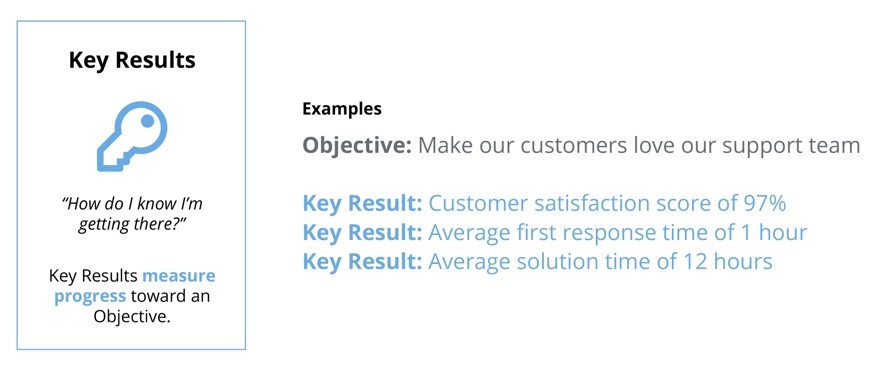
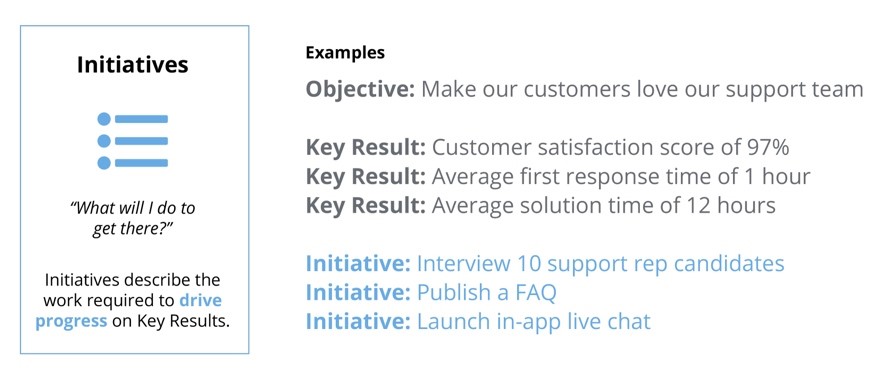
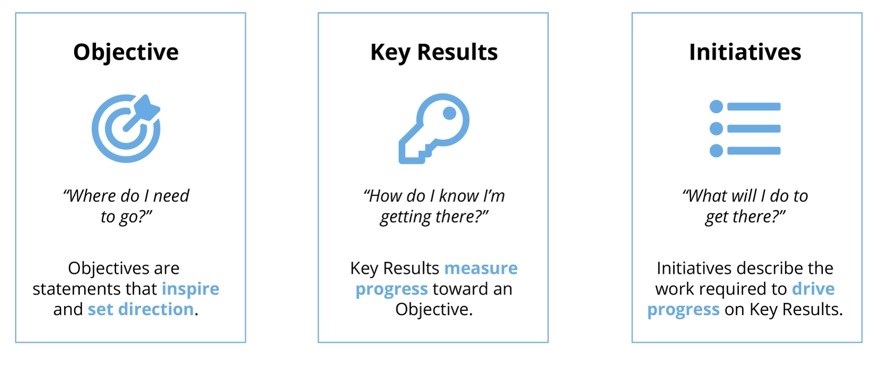
The OKR Crafting Process

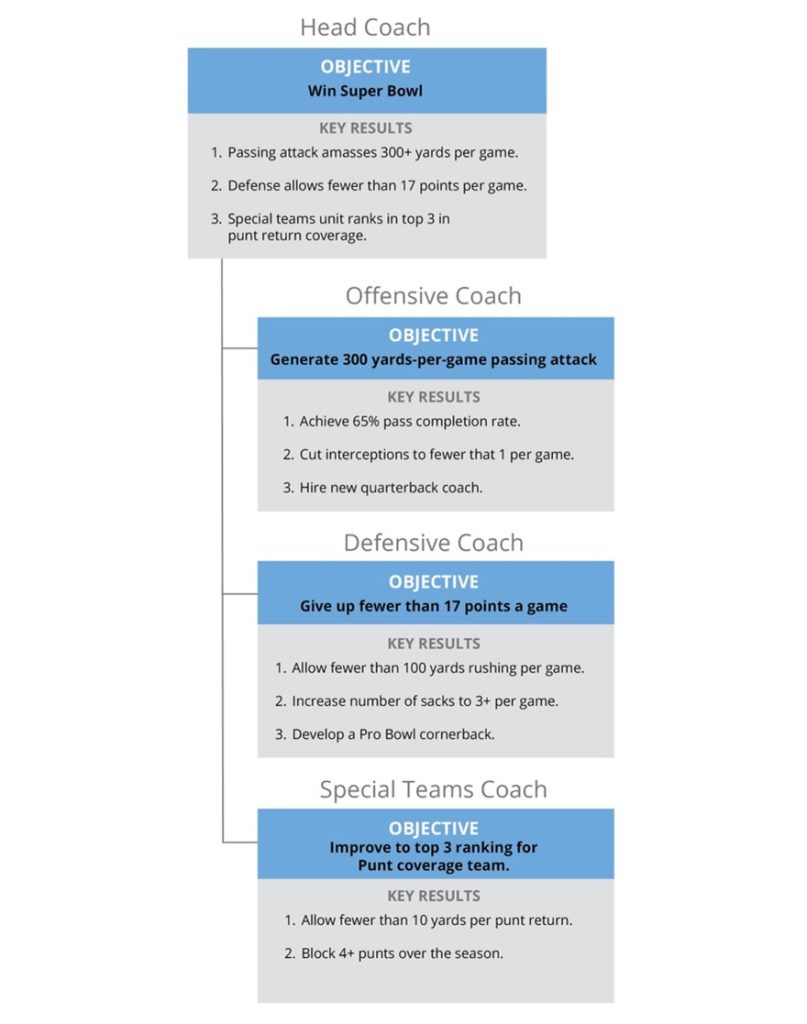
OKR Football Example

How Many OKRs Should We Have?

The late screenwriter Nora Ephron, famous for writing classics like When Harry Met Sally, Sleepless in Seattle, and Silkwood, had a remarkable talent for capturing the essence of a story. But before she became a Hollywood legend, Ephron was a journalist. She often credited her high school Journalism 101 teacher, Charlie Simms, with teaching her the most valuable lesson she ever learned about storytelling.

On the first day of class at Beverly Hills High School, Simms introduced his students to the concept of a “lead”—the opening sentence that captures the most critical elements of a news story. He explained that a good lead answers the who, what, when, and where. To drive the point home, he gave the class their first assignment: write the lead to a story based on the following facts:

Kenneth L. Peters, the principal of Beverly Hills High School, announced today that the entire high school faculty will travel to Sacramento next Thursday for a colloquium on new school methods. Among the speakers will be anthropologist Margaret Mead, college president Dr. Robert Maynard Hutchins, and California Governor Edmund “Pat” Brown.

The students furiously hammered away on their typewriters, each trying to craft a concise lead that summarized the who, what, when, and where. Their leads were variations of: “Margaret Mead, Maynard Hutchins, and Governor Brown will address the faculty on…” or “Next Thursday, the high school faculty will…”

When they finished, Simms reviewed their leads and set them aside. Then he told them they were all wrong. “The lead,” he said, “is ‘There will be no school Thursday!'”

In that moment, Ephron realized that journalism—and storytelling in general—wasn’t just about regurgitating facts. It was about figuring out what really mattered, cutting through the noise to find the point that resonated most.

Ephron would later say that this lesson worked as well in life as it did in journalism. And, as it turns out, it works great for OKRs too.

When you gather with your team to decide on your OKRs, you’re faced with a universe of possibilities. Customer concerns, shareholder interests, employee needs, competitive pressures—the list is endless. These are the organizational equivalent of the “who, what, when, and where.” Your challenge is to cut through the clutter and identify what is most important, what will have the most impact right now—essentially, the “lead” of your business story.

Woman giving thumbs up, holding a sign that says "Less is More."
Courtesy of Adobe Stock (edited in Canva Pro): OKR3-2-AdobeStock_295108345

So, how many OKRs should you have? We recommend following the principle of “less is more.” There is a significant opportunity cost to increasing your inventory of OKRs—namely, a lack of clarity and focus around what the company’s true priorities are. When you begin your OKR process, we suggest generating a small number—a handful at most—of objectives that are crucial to executing your strategy for the year. Then, as the year progresses, adjust your tactical objectives each quarter to keep moving those strategic objectives forward.

Next up… Driving OKR Alignment.

Bill Gelbaugh

Bill Gelbaugh is one of our Senior Partners here at Outhouse and champions our OKR efforts.

Let’s Get Moving! Election Results, the Dow is up, and What’s Next for Production Homebuilding?

Bill Gelbaugh · 11/10/2024 ·

Introduction

Hello! I’m Bill Gelbaugh, one of the Partners here at Outhouse, LLC. This morning, as I wrapped up our Sales and Finance meetings, one message came through loud and clear: It’s time to move forward! The election is behind us, the Dow is up, and there’s a sense of renewed energy in the air. Now that we have more political clarity, the focus is shifting toward what’s next—and that’s especially important for us in the production homebuilding market.

With the recent boost in market optimism, now is a great time to look at how the industry can leverage this momentum. In this post, I’ll dive into what we can expect for the production homebuilding sector in the coming months, how post-election shifts might impact our industry, and why we believe now is the time to act decisively. So, let’s dig in and see where the opportunities lie.

A symbolic growth graph against a breathtaking sunset, representing economic success and growth in a beautiful natural setting.
Image Courtesy of Adobe Stock

Post-Election Economic Climate and Market Optimism

Historically, election outcomes tend to influence market sentiment—and the initial post-election reactions often set the tone for the months ahead. With the recent election behind us, we’re already seeing an upward tick in the Dow and other major indices. This surge reflects a sense of renewed investor confidence, as markets generally react favorably to political stability and clarity. For those of us in homebuilding, this optimism in the financial markets is a promising indicator that demand and capital may flow more steadily in our direction.

Beyond market indices, the now decided political environment can bring some welcomed consistency to economic policies impacting homebuilding, from mortgage rates to tax incentives for residential construction. With clear policy paths, businesses are more likely to invest and make bold moves, something that could directly benefit production homebuilders and our clients. This is a window of opportunity to embrace a proactive approach and align ourselves with the positive momentum shaping the market.

New Homes Under Construction
Image Courtesy of Adobe Stock

Implications for the Production Homebuilding Market

With the election wrapped up and market signals leaning positive, the production homebuilding market has an opportunity to gain ground. Here are a few key areas where the recent changes and optimism may impact our sector directly:

  1. Interest Rates and Financing
    A critical factor for both builders and buyers is access to financing, and with the market’s optimism, there may be greater stability in interest rates moving forward. If the Federal Reserve maintains a balanced approach, mortgage rates could stay at manageable levels, encouraging prospective buyers to make their move. For builders, favorable interest rates can mean better loan conditions and a greater willingness among lenders to fund new projects—particularly in areas experiencing housing shortages.
  2. Housing Demand and Policy Initiatives
    The election outcome could influence policies that either directly or indirectly affect the homebuilding industry. For instance, any new measures to support affordable housing initiatives or incentives for new construction could stimulate demand and support the overall growth of the sector. With policy stability, builders can better anticipate regulatory requirements and plan their projects accordingly, which is key to keeping up with buyer demand.
  3. Investor Confidence and Capital Availability
    As the Dow rallies, investors tend to gain confidence in placing their funds in high-demand sectors, and housing continues to be one of them. Real estate often sees capital flow when the market trends upward, meaning developers might find more opportunities to attract investors or partners. With growing interest from both individual and institutional investors, the production homebuilding sector is positioned to secure the capital needed to meet demand and scale up production.
  4. Consumer Confidence Through Enhanced Buyer Experiences
    In today’s market, homebuyers seek a visually immersive, engaging buying experience. Outhouse, LLC meets this need by offering Brilliance Award-winning, cutting-edge interactive floor plans and advanced product visualization tools that allow buyers to envision their future homes in vivid detail. With customizable interactive floor plans, buyers can explore design options, experiment with layouts, and personalize features, fostering a hands-on, immersive experience that builds excitement and confidence in their investment.
    Beyond digital solutions, professional printing and display services ensure impactful, high-quality visual materials for model homes, sales centers, and signage, enhancing every stage of the buying journey. By integrating Outhouse’s innovative visualization and display solutions, builders can elevate brand presence, attract discerning buyers, and deliver a seamless, tech-forward experience from first look to final sale.
  5. Integrating Technology in Construction for Faster, Cost-Effective Builds
    As the housing market gains momentum, now is an ideal time for builders to invest in innovative construction technologies. Advanced methods like modular construction and 3D-printed components can help address labor shortages, accelerate project timelines, and manage costs—all key factors for meeting today’s growing housing demand. To scale efficiently, builders need to integrate cutting-edge technology into their processes, making tech-driven project marketing and sales essential.
    Outhouse, LLC supports builders with high-quality drafting, rendering, and visualization services that offer precise, visually compelling representations of projects. These detailed renderings enable builders to present homes in the best light, capturing buyer interest and building trust.
    Overall, the production homebuilding industry is positioned to thrive in this period of optimism and opportunity. With clearer policy direction and market momentum post-election, builders can confidently move forward to meet strong housing demands nationwide.
Close-up of a clock face with 'NOW OR NEVER' slogan emphasizing urgency and the importance of timely action in a high-stakes moment
Image Courtesy of Adobe Stock

Conclusion: Let’s Get Moving—The Time is Now!

With the election behind us and positive market signals on the rise, there’s no better time for production homebuilders to take decisive steps forward. The stability we’re seeing now creates a window of opportunity to expand, innovate, and meet the growing demand in residential construction. By capitalizing on market optimism and embracing the right tools, builders can stay competitive and create lasting value for clients.

At Outhouse, LLC, we’re here to support this vision. Our industry-leading drafting and rendering services, award-winning interactive floor plans, product visualizations, and top-notch printing and displays make it easy for builders to deliver a polished, immersive buyer experience. With our solutions, you can showcase projects in their best light, connect with clients effectively, and set a high standard for quality and professionalism.

So, let’s get moving! The time is ripe to elevate your home building projects, and we’re ready to partner with you every step of the way. Reach out to us today to see how our technology and services can help you maximize this moment—and build a brighter future for your business.

Bill Gelbaugh

Bill Gelbaugh is one of our Senior Partners here at Outhouse and champions our OKR efforts.

Crafting Great OKRs Part One

Bill Gelbaugh · 11/04/2024 ·

Part 3 of our Unlocking Outhouse’s Potential with OKRs series

In our journey so far, we’ve explored why OKRs are valuable and how to prepare your organization for this powerful framework. Now, it’s time to roll up our sleeves and dive into the art of crafting OKRs that truly drive results. In this post, we’ll focus on what makes for an effective Objective and Key Result, ensuring they align with your company’s broader goals.

Characteristics of Effective Objectives

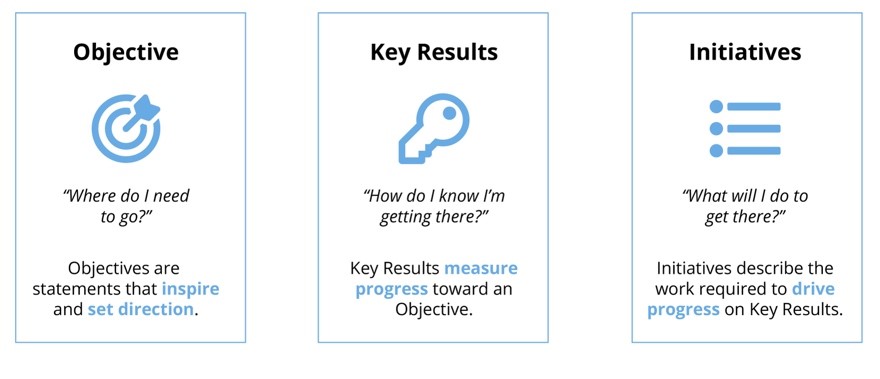
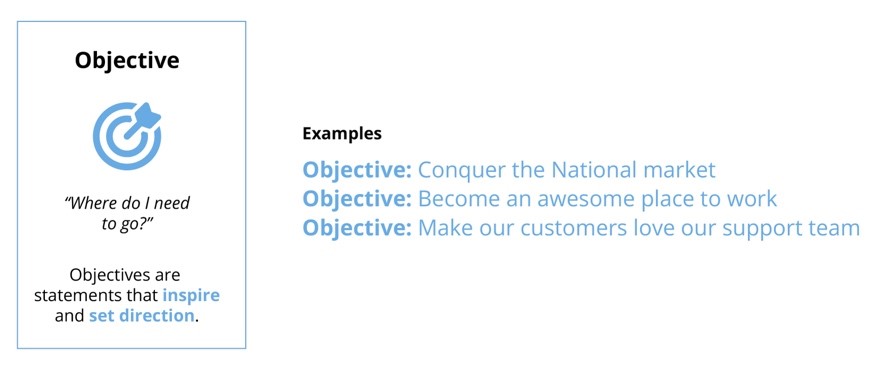
An Objective is a concise statement that outlines a broad, qualitative goal designed to propel your organization forward. For those new to OKRs, the challenge often lies in understanding what makes a good Objective. Let’s break it down:

Inspirational

A well-crafted Objective is more than just a collection of words describing a business goal. It should compel your team to strive for a higher standard of performance. The power of an Objective lies in its ability to challenge your team to think differently. For example, instead of aiming for a modest 10% improvement, an Objective that pushes for a 50% increase will force your team to solve tough problems and rethink their approach. That’s the essence of what OKRs are meant to achieve.

Qualitative

Objectives should represent what you hope to accomplish, expressed in words rather than numbers. While numbers are crucial, they belong in your Key Results. The Objective is about setting the direction and the ambition, not the metrics.

Attainable

Striking the right balance between inspiration and reality is crucial when crafting Objectives. While it’s important to push the limits of what your team believes is possible, you also need to be realistic. Encouraging your team to stretch their imaginations is key but remember that every Objective should still be within reach with the right effort.

Doable in a Quarter

Assuming you’re setting Objectives on a quarterly basis, they need to be achievable within that three-month period. If your team suspects that an Objective will take a year to accomplish, then it’s probably closer to a strategy or vision than a quarterly goal.

Controllable by the Team

Whoever drafts the Objective, whether it’s at the corporate, department, team, or individual level, must be able to control the outcome. If your Objective isn’t met by the end of the quarter, and your first thought is to blame external factors like “Sales didn’t deliver,” then you’re missing the spirit of OKRs. The Objective should be something your team can directly influence.

Provide Business Value

Your Objectives should be directly tied to your strategy and should create tangible value for the business if achieved. If there’s no clear business benefit at the end of the day, then it’s probably not worth the effort.

Tips for Creating Great Objectives

Avoid the Status Quo

When setting Objectives, aim to push the boundaries of what your team can achieve. Avoid Objectives that simply recite what you’re already doing, like “Maintain market share” or “Keep training employees.” If you can accomplish an Objective without changing how you work, it’s unlikely to drive significant progress.

Use Clarifying Questions

Sometimes, the best way to get to the heart of an Objective is by asking simple, clarifying questions. For example, if someone suggests that you should “Create value for our customers,” dig deeper. What do they mean by “value”? Are they referring to a specific segment of customers, or all customers? Escalating from abstractions to specifics will help you identify the true Objective that needs focus.

Frame Objectives in Positive Language

Your Objectives should be framed in a way that motivates and compels your team to take action. For instance, instead of saying “Reduce the amount of junk food I eat,” you might frame the Objective as “Eat more calories from healthy food.” The latter encourages proactive behavior and has a higher likelihood of success.

Start with a Verb

Every Objective should start with a strong action verb that drives the intended direction. Do you want to “maximize loyalty,” “build loyalty,” or “leverage loyalty”? The choice of verb shapes the actions that follow, so it’s essential to be deliberate in your wording.

Identify What’s Holding You Back

A powerful way to create meaningful Objectives is to identify the barriers that are preventing your team from executing your strategy effectively. What challenges are holding you back? Taking an unvarnished look at these obstacles can help you set Objectives that address critical issues and drive progress.

Use Plain Language

While it’s important to be precise, your Objectives should be written in plain language that everyone in the organization can understand. Avoid jargon and acronyms whenever possible, or if you must use them, ensure that everyone knows what they mean. Clear communication is key to ensuring everyone is aligned and understands the importance of the Objective.

Characteristics of Effective
Key Results

If Objectives set the direction, Key Results are the benchmarks that measure your progress along the way. They answer the question, “How will we know if we’ve met our Objective?” While it might seem straightforward, creating effective Key Results that accurately gauge progress can be challenging. Here’s what to keep in mind:

Challenging

Research has shown that setting high goals leads to better performance and greater satisfaction at work. When drafting Key Results, aim high. Challenge your team to push their limits and think differently. However, ensure that the goals are still within reach, so your team stays motivated to achieve them.

Measurable

Key Results should always be qualitative and measurable. Whether it’s a raw number, a dollar amount, or a percentage, your Key Results need to be tied to clear metrics. Progress should never be a matter of opinion—numbers provide the clarity needed to gauge success.

Specific

When writing Key Results, clarity is crucial. Ensure that everyone involved understands exactly what the Key Result means and what success looks like. This shared understanding prevents miscommunication and ensures that everyone is working towards the same goal.

Owned

Those responsible for delivering Key Results should be actively involved in their creation. When team members help shape the Key Results, they’re more likely to be committed to achieving them. Ownership drives accountability and engagement.

Progress-Based

According to Harvard Professor Teresa Amabile, the most important factor in boosting motivation and creativity is making progress in meaningful work. Your Key Results should reflect this principle, allowing your team to see and celebrate progress as they work towards the Objective.

Vertically and Horizontally Aligned

Your Key Results should align both vertically with your team’s broader goals and horizontally with the objectives of other teams. Regularly reviewing and sharing Key Results ensures alignment across the organization, fostering collaboration and coherence.

Drive the Right Behavior

The saying “You get what you measure” holds true. Once you focus on a specific metric, you’re naturally drawn to improving it. Think carefully about the behaviors each Key Result might encourage and ensure they align with your broader objectives.

Tips for Creating Key Results

Focus on the Key, Not All Results

This exercise isn’t about listing every possible outcome—it’s about identifying the most critical results that will drive progress on your Objective. Focus on what truly matters and avoid the temptation to track every potential action.

Describe Results, Not Tasks

Key Results should focus on outcomes, not activities. For example, “Add twenty-five qualified opportunities to the pipeline” is a Key Result, while “Email a prospect” is a task. The former measures progress, while the latter is just one step along the way. Focus on the results that signify true progress.

Use Positive Language

Just as with Objectives, framing your Key Results positively can have a powerful impact. For example, instead of “Lower error rate to 10%,” try “Increase accuracy to 90%.” The positive framing can boost motivation and commitment.

Keep Them Simple and Clear

While Key Results should be robust, they should also be easy to understand. Complexity can lead to confusion and misalignment, so keep your Key Results straightforward.

Assign an Owner

Key Results need a clear owner—someone who is accountable for their achievement. Without an owner, responsibility can become diffused, leading to inaction. Make sure someone is clearly responsible for driving each Key Result to completion.

By following these principles and tips, you’ll be well on your way to crafting OKRs that not only inspire your team but also drive meaningful progress. Remember, the power of OKRs lies in their ability to align your organization’s efforts, ensuring that everyone is working towards the same ambitious goals.

Next up… Crafting Great OKRs – Part 2.

Bill Gelbaugh

Bill Gelbaugh is one of our Senior Partners here at Outhouse and champions our OKR efforts.

Unlocking Outhouse’s Potential with OKRs 

Bill Gelbaugh · 09/26/2024 ·

Courtesy of Adobe Stock By Kattika

2. Preparing for the OKR Journey 

In our first post, we explored why your company might want to adopt OKRs. Now, as we move forward, it’s time to focus on preparation. Just like building a home, laying a solid foundation is crucial before you start raising the walls. The same holds true for OKRs. A little preparation goes a long way in ensuring a successful implementation. And remember, OKRs are a journey, not a one-time event. 

This guide is tailored to help home builders, trade contractors, suppliers, architects, engineers, and others in the housing industry adapt OKRs to your unique company culture. Most of us don’t have a Silicon Valley mindset, so adaptation is key. However, there are some basic questions every company should address to get started on the right path: 

The Planning Phase 

Who Will Champion OKRs? 

Every successful OKR implementation starts with a passionate champion. This person, often a senior executive, must be deeply committed to rolling out the OKR strategy. Without this sponsorship, no initiative will survive. Who in your company has the drive and influence to lead this charge? Identify your champion, and make sure they have the backing they need to succeed. 

What Is the Most Critical First Step? 

Before diving into the nuts and bolts of OKRs, it’s essential to secure buy-in from your team. Everyone needs to be on board with the OKR program. This step isn’t just about understanding the framework, philosophy, and goals—it’s about fostering a collective commitment to the process. By the end of this series, you should feel confident in reviewing OKRs with your team and ready to get them excited about the journey ahead. 

What Matters Most? 

OKRs aren’t about doing everything; they’re about focusing on what’s most important. The beauty of OKRs lies in their ability to help you isolate the most critical business issues and dedicate your efforts to solving them. What are the fundamental priorities for your company right now? Your OKRs should zero in on these key areas, driving your business forward with purpose. 

How Will We Create Transparency? 

One of the greatest strengths of OKRs is their transparency. Ideally, OKRs should be visible throughout the organization, allowing everyone to see what’s being measured and provide feedback. This openness not only fuels collaboration but also ensures alignment and strategy execution across all levels of the company. 

How Will We Live Our OKRs? 

The real magic of OKRs comes from integrating them into the daily life of your company. They aren’t just set and forgotten—they should be part of your daily, weekly, and quarterly routines. From initial planning meetings to status updates and dashboards, OKRs need to be lived and breathed by your entire team. 

The Development Phase 

Once you’ve answered these foundational questions, it’s time to roll up your sleeves and start developing your first set of OKRs. Here’s how to approach this next phase: 

  1. Mission, Vision, and Strategy: Your OKRs should be deeply rooted in your company’s mission, vision, and strategy. These elements are the bedrock of your OKRs, driving the achievement of your long-term goals. Make sure they’re solid before moving forward. 
  2. Corporate-Level OKRs: Start at the top by creating OKRs at the corporate level. You might involve a small team, gather input from employees through surveys, or conduct executive interviews. However you approach it, the key is to ensure that these OKRs align with your broader strategy and are communicated clearly to the entire organization. 
  3. Presenting OKRs: Don’t just send out an email and call it a day. Use multiple channels to communicate your OKRs—share them electronically, post them on your intranet, and most importantly, discuss them in person. An all-hands meeting, for example, can be a great way to facilitate dialogue and ensure everyone understands the OKRs and the reasons behind them. 
  4. OKR Education: While OKRs are simple in theory, they require proper education to implement effectively. Take the time to educate your team not just on the fundamentals, but on why you’re choosing to use OKRs now, success stories from other firms, and what they can expect along the journey. 
  5. Monitoring OKRs: OKRs are not a “set it and forget it” tool. You need to monitor them regularly, using an OKR Scorecard and following a quarterly, monthly, or weekly schedule—whatever cadence works best for your organization. 
  6. Reporting Results: At the end of each quarter, score your OKRs and communicate the results across the organization. This isn’t just about accountability; it’s about learning and improving as you move forward. 
Courtesy of Adobe Stock By SakdaSong

The Strategy Alignment Phase 

OKRs should never exist in isolation—they need to reflect your company’s broader purpose, long-term goals, and strategy. Here’s how to ensure alignment: 

  • Company Mission: Your mission statement defines your core purpose—why your company exists. It’s your organization’s guiding light, constantly pursued but never fully achieved. Aligning your OKRs with this mission ensures that the work you do today contributes to your long-term purpose. 
    Your mission isn’t just a lofty ideal—it’s the compass that guides every decision your company makes. It reflects why your employees show up every day and serves as a reminder of the bigger picture, the greater good your company is striving to achieve. Whether it’s building homes that stand the test of time or creating communities where families thrive, your mission should be the foundation upon which your OKRs are built. 
    Unlike a vision or a strategy that may evolve over time, your mission remains a constant. It’s the steady north star that ensures every OKR you set is aligned with the core purpose of your organization. When your mission is clear and compelling, it’s much easier to steer the company in the right direction, keeping your OKRs in sync with the ultimate goal. 
  • Long-Term Vision: While your mission defines your company’s purpose, your vision paints a picture of where you want to be in the future. This vision is the bridge between your mission and your strategy—it’s the destination on the horizon that everyone in your organization is working toward. 
    Your vision statement should be a vivid, concrete picture of your desired future state, whether it’s five, ten, or fifteen years down the line. It’s not just about imagining a better tomorrow; it’s about providing a clear, tangible target that informs your strategy and your OKRs. Without this vision, your team might work hard, but without a clear direction, their efforts could be scattered and less impactful. 
    When your vision is well-defined, it fuels motivation and aligns your team’s efforts. Every OKR should serve as a stepping stone towards achieving this vision, ensuring that your short-term actions contribute to long-term success. It’s this alignment that transforms a collection of individual goals into a cohesive, strategic push towards a shared future. 
  • Annual Strategy: Your strategy is your game plan for achieving your vision. It’s about making tough decisions—choosing which markets to target, which customers to serve, and which opportunities to pursue or pass on. This is where the power of “No” becomes critical. Not every opportunity is worth chasing, and your strategy helps you focus on what matters most. 
    An effective strategy clarifies your priorities and sets the stage for your OKRs. It answers the critical questions: What are our preferred markets? Who are our optimal customers? What are their most pressing needs? By addressing these, your strategy guides the creation of OKRs that not only align with your vision but also address the real-world challenges and opportunities your company faces. 
    When your OKRs are directly tied to your annual strategy, they become a powerful tool for executing that strategy. They provide clarity, focus, and a roadmap for achieving your strategic goals, ensuring that every part of the organization is working in harmony towards the same objectives. 
    Finally, remember that a great strategy isn’t static—it evolves as your market changes, as new challenges arise, and as you learn from your successes and setbacks. Your OKRs should reflect this dynamism, allowing your company to remain agile and responsive while staying true to your mission and vision. 

Ready to start developing your OKRs? With a clear understanding of your most critical objectives and how to adapt OKRs to fit your company’s culture, you’re now ready to take action! 

Next up… Crafting Great OKRs – Part 1. 

Bill Gelbaugh Outhouse Senior Partner

Bill Gelbaugh is one of our Senior Partners here at Outhouse and champions our OKR efforts.

Managing Effectively With OKRs

Bill Gelbaugh · 12/20/2021 · Leave a Comment

A five-part series: 1. Introducing OKRs, 2. Preparing for the OKR Journey, 3. Crafting Great OKRs, 4. Driving OKR Alignment, and 5. Managing Effectively with OKRs

Summarized by Bill Gelbaugh from: Objectives and Key Results by Paul R. Niven and Ben Lamorte, with additional material from Measure What Matters, Lattice OKR 101 and Perdoo.

Creating OKRs and not rapidly sharing and reviewing results is akin to hoping to win the lottery without going to the trouble of buying a ticket. You can’t “set and forget” goals and hope to achieve any of the OKR benefits we’ve been chronicling. The modern business offers countless distractions to divert your attention from what matters most—a hundred fires you can fight every day—but to execute successfully and take your performance to the next level, regular and disciplined reviews of OKR results must become part of your operating rhythm and cadence of your corporate culture.

WEEKLY MEETINGS

Our point of departure is Weekly Meetings. The purpose of the Weekly sessions is threefold: Assessing progress, identifying any potential issues before they blossom into significant problems, and, especially as you begin using OKRs, to ensure your team stays focused on what matters. Here are some topics you may wish to include:

Logistics: Start by simply determining who will be included in the meeting, what time will work best for everyone’s schedule, and where the meeting will be held.

Priorities: What are the key priorities, the things that must get done this week to inch closer to achieving your OKRs? As we alluded to above, it’s easy to get trapped in the whirlwind of pressing and urgent issues swirling about in any business, so ensure the priorities discussed are in fact leading to the achievement of your OKRs.

Status: During the Weekly Meeting, you can gauge the team’s current level of confidence. Has it ratcheted up? Gone down? Either way, the most important question is why. If you’re progressing as planned, you’ll want to put mechanisms in to stay there, but if the team feels momentum is sagging, perhaps it’s time to discuss how you can strategically shift resources to put things back on track.

Engagement: As we’ve noted several times, OKRs should challenge and stimulate people to engage in the breakthrough thinking necessary to reach unprecedented heights. Use the weekly session to gauge the team’s mood. Are they still actively engaged in the pursuit of objectives, or are they merely paying lip service with no real intention to invest the discretionary effort to target demands?

The Big Picture: Earlier we defined a health metric as something the company will frequently monitor because it is representative of successful execution of their strategy. Things should be getting better overall, well-designed OKRs should ultimately propel the success of your overall health metrics.

UPPER RIGHT | Each quarter set a bold, qualitative Objective and three quantitative Results.

The Objective is the inspiration for the quarter, and the Results are what happens if we do the right things. Weekly we look at them, and we ask, are we closer or farther from making these Results? We will start the quarter with each Key Result at fifty percent confidence, a 50/50 (0.5) shot at making it. So, each week, we have a conversation, and say, have we gone up or down? If we are dropping to 20% (0.2) from 80% (0.8), we want to know why. What changed? How are we going to address and improve this KR?

LOWER RIGHT | This is our “health metrics,” we can’t just stop paying attention to everything!

Here, in the lower right, we put “health metrics.” These are things we want to protect while we shoot for the moon up in the upper right. Let’s say we pick an Objective that’s about radical revenue growth. We’re trying to get as many new clients partnering with us as we can, right? Well, we don’t want to forget our current clients in the rush to get new ones. Rate current Customer Satisfaction: green, yellow or red.

UPPER LEFT | Here we write the initiatives we will do this week to advance the OKRs.

Here in the upper left, we write the three to five big initiatives we will do this week to affect the OKRs. We share them, so we can question if we are spending time on the things that will get us our Results. We don’t list everything we’re going do. We list the things that must happen, or we’re not going to make our Objectives. Life always gives you plenty to do. The secret is focusing on the things that matter!

LOWER LEFT | This is the “heads up” quadrant of important things for the next month.

Here in the lower left, is our “heads up.” It’s the pipeline of important things we expect to happen in the next month. That way Marketing, Sales, Operations, Admin don’t get caught flat-footed when something must be supported.

QUARTERLY REVIEWS

The time for sticking a finger in the wind or relying on subjective confidence levels to assess where you are has come to an end, and the moment has arrived to actually grade your performance at the end of the quarter. The two primary components of the review meeting are “what and how.”

The first component, the “what,” comprises the grades (scores) you assign for each of your key results. Based on performance during the quarter, each team (or individual should you connect that far into the organization) will determine their final score, and provide the rationale for that determination to their peers, colleagues, and superiors. This wide sharing of results is yet another benefit of OKRs, as it provides all teams the chance to learn more about their colleagues’ objectives, key results, triumphs, and challenges, what works, and what is ultimately possible when the entire organization is working in alignment. Assuming you’ve been rigorous in holding Weekly Meetings and also conducted a mid-quarter check-in, providing a final grade to OKRs should be a relatively simple, straightforward, process.

While the grades you assign are obviously important, what really stokes the flames of learning are the conversations spawned from a deep investigation of what occurred during the quarter.

The second component of the quarterly review meeting, the “how,” is what will ultimately drive the success of your OKRs program, and your organization’s ability to execute. While the grades you assign are obviously important, what really stokes the flames of learning are the conversations spawned from a deep investigation of what occurred during the quarter. The scores should serve as a launching point for intense discussions that challenge conventional views, unearth assumptions, and test a working hypothesis. In our experience, many organizations struggle with these meetings where candor and honesty should be the order of the day. Although some companies are able to engage in passionate discussions, leaving nothing on the table, the well-worn rules of civility hamper others from reaching a level where actual revelations are found.

Recent research into effective teams backs up this assertion by noting that the psychological safety of participants is a vital enabler of group success. What we are saying is that in order to make the best use of you OKR data (scores), you need to carefully think about how you’ll structure your meeting to ensure learning is maximized as your goal.

Updating OKRs at the End of a Quarter

The actual mechanics of OKRs creation are quite straightforward. At the beginning of each year, the company creates its highest-level set of OKRs. The exercise may include both strategic annual OKRs and more tactical quarterly OKRs. These high-level “corporate” OKRs provide the context for the connecting process we discussed in detail earlier, in which business unites, teams, and perhaps even individuals create their own OKRs which demonstrate their contribution to the overall strategy execution.

At the end of each quarter, OKRs are graded, and new OKRs are then developed throughout the organization. Some OKRs may remain the same for several quarters, especially those identified as particularly critical in light of current strategic or operational challenges. You may also carry forward any OKRs that you did not successfully achieve during the previous quarter, those whose success is of ongoing strategic importance. Any OKRs you did achieve will most likely be eliminated, updated with a new crop that once again stretches the team to deliver its very best.

SCORING THE RESULTS

1.0 Score is achieved!

An extremely ambitious outcome that may appear nearly impossible to achieve. This is where you begin; all key results should be written with a 1.0 goal in mind to foster breakthrough thinking. It may appear to be a shot for the moon if the company has never come close to attaining that level of performance in the past. As this is a stretch goal, if you achieve a 1.0 you may want to consider setting a higher bar next time.

0.6 – 0.7 Score is a success

This level represents progress that is difficult, but ultimately attainable, and what we hope at a minimum to achieve. It’s a lofty number well on the way to our stretch, but achievable based on past results.

0.3 Score is mediocre

We can phrase this the “business as usual” target level. It represents performance we can achieve with standard effort and little or no assistance from other teams. This is considered mediocre, what OKRs are designed to eliminate. If at the end of a quarter a team is only able to reach a 0.3 on a key result you will certainly want to ascertain why!

In our experience, those new to OKRs will tend to encounter one of two outcomes in their initial foray with the framework; either they will in fact have all ones, or at the opposite end of the spectrum, they’re left scratching their heads because, despite their Herculean efforts, their reports are littered with zeros. Eventually, after a few quarters (more or less; every organization is different) your key result grades should begin averaging close to 0.6 to 0.7. Anything higher perhaps your targets are not aggressive enough, meaning you’re unable to take full advantage of the talent and potential your teams have to offer.

In Conclusion

With this discussion on managing effectively with OKRs, our five-part series on Objectives and Key Results comes to a conclusion. Watch your email for the upcoming release of the entire series in a White Paper format. For any questions you may have, contact Bill Gelbaugh at [email protected].

Bill Gelbaugh is one of our Senior Partners here at Outhouse and champions our OKR efforts.

Driving OKR Alignment

Bill Gelbaugh · 11/22/2021 · Leave a Comment

CREATING EMPLOYEE ENGAGEMENT

Two people holding giant puzzle pieces. with a grey background.

A five-part series: 1. Introducing OKRs, 2. Preparing for the OKR Journey, 3. Crafting Great OKRs, 4. Driving OKR Alignment, and 5. Managing Effectively with OKRs.

Summarized by Bill Gelbaugh from: Objectives and Key Results by Paul R. Niven and Ben Lamorte, With additional material from Measure What Matters, Lattice OKR 101 and Perdoo.

Having crafted our Objectives & Key Results (OKRs), it is now time for a coordinated approach by teams within your company to accomplish the desired goals.  Although a significant amount of autonomy should be given to teams as they develop their OKRs, the key to overall corporate success is connection and alignment.  As you communicate your corporate OKRs, it is imperative that everyone in the organization understands them, what they precisely mean, why they were chosen, and how they are vital to the company’s success.  A well-executed connection process provides a direct line of sight from every individual employee all the way back to the corporate OKRs.

Illuminating the relationship between what employees do and how those actions lead to overall strategy execution is best accomplished by connecting OKRs from top to bottom in your organization. By connecting, we mean creating sets of OKRs throughout the company that align with your highest-level OKRs (which could be corporate or business unit, depending on where you’re starting) and signals the unique contribution offered by teams and individuals throughout the organization.

When you connect OKRs, you generate learning opportunities in two directions. First, as business units, departments, and individuals develop their OKRs, it provides them the opportunity to showcase their unique role in creating overall value for the company. To do this effectively, they must understand the business’s strategy in order to develop OKRs that align with it. So, as they create OKRs, they learn more about and deepen their understanding of the organization’s purpose and strategy. Simultaneously, as OKR scores are analyzed across the company, leaders benefit from the ability to examine results spanning the entire company.

How Deep to Connect

Ultimately your goal should be to spread the use of OKRs throughout the entire company. The question is one of timing. Do you rush to connect from top to bottom, perhaps in the first year? Alternatively, do you employ a more measured approach, staggering the implementation over a period of years?

OKRs can be a transformative device for your business, sparking new thinking that leads to previously uncontemplated levels of success. To fulfill that potential, the framework must be embraced and used at all levels of the company, allowing you to foster fluency in a new corporate language; that of strategy execution. Obviously, the faster you connect, the faster your employees master this new taxonomy, the sooner results will improve.

We firmly believe in momentum and suggest you move aggressively but thoughtfully in connecting OKRs. That sounds like a contradiction, so we’ll unpack the key terms. Aggressive is self-explanatory, meaning you connect quickly and deeply to all levels of the company. However, we temper that with the word thoughtfully, which in this context implies you have contemplated and can answer to the affirmative, these questions:

  • Do we have executive support for OKRs?
  • Do we have a clearly documented strategy that is reflected in our top-level corporate OKRs?
  • Are we committed to using OKRs, regardless of the initial results, to manage the business?

If you can successfully overcome these hurdles, then rapid rollout may be appropriate.

Preparing your Groups for Connecting

Previously we discussed the importance of a mission statement, which conveys your core purpose as an organization. All business groups that are going to create connected OKRs should create a mission that clearly outlines why they exist and how they add value to the organization.

Armed with their mission statements, each connecting group must then answer this fundamental question: “How do we support the organization’s mission and strategy?” In broad brush strokes, how does this group contribute to the company’s success? As we’ll learn shortly, the concept of influence is the key to connecting, and this question primes groups for the task by having them enumerate, in advance, how they are going to support the company’s overall strategic goals.

As you communicate your corporate OKRs, it’s imperative that everyone in the organization understands them, what they precisely mean, why they were chosen, and why they are vital to the company’s success.

The Key to Connecting is Influence

Allowing all groups, even individuals, to show how they influence overall corporate OKRs is the purpose and goal of the connecting exercise. It all begins with the top-level set of OKRs. These are the critical levers of your success, and everyone in the company must possess a deep understanding of them before you begin connecting. We’ll assume you’re starting from the corporate level. If that’s the case, the first actual connection occurs as business units study the corporate OKRs and ask, “Which of these OKRs can we influence the most, and how?”

The goal: a well-executed connection process provides a direct line of sight from every individual employee all the way back to the corporate OKRs. 

Creating Alignment

Ensuring your people are aligned around a common purpose is job number one for any successful corporation. As demonstrated, connecting OKRs provides an outstanding opportunity to drive that alignment through every job and function of your firm. In this upcoming section, we’d like to share the two types of alignment you’ll be fostering during the alignment process: vertical and horizontal.

Vertical Alignment

This is the type of alignment most people think of when considering connecting goals through an enterprise. As the word implies, vertical connecting creates OKRs that flow downward, eventually reaching the individual employee level. However, as we’ve previously noted, it does not mean the executive team dictates a number of obligatory goals that are essentially forced upon lower-level groups regardless of fit or necessity. Instead, vertical connecting is facilitated when teams, departments, or individuals look to the OKRs of the group to whom they report and ask: “How can we influence those OKRs? What can we do, and measure, at our level to drive both our and their success?” Again, the process is one of loose coupling. With vertical alignment, we’re attempting to create a direct line of sight from what your group does every day to the group to whom you report and ultimately to the company’s overall aspirations.

Vertical connecting is facilitated when teams, departments, or individuals look to the OKRs of the group to whom they report and ask: “How can we influence those OKRs?

Here’s an example of driving vertical alignment: The CEO of a mid-sized company declared that customer retention was their top priority. Traditionally, customer retention had been the sole domain of the customer success team; it managed ongoing client interactions and renewals. Soon after the CEO’s announcement, everyone assumed that the customer success team would work harder to drive customer retention, and other departments would continue to focus on their current priorities. However, with OKRs in place, they could create a culture of alignment across the company.

The product team had traditionally focused on what they felt new customers would want or differentiate them from the competition. However, with the advent of OKRs, the product team now asks the question before approving a new feature request: “How does this product improvement drive customer retention?” The marketing team also shifted its outlook because of the OKR implementation. They took the time at their user conference to interview customers and gather valuable survey data. Finally, even the sales team changed their paradigm thanks to OKRs. They are now taking time to call on their installed base and ask questions around how they can add more value. They do this to build the relationship and emphasize the importance of working together over the long haul. Again, the goal is to help promote and drive customer retention. Each of the teams profiled above is doing something different, something pertinent to the specific function. Still, the common denominator is identifying actions that help them drive the corporate strategy of increasing customer retention. That’s vertical alignment in action.

Horizontal Alignment

We mentioned in the previous section that when it comes to connecting goals, most people are familiar with the concept of vertical alignment or cascading down. This familiarity results from the fact that vertical cascading is widely employed in most organizations, and effectively at that. The deeply entrenched notion that execution hinges on alignment has been accepted for decades (at least as far back as Drucker’s work in the 1950s). Thus, it has been rigorously studied, with best practices shared and widely used throughout the business population. Why is it then, if organizations are aware of the value inherent in alignment and have been utilizing vertical cascading for generations, our strategy execution rates remain so stubbornly low?

Horizontal Alignment entails having the discipline to hold detailed conversations with other units throughout the company to discover mutual dependencies and ensure both teams then create OKRs that reflect them.

It turns out that there is a second form of alignment, one that most companies have largely ignored, that may prove even more critical in the quest to execute strategy: horizontal alignment. As shared earlier in the text, much of the work in the modern enterprise involves disparate teams (silos) coming together to solve customer issues or create new value (separately and individually). When one unit can’t depend on another, many damaging events tend to ensue: duplication of effort, missed opportunities, and escalating conflicts that damage the company’s culture. Once again, we believe OKRs can fill this void.

The good news is that creating horizontal alignment is not a complicated endeavor whatsoever. It simply entails having the discipline to hold detailed conversations with other units throughout the company to discover mutual dependencies and ensure both teams then create OKRs that reflect them. The resulting OKRs may be unique for each unit, or they may sometimes decide to use “shared OKRs.” These come into play when multiple teams work very closely to achieve a result, and thus it makes sense to share the same OKR. Shared OKRs help avoid situations in which one team may be celebrating because they completed their component of the project, but another is working frantically on their piece (which relies on the first team), and as a result of this lack of cooperation, the company fails to reach its overarching goal.

Confirming the Alignment of Connected OKRs

Creating a set of corporate OKRs that can improve focus on what really matters is one thing. However, the value of an OKR implementation can increase exponentially when you connect, thereby allowing all participants to announce their contribution to the bigger picture. Connecting may be the most essential part of your OKR process; therefore, it is critical to ensure it is done well and serves its purpose. For that reason, once you begin rolling out the program and having lower-level groups develop their OKRs, you can’t take it as an article of faith that those OKRs are, in fact, aligned. You’ve got to check each and every set of OKRs to ensure they are drawing a line of sight back to your strategic goals.

Bill Gelbaugh is one of our Senior Partners here at Outhouse and champions our OKR efforts.

CRAFTING GREAT OKRs – Part Two

Bill Gelbaugh · 09/20/2021 · Leave a Comment

A five-part series: 1. Introducing OKRs, 2. Preparing for the OKR Journey, 3. Crafting Great OKRs, 4. Driving OKR Alignment, and 5. Managing Effectively with OKRs

Summarized by Bill Gelbaugh from: Objectives and Key Results by Paul R. Niven and Ben Lamorte. With additional material from Measure What Matters, Lattice OKR 101 and Perdoo

CRAFTING: THE PROCESS TO CREATE GREAT OKRs

Having discussed characteristics and tips for creating effective OKRs in part one, we are now ready to commence creating great OKRs.

Create
We recommend not using a large brainstorming group to draft your OKRs. Use a small team. A very small team, most likely two or three people. OKR teams are formed to tackle specific business problems, and to discover creative solutions to problems.  People require deep, time-consuming concentration on the task. It’s not realistic to expect a group of 20 (or more) to drop everything and spend the time necessary to create a draft set of OKRs. However, for two or three people, despite the inevitable demands on their time, and while it may not be convenient, it is possible. The small team you convene can invest the required time to delve into the background necessary to create your OKR: Your place in the competitive environment, scrutinizing your strategy, determining your core capabilities, and so on. These are the raw materials that lead to effective OKRs, and they must be carefully considered.

Whether it’s the corporate level or department, we suggest your small team document two to three objectives with one to three key results each. They should be written at a stretch level (20%-30% beyond what you feel is achievable) to inspire.

Refine
Once your small team has completed their initial draft set of OKRs, submit to the wider team for review prior to the first actual full team meeting/workshop. In attendance for the workshop, we would expect the leadership team if you are working on your corporate level OKRs, or the team-level leadership group if it’s a team set of OKRs. The purpose of the session is to critically examine what has been prepared, have the small team explain their choices, generate debate (a vigorous debate we hope), and ultimately come to an agreement on the set of OKRs you will use for this next quarter.

Align
Much of the work in modern organizations is cross-functional in nature–teams working together to solve problems or create new modes of working that will benefit multiple areas of the business. OKRs created at the team level must be created with this context front of mind. 

The small team or dynamic duo we profiled in the previous steps should take your draft OKRs on a road trip around your organization, discussing dependent OKRs with other team leads. You’ll be liaising with colleagues to discuss how some of your OKRs depend on their best efforts while sharing with other teams how you are uniquely positioned to assist them in meeting their goals.

Scoring will often help you in assessing the level of dependency between you and another team. For example, if you determine that one of your key results is highly dependent on another team’s assistance, your aim in meeting with them is to ensure they acknowledge the dependency and pledge their support, which will then allow you to ratchet up your targets because you’re confident they’ll provide their backing when necessary. The converse is also true; other teams may rely on you to meet their targets and, thus, you’ll work with them to show how you can help.

Finalize
Assuming you’re creating OKRs at the team level, during this step the team lead and partners will confer with their superior (most likely a member of the senior executive team) to receive final approval to use the OKRs in the upcoming quarter. It’s also important to ensure that the executive understands the rationale behind the scoring targets you’ve chosen. The last thing you want when results begin to accumulate is mismatched expectations that lead to confusion and disappointment.

Transmit
There are two components in the final step. First is the fairly rote necessity of loading your OKRs into a software system or whatever product (Google Sheets, Excel, etc.) you deem appropriate to track your results each week. A simple process indeed, but a vital one nonetheless. OKRs must be rigorously and formally cataloged and monitored to insure the integrity of the entire OKR process.

The second task is transmitting the OKRs to your team and beyond. We encourage you to communicate them widely, using a variety of media. One method, sharing them in an in-person venue, such as an all hands or town hall style meeting is strongly recommended for a number of reasons. Chiefly, it provides an opportunity for employees who were not directly involved in OKRs creation to ask questions of those who were there when the critical decisions were made.

THE OKR CRAFTING PROCESS

Following are some practical examples of Objectives, Key Results and Initiatives to help you get started.

For further inspiration, this football team graph is an example of OKRs in action. Starting with OKRs for Head Coach, you can see how objectives and key results for other coaches fall into place to support the overall team objective.

OKR | Football Team Example

HOW MANY OKRs SHOULD WE HAVE?

The late screenwriter Nora Ephron left us with a number of Hollywood classics, including When Harry Met Sally, Sleepless in Seattle, and Silkwood. All three were Academy Award-nominated for writing. Before she turned her talents to the screen, Ephron was a journalist, and perhaps her greatest gift in that world was the ability to capture the essence of a story. She learned the importance of identifying a story’s core early on, at Beverly Hills High School, from her Journalism 101 teacher Charlie Simms. Here’s the enduring lesson Simms passed on to Ephron. 

He started the first day of class by explaining the concept of a lead. He explained that a lead (i.e., the leading sentence) contains the why, what, when, and who of the piece. It covers the essential information. Then he gave his students their first assignment; write the lead to a story. He presented the facts of the Story:

    Kenneth L Peters, the principal of Beverly Hills High School, announced today that the entire high school faculty will travel to Sacramento next Thursday for a colloquium in new school methods. Among the speakers will be anthropologist Margaret Mead, college president Dr. Robert Maynard Hutchins, and California Governor Edmund “Pat” Brown.

The students then hammered away on their typewriters outlining their lead. Each attempted to summarize the who, what, where, and why as concisely as possible: “Margaret Mead, Maynard Hutchins, and Governor Brown will address the faculty on…”; “Next Thursday, the high school faculty will…” Simms reviewed the students’ leads and put them aside. He then informed them that they were all wrong. The lead, he said, was “There will be no school Thursday!” In that instant, Ephron realized journalism was not just regurgitating facts but about figuring out the point. It wasn’t enough to know the who, what, when and where; you had to understand what it meant. Moreover, why it mattered.

When it comes to how many OKRs you produce, we recommend you adhere to the tried and true aphorism: less is more.

Ephron later noted that what Simms had taught her worked just as well in life as it does in journalism. It also works great for OKRs. The day you set foot in the conference room with your team to debate and decide on your OKRs, you’re searching for the business equivalent of the “lead.” Just think of the universe of possibilities that awaits you when someone says, “Okay, what are our most important objectives?” You have customer concerns, shareholders or partners, employees, competitors, the list is endless. They are the organizational equivalent of the “why, what, when, and who.” Your challenge is to cut through the clutter and pinpoint exactly what is most important to you, what will have the most impact right now.

When it comes to how many OKRs you produce, we recommend you adhere to the tried and true aphorism: less is more. There is a huge opportunity cost to increasing your inventory of OKRs. Primarily, lack of clarity and focus around what the company’s priorities truly are. When you begin your OKR process, we recommend you generate a small number (a handful most likely) of objectives that are crucial to the execution of your strategy for the year. Then change tactical objectives each quarter to move the strategic objective forward.

Bill Gelbaugh is one of our Senior Partners here at Outhouse and champions our OKR efforts.

3 CRAFTING GREAT OKRs – Part One

Bill Gelbaugh · 09/13/2021 · Leave a Comment

A five-part series: 1. Introducing OKRs, 2. Preparing for the OKR Journey, 3. Crafting Great OKRs, 4. Driving OKR Alignment, and 5. Managing Effectively with OKRs.

by Bill Gelbaugh from: Objectives and Key Results by Paul R. Niven and Ben Lamorte. With additional material from Measure What Matters, Lattice OKR 101 and Perdoo.

Having explored the basics of OKRs and prepared for the OKR journey, we are now ready for implementation.  Due to the length of this section, we will be covering the crafting of OKRs in two posts – one this week and one the following Monday.  OKRs are comprised of three components – 1) Objectives, 2) Key Results, and 3) Initiatives.  Where do we begin?  We always start with the objective as it is the cornerstone of successful OKRs. 

CHARACTERISTICS OF EFFECTIVE OBJECTIVES

An objective is a concise statement outlining a broad qualitative goal designed to propel the organization forward in a desired direction. One challenge faced by those new to OKRs is a lack of context for the exercise. “What exactly is a good objective?” you may wonder. To assist you in overcoming this potential barrier, we’ll outline a number of criteria you should keep in mind when constructing your objectives.
 

Inspirational
A well-written objective is more than a short collection of words that string together to describe a business goal. Your objectives should compel people to a higher standard of performance based on the inspirational power of the message. People should be forced to think differently based on the inherent challenge and inspiration of the objective. It’s not enough to say you want to see 10 percent improvement when you know that’s well within your reach. It means you’ll just keep doing the same things, just working ever so slightly harder. However, if I said to you, I need 50 percent improvement in what you’re doing; you’d probably say, “Gosh, in order to do that, I’d have to completely solve this hard problem,” or “I need to completely rethink how I’m addressing X or Y.” That’s what OKRs are supposed to do.

It’s not enough to say you want to see 10 percent improvement when you know that’s well within your reach.

Qualitative
Objectives should represent what you hope to accomplish, and therefore, be expressed in words and not numbers. The use of numbers will be thoroughly covered with key results.

Attainable
It’s no accident that this item appears directly below our call for inspirational objectives. Finding the balance between inspiration and reality is one of the foremost trials of creating objectives that work. We encourage you to push the limits of employees’ imaginations when setting objectives, but please be cognizant of the fact that limits exist.

Doable in a Quarter
Assuming you’re creating objectives each quarter, you’ll want to advance something that can, indeed, be accomplished during the subsequent three months. If, after drafting an objective, the collective wisdom of the team suspects it will take a year to realize, then perhaps what you’ve developed is closer to a strategy or even a vision.

Controllable by the Team
Whoever drafts the objective, whether it’s at the corporate, business unit, department, team, or individual level, must be able to control the outcome. If, at the conclusion of the quarter, your objective has not been reached and your first temptation is to say, “Well, sales didn’t deliver, so we missed our objective,” you’re missing the spirit of the exercise.

Provide Business Value
Your objectives should be translated from your strategy and directed toward creating tangible value for the enterprise if achieved. If there is no promise of a business benefit at the end of the day, there is little need to expend the resources necessary to accomplish the objective.

TIPS FOR CREATING GREAT OBJECTIVES

Avoid the Status Quo
Your aim is to always identify new objectives that tug at the edges of your capabilities. Therefore, you should avoid those that simply recite what you’re already doing, for example: “Maintain market share” or “Keep training employees.” If you can accomplish an objective with virtually no change in the way you’re working, it is most likely going to prove to be wholly ineffective in moving your business forward.

Use Clarifying Questions
Often, the best way to cut the confusion is to simply and sincerely ask, “What do you mean by…?” If, for example, someone offers that you must “Create value for our customers,” assume the role of an OKR anthropologist and try to ascertain the specifics of that comment. Are they referring to a particular segment of customers? All customers? What does value mean in this context? Escalating from abstractions to specifications will help you unearth the true objective that requires your focus.

Frame Objectives in Positive Language
Ideally, you and your team should feel compelled to work towards achieving the objectives you set. Therefore, you should carefully consider how you frame them. As an example, let’s say you want to improve your eating habits. When designing an objective you have two choices. You could say, “Reduce the amount of junk food I eat.” Alternatively, you might term it this way: “Eat more calories from healthy food.” Choosing the latter will force you to research healthy foods, identify those you’d like to experiment with, and ultimately provide a greater likelihood of success.

Start With a Verb
Very basic advice, but frequently ignored. An objective is a concise statement outlining a broad qualitative goal designed to propel the organization forward in a desired direction. That implies action. Thus it’s crucial that every objective begins with a verb to denote the action and desired direction. Does the company want to maximize loyalty, build loyalty, leverage loyalty? Each of these is quite different and would drive diverse actions. Action verbs are what bring your objectives to life.

What’s Holding You Back?
There is real power in recognizing and overcoming challenges to improve your situation. When considering possible objectives ask yourself what problems are holding you back from executing your strategy. Taking an unvarnished look at the problems that separate you from the successful execution is a great starting point in the creation of objectives.

When considering possible objectives ask yourself what problems are holding you back from executing your strategy.

Use Plain Language
While you don’t want to shy away from using words that accurately convey the essence of the objective, you should err on the side of choosing language that everyone can immediately understand to generate widespread comprehension of the objective and why it’s important. We also suggest sparing use of acronyms. Should you include any, ensure everyone is aware of their meaning.

CHARACTERISTICS OF EFFECTIVE KEY RESULTS

Key results are defined as a quantitative statement that measures the achievement of a given objective. If the objective asks, “What do we want to do?” the key result asks, “How will we know if we’ve met our objective?” Sounds easy enough, especially since tracking results is something that comes almost naturally to most of us now, given the rise of Fitbits and other wearable devices. However, creating effective key results for your business, those that accurately gauge progress on your objectives can prove elusive

Aspirational
The results of years of goal science research are quite clear and compelling: Setting the bar high leads to improved performance and enhanced satisfaction at work. Conversely, should you decide to draft easy to attain results, you can expect achievement, but subsequent motivation and energy levels will most likely fall. So, when drafting your key results we urge you to stretch the limits in order to challenge your teams to think differently. However, ensure the results are ultimately achievable.

Quantitative
Objectives are always qualitative, representing a desired action, while key results are necessarily quantitative so that we can apply numbers to determine whether or not we’ve met the objective. It could be a raw number (number of new visitors to your website), dollar amount (revenue from new products), percentage (percentage of repeat customers), or any other form of quantitative representation. Progress on key results should never be a matter of opinion, that’s why numbers are so powerful.

Specific
Clarifying terms and concepts, and ensuring shared understanding, is critical when writing key results should you hope to foster communication among teams and avoid unnecessary and damaging ambiguity.

Owned
Those responsible for delivering key results must be actively engaged in the process, principally in the creation. You will always be more prepared (and disposed) to execute on something that you helped create, since you molded your intentions based on a common understanding of the desired result, and your willingness to find innovative ways of achieving it.

Progress-Based
Harvard Professor Teresa Amabile has written extensively about what she terms “The Progress Principle.” It suggests that: Of all the things that can boost emotions, motivation, and perceptions during a workday, the single most important is making progress in meaningful work. Moreover, the more frequently people experience that sense of progress, the more likely they are to be creatively productive in the long run.

Vertically and Horizontally Aligned 
We would underscore the importance of ensuring your key results are vertically aligned by reviewing them within your team and leadership, and horizontally aligned by sharing and reviewing with teams upon whom you depend, or who depend on you. 

Drive the Right Behavior 
There are a number of pithy statements relating to measuring performance; perhaps the best-known being, “You get what you measure.” That is often the case. Once you shine a metaphorical light on anything, you will necessarily be drawn to it, and increase the attention paid toward it. We suggest you think carefully about the behavior each key result you generate may engender in people.

TIPS FOR CREATING KEY RESULTS

Key, Not All
This exercise is not an excuse to demonstrate how overworked and overburdened you are by cataloging every conceivable action you’re considering for the next quarter. On the contrary, it’s a strategic endeavor focused on highlighting and maximizing the most critical value drivers of your business. Maintain exclusive emphasis on identifying the key results that denote the most actual progress on your objectives.

This exercise is not an excuse to demonstrate how overworked and overburdened you are by cataloging every conceivable action you’re considering for the next quarter.

Describe Results, Not Tasks
Related to the item above, your goal is to isolate key results, not create a list of tasks or activities. To clarify our terms, when we say task we’re referring to something that can typically be accomplished in a day or two; that would reside comfortably on a to-do list. “E-mail a prospect” or “Meet with the new VP of Sales,” are tasks, not key results. Whereas, “Add twenty-five qualified opportunities to the pipeline” is a key result. To distinguish between a task and key result, look at the verb you assign. If you find yourself using “help,” “participate,” “assess” or other relatively passive verbs (passive in this context at least) you’re most likely offering up tasks rather than key results. If that’s the case, move up the value ladder by asking, “Why are we helping, or participating, or assessing?” What is the outcome? Once you do that, a more solid key result featuring an action-oriented verb is likely to emerge.

Use Positive Language
We shared this advice when discussing how to create objectives and it holds equally well here. Bigger is better with key results. Rather than offering “Lower error rate to 10 percent,” consider the messaging power inherent in: “Increase accuracy to 90 percent.” The positive framing will enhance motivation and increase commitment.

Bigger is better with key results.

Keep Them Simple and Clear
Creating robust key results doesn’t mean you should require a Ph.D. to decipher them.

Be Sure to Assign an Owner
There is a well-known phenomenon in social psychology literature termed diffusion of responsibility. Distilled to its essence, it suggests that people are less likely to take action or assume responsibility when others are present. The quintessential example is someone suffering a heart attack on a busy urban street with nobody stopping to help, because they all assume someone else will. In less dramatic fashion, key results may suffer the same fate if an owner is not assigned (i.e., since no one individual is ultimately responsible for the result, no action is taken and the goal languishes).

CHARACTERISTICS OF EFFECTIVE INITIATIVES

Initiatives are where the rubber meets the road, the fun begins, and the actual work gets done.  They are the tasks that move you in a meaningful way towards achieving your Key Results and Objective.  The best way to get started is to ask:

“What tasks (initiatives) will accomplish this with the most efficacy?” 

Once you have answered this question, a few key steps will have you on your way to creating successful initiatives.

“What tasks (initiatives) will accomplish this with the most efficacy?”

Set a Strategy
Be sure your team is working on the right initiatives, and that there is a direct line of sight with accomplishing your objective.  Determine where greater efficiencies can be created, or the steps needed to produce a better result or achieve specific outcomes.  Also be sure to discuss obstacles or challenges you might face.  If making significant change, consider if the team might benefit from training or a dedicated roundtable discussion.

Secure Buy In
Each team, unit, or group of people should be developing and working on initiatives in a coordinated fashion.  All members of the team have a legitimate say in prioritizing initiatives, thereby increasing their level of vested interest in the process.  Inclusion and transparency fuel collaboration, alignment, and ultimately the execution of strategy.

Make a Plan
Determine who will be championing individual tasks, if they will need additional team members to support, and the time frame to complete each task, “Who” will do “What” by “When”.

Execute
With strategy, buy in, and plan in hand, your team is now ready to carry out their initiatives.  They are the ones who are accountable for executing the plan.  Meetings should be set quarterly, monthly, and/or weekly for managers/leaders and teams to review progress and celebrate milestones achieved along the way.  There may be a lot to accomplish, but the goal is to foster communication and collaboration, and have fun too.  OKRs are designed to be inclusive and inspirational, leading to greater success in achieving your objectives. 

Bill Gelbaugh is one of our Senior Partners here at Outhouse and champions our OKR efforts.

  • Page 1
  • Page 2
  • Go to Next Page »

Ready to get started, want more info?

Contact Us
  • Facebook
  • Instagram
  • LinkedIn
  • YouTube

Outhouse

11048 N 23rd Ave #103
Phoenix, AZ 85029

602-371-4394

© 2026 All rights reserved