
• Skip to primary navigation
  • Skip to main content
Outhouse logo

Outhouse

The Outsource Hub for Home Builders

  • Home
  • Products & Services
    • Architectural/CAD
    • Rendering
    • Virtual Reality
    • Interactive Floor Plans
    • Interactive Site Maps
    • Interactive Kiosks
    • Print Marketing
    • Sales Office Displays
  • Partners
  • News
    • Events
    • Blog
    • Podcast
  • About Us
  • Contact Us
  • Show Search
Hide Search

Fibonacci

From Blueprint to Buyer: How Builders Use the Fibonacci Sequence and Golden Ratio to Captivate Homebuyers

Tabitha Warren · 08/26/2025 ·

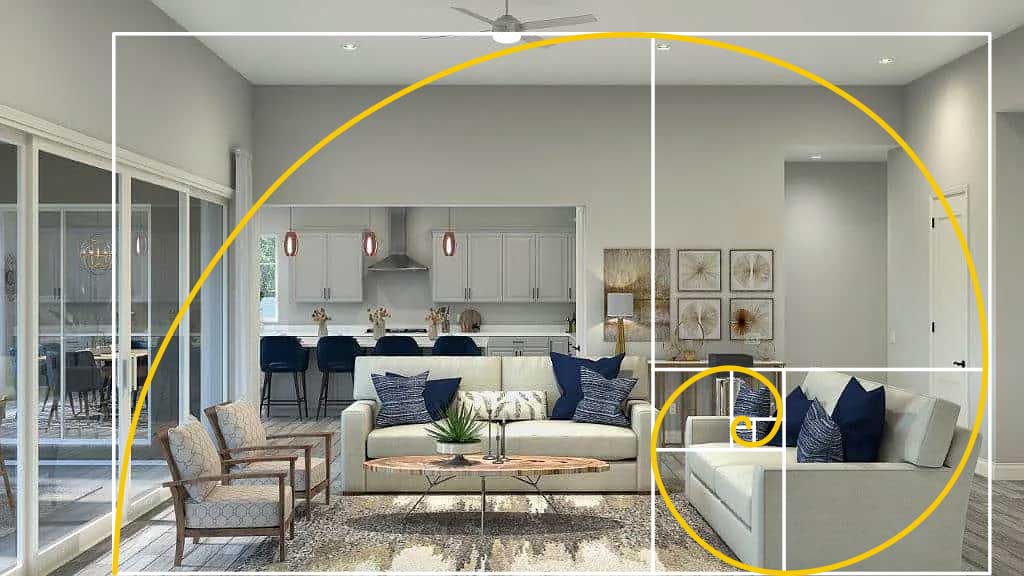
Cachet Homes McKinley Glenn Interior Rendering with Fibonacci overlay.
Cachet Homes McKinley Glenn’s Designs follow Fibonacci principles beautifully.

When I first explored the Fibonacci sequence and the Golden Ratio in my previous blog, I focused on the hidden mathematics behind beauty in architecture and home design. Since then, I’ve had the opportunity to see how our builders are actively incorporating these timeless ratios into their designs, and how that mathematical harmony directly impacts what buyers see, feel, and fall in love with.

Why Buyers Respond to Fibonacci and Golden Ratio Designs

Homebuyers may not be consciously measuring a window’s width against the wall, but our eyes instinctively respond to balance and proportion. Spaces designed with the Golden Ratio, approximately 1:1.618, tend to feel “right” without buyers knowing why.

  1. Front elevations often feature gables, windows, and doors arranged according to Fibonacci-inspired proportions, creating an inviting, well-balanced first impression.
  2. Interior layouts that follow these sequences allow rooms to “flow,” subtly guiding the eye and making spaces feel larger and more comfortable.
  3. Detailing and décor, from staircases that spiral like a nautilus shell to the placement of pendant lights, enhance the sense of visual harmony.

In other words, math becomes emotion. A home with good proportions doesn’t just look appealing. It feels like home.
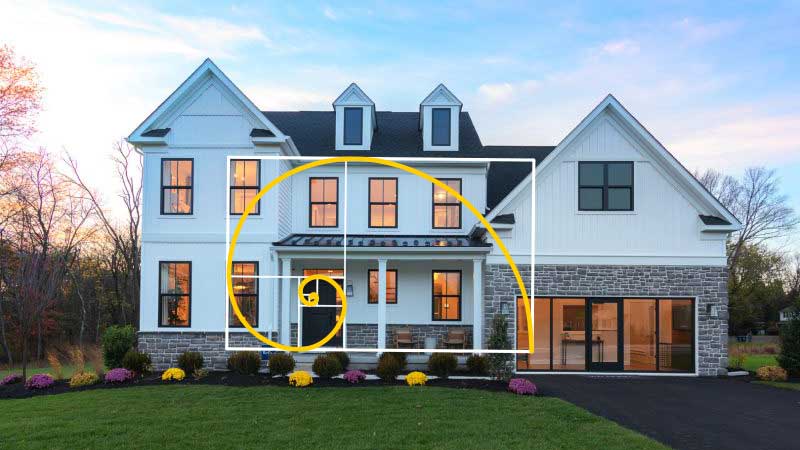
WB Homes Brexley Wells Exterior Elevation Home Rendering with Fibonacci overlay.
WB Homes Brexley Wells Elevation is an excellent example of Fibonacci exteriors.

Seeing the Golden Ratio in Renderings and Virtual Tours

Today’s homebuying experience often begins online, and it is here that the Fibonacci sequence and the Golden Ratio quietly work their magic. Builders using 3D renderings and virtual tours showcase these balanced designs in ways that engage buyers before they even step foot on a property.

  1. Renderings highlight proportional windows, rooflines, and façade elements that instantly register as beautiful to the human eye.
  2. Virtual tours allow buyers to experience how balanced room proportions create a seamless flow from a living room to a kitchen, with sightlines that feel natural and expansive.

We’ve seen this come to life in the interactive kiosks we create with our builder partners:

  1. WB Homes – Ashford Preserve showcases harmonious front elevations and open interiors that naturally guide the eye.
  2. Cachet Homes – McKinley Glen allows buyers to virtually walk through spaces designed with balance in mind, noticing (even subconsciously) how the proportions create comfort and appeal.

By the time a buyer books a tour, the mathematical “magic” of these homes has already done its work.

The Subtle Science Behind a “Dream Home”

What makes a buyer say, “I could see myself living here”? Often, it’s not just square footage or finishes. It’s the harmony created by the Golden Ratio and the Fibonacci sequence. Builders who embrace these principles aren’t just designing structures; they’re creating spaces that resonate on a psychological level.

Whether you’re walking through a model home, scrolling through a virtual tour, or admiring a rendering, those invisible spirals and ratios are quietly at work. They’re the bridge between mathematics and emotion, blueprint and dream home.

If you have any questions about creating beautiful digital assets, feel free to reach out!

Contact us!

The Fibonacci Sequence and The Golden Ratio in Home Design

Tabitha Warren · 09/05/2024 · Leave a Comment

The Secret Formula Behind Beautiful Homes: The Fibonacci Sequence and the Golden Ratio Use Math to Create Beauty in Your Home

Examples of the Fibonacci spiral: stair cases, grapefruit, shells, sunflower, plants
Fibonacci spirals in a variety of contexts courtesy of Canva Pro

Coming from a financial background, when I think about the Fibonacci sequence, I think of a mathematical tool that market analysts use to understand and project market trends. I think of debatable market theory that sparks hot button discussions. For me, the Fibonacci sequence elicits thoughts of pie charts and trend lines. It’s an interesting tool in a market analyst’s toolbox.

When a colleague mentioned it to me in the realm of homebuilding, art, and aesthetics, my mind was blown. I had to learn more about this versatile sequence.

A Bit About the Fibonacci Sequence

The origin of the Fibonacci sequence is much discussed, but it’s believed that it has a hodgepodge evolution with both ancient Indian and medieval European ancestry. The mathematical concept itself seems to have appeared in Indian history as early as 200BC. Sanskrit poetry suggested the sequence in its rhythmic patterns.

In the West, the sequence became more widely known around 1202 as a result of Leonardo of Pisa, aka Fibonacci, when he introduced it to discuss the nature of rabbit population growth. The name “Fibonacci Sequence” wasn’t made popular until much later by a French mathematician named Edouard Lucas. Lucas conducted extensive research on the sequence. He realized that it had deeper relationships with other mathematical concepts. His formalization of this mathematical study allowed for a broader understanding of underlying mathematical structures and eventually led to his development of his own sequences, Lucas sequences, as well as the Lucas-Lehmer primality test.

Vector Set by Studioworkstock courtesy of AdobeStock

The Journey from Mathematics to Nature and Art

The Fibonacci sequence is a series of numbers in which each number is the sum of the two preceding numbers (0, 1, 1, 2, 3, 5, 8, 13). In nature, it is often seen in the arrangement of leaves, petals, seeds, and even galaxies. The Golden Ratio is a mathematical constant approximately equal to 1.618. It can be found in plenty in nature from the ratio of the length of a human arm to the length of the forearm, to the ratio of the length of a snail shell to its width, to the ratio of the distance between branches of a tree to the distance between the trunk and its branches.

If you look around you, you’re bound to notice the repeating patterns at work. Scientists hypothesize that the Fibonacci sequence and the Golden Ratio often lead to the most efficient arrangement for space-saving in nature. An example of this might be the number of seeds that can fit into the head of a sunflower, any other arrangement would not allow this maximized number of seeds. If you take the time to explore, you’ll notice this same thing in pinecones, lilies, and tree branches. All these things grow in spirals and often demonstrate Fibonacci patterns. Beyond plant life, you can observe this pattern in honeybee colonies and the nautilus shell. Look around, and you’ll be surprised to see mathematical sequences everywhere adding to the beauty of the visuals we assume happen at random.

In art, one need only look for a subtle spiral flow to recognize the influence of the Fibonacci sequence, guiding the viewer’s eye through the piece. Artists have embraced the Fibonacci sequence and the Golden Ratio for centuries. Master artists like Leonardo da Vinci had an affinity for mathematics, incorporating it into their art. The Mona Lisa and The Last Supper create a sense of balance and harmony that have captured the hearts and minds of audiences across the world. Leonardo employed the Golden Ratio to create a visual flow that captivates viewers.

The Fibonacci House by Square Three Architecture

Fibonacci Sequence and the Golden Ratio in Architecture and Home Design

Ancient structures like the Parthenon in Greece are testament to the Golden Ratio as far as showcasing adherence to proportions. The influence of these mathematical principles lends a timeless elegance to historical structures. Modern architects can draw inspiration from these architectural beauties when designing for enduring appeal. The golden ratio helps create a balance that makes sure that buildings are both visually pleasing and functional.

In home design, the Golden Ratio and the Fibonacci sequence offer a blueprint for creating spaces that feel instinctively balanced and inviting. Room dimensions, furniture placement, window and door sizes, and even decorative elements can all be guided by these principles. Notably, some architects have even designed entire homes based on the Fibonacci sequence. If you have a chance, take a look at this home by Square Three Architecture. They call it the Fibonacci House, and it is designed entirely around a Fibonacci spiral, incorporating the sequence throughout. The Fibonacci House is an extreme example, but it effectively demonstrates how the sequence and the Golden Ratio can be used to create pleasing flows within a design.

Other Ratios in Home Design

The Golden Ratio and the Fibonacci sequence may be the most used ratios in home design, but there are other mathematical sequences that can be used to create aesthetically pleasing spaces. Another approach to explore might be the Rule of Thirds. This rule divides a space into nine equal parts, with the points of intersection serving as focal points for furniture or decor. While not directly related to the Fibonacci sequence, the Rule of Thirds offers a similar approach to achieving visual balance and appeal.

The Fibonacci sequence and the Golden Ratio are more than just mathematical tools or systems; they are the underlying architects of wonder and coherence in our physical environments. From the beauty of nature to the style of art and the hygge of our homes, their influence is everywhere. A timeless aesthetic can be brought into our designs through balance and proportion if we understand these principles and incorporate them into our designs properly. The next time you’re awestruck by the sunsetting over the ocean, a fascinating painting, or a stunning room design, consider the Fibonacci sequence and the Golden Ratio. They might just be the underlying mathematical forces that harmonize the beauty you sense.

Ready to get started, want more info?

Contact Us
  • Facebook
  • Instagram
  • LinkedIn
  • YouTube

Outhouse

11048 N 23rd Ave #103
Phoenix, AZ 85029

602-371-4394

© 2026 All rights reserved