• Skip to primary navigation
  • Skip to main content
Outhouse logo

Outhouse

The Outsource Hub for Home Builders

  • Home
  • Products & Services
    • Architectural/CAD
    • Rendering
    • Virtual Reality
    • Interactive Floor Plans
    • Interactive Site Maps
    • Interactive Kiosks
    • Print Marketing
    • Sales Office Displays
  • Partners
  • News
    • Events
    • Blog
    • Podcast
  • About Us
  • Contact Us
  • Show Search
Hide Search

architectural

The Floor Plan Mistake That Costs You Once or Four Hundred Times

Bill Gelbaugh · 11/09/2026 · Leave a Comment

What the First Two Posts Were Really Building Toward
Craig’s post made the case for one CAD standard across every architect you hire, so the construction document layer stays consistent no matter who designed the plan. My last post traced what happens when a gap slips through anyway: a mislabeled layer, an uncalled material, a dimension close enough to pass permitting but not clean enough to survive on-site construction. That gap becomes a guess someone downstream has to make under deadline, and the guess eventually shows up as two versions of the truth: the home the buyer saw in the rendering, and the home the crew framed.

Both posts were really circling the same question from different angles: what does a CAD mistake cost, and who pays for it. Neither post asked the question that decides the answer. 

How many times does the house get built?

The Question Nobody’s Asking

Ask any builder to explain the difference between production and custom, and you’ll get an answer about the buyer’s experience: more choices here, fewer there, a faster timeline on one side and more freedom on the other. That’s true, and it’s also the wrong place to be looking if you’re trying to understand what a CAD error costs you.

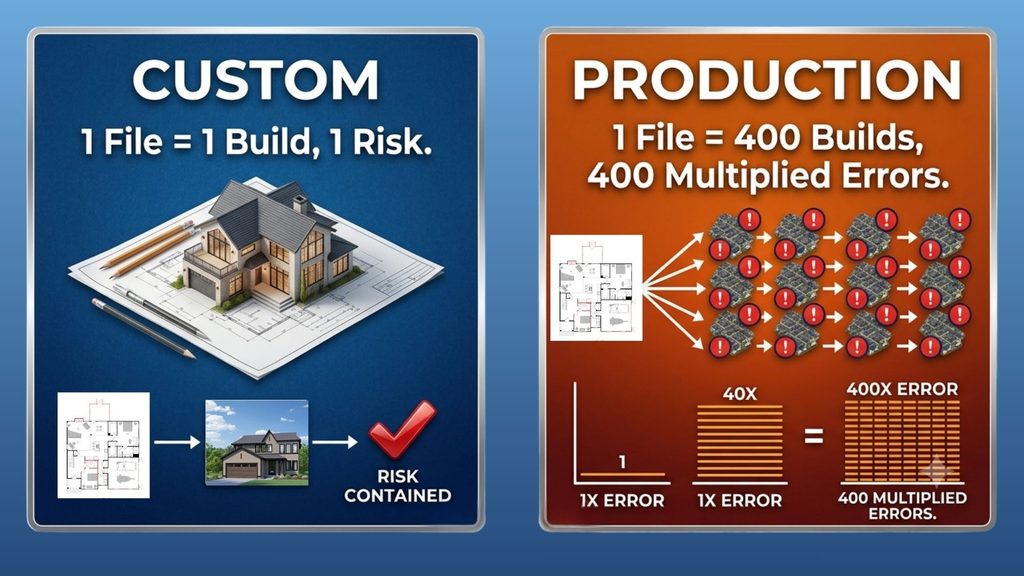
Here’s the question that matters instead. When a custom home’s construction documents carry a mistake, one house absorbs it. The framing crew builds it once, the buyer lives with it once, and when the project closes, so does the exposure. When a production plan carries the same mistake, the file doesn’t get built once. It gets built fifty times, a hundred times, sometimes closer to four hundred, across however many lots that plan is assigned to before several communities sell out. The mistake isn’t corrected between builds. It’s replicated, over and over

The Multiplication Nobody’s Pricing

I’ve watched builders price CAD accuracy like it’s a single-project risk. Get the drawing right, get the permit through, move on. That math works fine for a custom builder, whose entire exposure to any given plan begins and ends with one house. It stops working the moment the same plan becomes the template for a subdivision.

Think about what actually gets multiplied. A visualization asset built from a flawed source file doesn’t just misrepresent one buyer’s future home. It’s the same rendering, the same marketing floor plan, shown to every buyer who tours that model or clicks that listing, all of them forming an expectation from the identical inaccuracy. A field detail that got interpreted wrong once because the CAD file left a gap doesn’t get corrected on lot two. It gets interpreted the same way by whichever crew is running that plan, lot after lot, until someone finally notices the pattern, usually because a buyer noticed it first.

That’s the part the customer-experience framing misses entirely. Production and custom aren’t just different buying experiences. They’re different exposure models built on the exact same kind of underlying CAD mistake, and the production side is carrying a multiplier the custom side never sees.

Where the Multiplier Lives
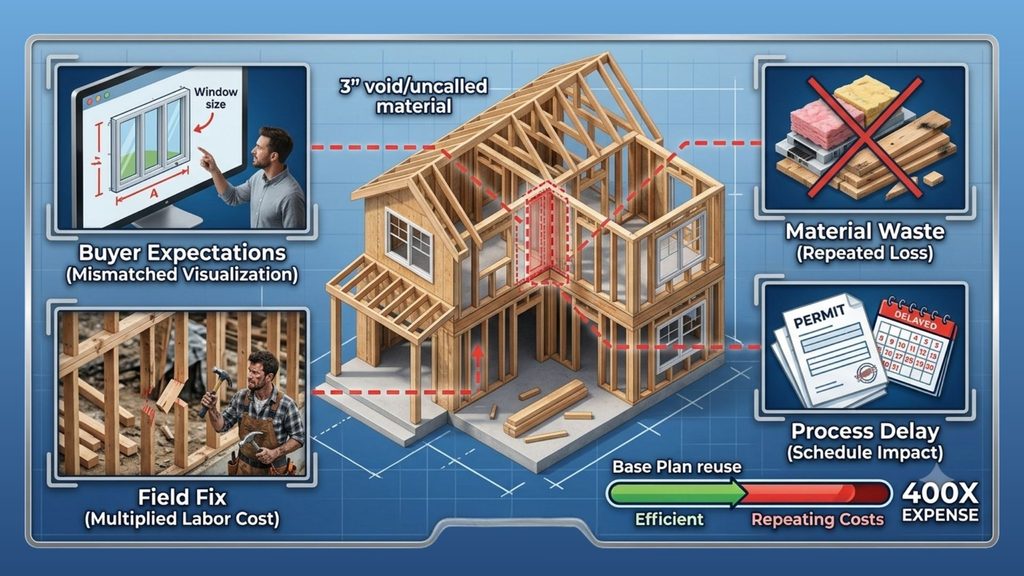
The mechanism is worth discussing here, because it’s not abstract. A production builder’s plan library exists precisely because a single clean file gets reused: the same structural drawing, the same rendering asset, the same marketing floor plan, distributed across every sale that plan touches. That reuse is the entire economic logic of production building. It’s also exactly why a CAD mistake in that file doesn’t stay small. The same efficiency that makes production building profitable is the mechanism that turns a one-time drafting error into a repeating cost.

Semi-custom sits in an uncomfortable middle. The base plan still repeats, so the multiplier is still live, but every structural option a buyer selects forks the file into a new variant that has to be accurate on its own terms. A mistake in the base plan multiplies across every home built from it. A mistake in an option package multiplies across every buyer who chose that specific configuration. Neither is contained the way a custom project’s exposure is contained.

Custom home builders, by comparison, are working with the lowest-stakes version of a CAD mistake in this entire equation, and it’s worth pointing to directly instead of implying it. One house. One crew. One buyer. When the project closes, so does the risk. That’s not a knock on the diligence custom builders bring to their drawings. It’s just math. The same drafting error that costs a custom builder one difficult conversation costs a production builder however many lots that plan touches, multiplied by however long it takes someone to notice the pattern.

What This Means for How You Treat the File

None of this changes what Craig argued or what I argued last time. Standardize your CAD process. Catch the gaps before they become someone else’s guess. What it changes is how much attention that standard deserves before the first house on a plan ever breaks ground, because the cost of getting it wrong isn’t fixed. It scales with every lot that plan is assigned to.

A custom builder can afford to treat CAD accuracy as due diligence on one project. A production builder is making a bet on every future sale that plan will ever generate, and the file is either accurate before the first foundation gets poured, or the mistake is already planned for repetition.

What Will You Choose?

You can treat CAD accuracy as a per-project concern, regardless of whether you’re building one home or four hundred from the same file. Or you can recognize that the moment a plan enters your rotation, every drafting error in it stops being a single mistake and starts being a decision you’re making on behalf of every buyer who hasn’t signed a contract yet.

Outhouse has spent thirty years watching that multiplier play out, on both sides of the equation. What will you choose?

Want to know more about CAD?
Visit Outhouse

Texture, Tone, and Trust: The Neuroscience of High-Fidelity Visualization

Tabitha Warren · 06/08/2026 · Leave a Comment

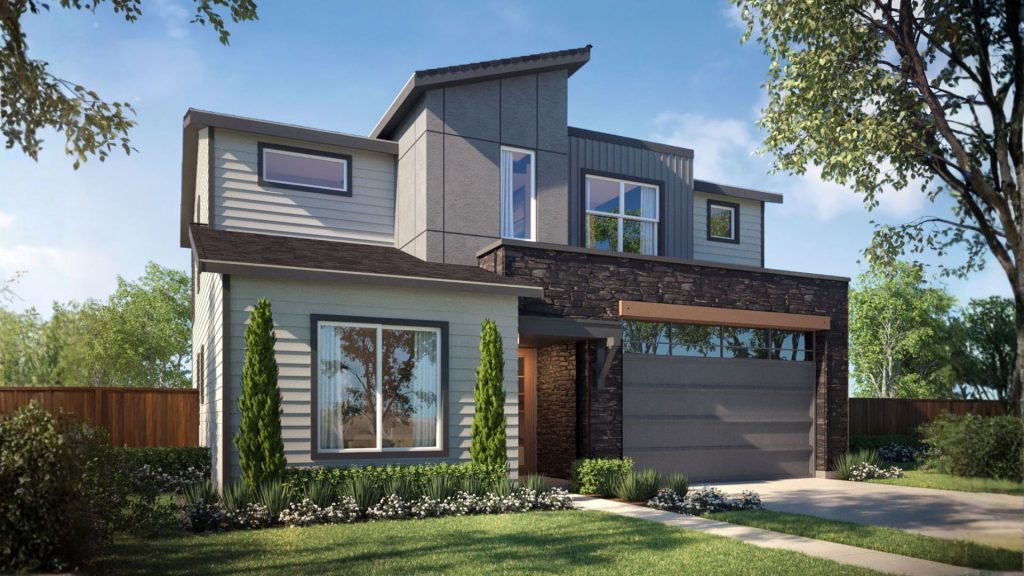
Front yard rendering of a Postmodern House.

The 2.5-Second Threshold

Curb appeal used to happen at the street. Now it happens on a smartphone screen, and the judgment window is tighter than most builders realize. 

Your buyer’s brain makes a brand assessment in just 2.5 seconds. In that heartbeat, they decide whether your brand represents quality or a compromise. When 3D renderings appear flat or poorly lit, the brain’s amygdala, the center for processing emotions and trust, can register a “fake” signal. In a market where trust is the primary currency, a low-fidelity image doesn’t just look bad; it creates subconscious doubt. 

Why the Moment Is Especially Demanding Right Now

Current 2026 design trends are dominated by Organic Modernism. This style relies heavily on tactile surfaces: lime-wash walls, white oak cabinetry, tumbled stone, and linen textures. These materials aren’t just colors; they are experiences defined by how light interacts with their surfaces. 

And here’s the thing: that’s exactly what makes them so demanding to render. Lime-wash has depth that shifts with lighting conditions. White oak has a grain that catches light differently at different angles. Tumbled stone carries shadow and dimension at scales a standard CAD export can’t resolve. When a rendering flattens those surfaces, when the grain maps as texture, when the lime-wash reads as paint, the amygdala fires. The buyer doesn’t know why something feels off. But something feels off. 

You aren’t selling a floor plan. You’re selling the feeling of home. And the materials that evoke that feeling most powerfully right now are the exact materials that demand the most from your visuals. 

Organic Modernism

The Technical Bridge to Certainty

Getting there means moving beyond “good enough.” It requires a commitment to physical accuracy in the rendering that matches the commitment to the actual construction. 

Two capabilities make the real difference. 

Global Illumination isn’t about adding a light source to a scene. It’s about simulating how light actually moves through a space, how it bounces, casts shadows, and shifts by the hour and the season. The sun hitting a breakfast nook at 8:00 AM in September creates a quality of light the brain recognizes as real before the conscious mind has processed anything. That recognition is what “sense of place” actually means, not a stylistic quality, but a neurological one. 

PBR  (Physically Based Rendering) uses advanced material science so buyers can practically feel the wood grain and the coolness of the quartz through the screen. When materials respond to light the way they would in the actual room, the brain’s “fake” detector stays quiet. Your buyer stops scrutinizing and starts feeling, and feeling is what buying is all about. 

Global Illumination

What the Data Shows

Neuroscience is backed by real outcomes. According to the Dodge Construction Network’s 2026 Outlook, builders using high-fidelity, photorealistic renderings see a 30% higher engagement rate than those using standard CAD exports. The reason is biological: high-fidelity visuals bypass the logical brain and trigger an immediate emotional response. 

The Institute of Residential Marketing reports that homes marketed with high-quality 3D visuals can command a 3–5% price premium during pre-sales. On a $600,000 home, that’s $18,000 to $30,000. Not because the home changed, but because the buyer’s perceived risk went down. When you provide visual certainty, you reduce the doubt that the amygdala was protecting against. 

Building Trust Through Detail

In a crowded market, the builders who earn trust earliest earn the most. And trust isn’t built through the sales conversation alone; it’s built in the 2.5 seconds before the conversation begins. 

When your visuals are indistinguishable from reality, you aren’t just showing a house. You’re demonstrating a standard of care, a signal that the quality of your construction and your communication are one and the same. 

The visual standard should match the build standard. At Outhouse, we believe that high-fidelity visualization is the shortest path to buyer confidence. We help builders bridge the gap between “imagining” and “knowing.” 

To see how we can bring your next project to life with neurological precision,

Explore our visualization gallery

Don’t Retire Print Marketing – Reimagine It

Jim Sorgatz · 02/24/2025 · Leave a Comment

Brochure of a K. Hovnanian Homes house

People often ask us why a print company specializing in print for home builders is necessary. Heck, today, builders sometimes ask us if print marketing is still a valuable sales tool! The answer to both questions is a resounding “Yes!” We explain why in this post.

The Role of Print in New Home Sales

In a recent episode of the Digital Velocity Podcast, co-hosts Erik Martinez of Digital Velocity and Tim Curtis of NaviStone talk with Alex Kupski and Jake Hoffman, co-hosts of the Millennials in Print Podcast, about the Power of Print in the Digital Age. They conclude, “The more channels you’re present on and the more channels you’re marketing to people on, ultimately, the more effective you’re going to be. Print, just like social, just like email, just like your website, just like a commercial on TV, is a channel for you to market on. It’s another arrow in the quiver. It’s another way to reach people you might not have before.”

…the ubiquity of digital media has given print media a strange new power.” –Brandon Ortiz, Salesforce.com

Print marketing works best when paired with digital marketing. Digital marketing is often the most effective way to draw people in. With interactive site plans, interactive floor plans, renderings, virtual tours, visualizers, and Matterport tours, your website is arguably a home builder’s most potent marketing tool. But it is only effective for a home buyer’s few precious moments on your website. Print collateral, on the other hand, has a much longer life span. Brochures and floorplan/elevation minis often sit on a potential buyer’s countertop or table for weeks or months, a lasting reminder of your homes and communities. Not every prospect immediately purchases a home, so print is a great way to keep them focused on yours. 

David Weekley Homes brochure with cactus front cover, and homes on the back

Data shows that print used in tandem with digital marketing is one of the most effective sales strategies as the two mediums strengthen and reinforce each other. A study by InfoTrends found that 66% of direct mail is opened, and 56% of consumers who respond to direct mail go online or visit a physical store. A recent article in SFGate offers some great tips to sync your print and digital marketing efforts:

  • Place QR codes on print materials.
  • Provide digital opt-ins for direct mail.
  • Include social media reviews and comments on print materials.
  • Include hashtags and calls to action on print materials.

Although digital and print marketing take different forms, They work together to engage customers and keep your brand at the top of their minds.

It isn’t game over for print marketing. The game has only changed.”

The game has changed regarding print marketing strategies. When you discover the power of fusing “low-tech with high-tech,” you will separate yourself from the homebuilders who made the mistake of transitioning to 100% digital marketing.

Print is particularly effective where there is a physical customer presence – In industries where customers interact in person, such as model home sales offices, print materials provide tangible takeaways. Homebuilders can leverage brochures, direct mail, and high-quality printed floor plans to keep their homes top of mind for buyers who may not be ready to purchase immediately.

Print Remains Relevant in the Digital Age – As digital marketing becomes more saturated, print marketing offers brands a way to cut through the noise. As digital marketing becomes more easily ignored, physical marketing materials command attention, creating a lasting impression.

Moreover, print campaigns should be fully integrated with digital efforts. Rather than treating print as an afterthought, homebuilders can maximize impact by designing campaigns that blend the strengths of both mediums. Brochures, mailers, even print ads should include QR codes, personalized URLs, or augmented reality elements that direct potential buyers to interactive experiences online. Instead of evaluating print and digital separately, builders should use KPIs that measure how both contribute to lead generation and engagement.

Why Use a Builder-Specific Printing Company?

The challenge builders face that is unique to our industry is the weekly sales cycle. From week to week, home prices may change, lot availability changes, and options may vary. The typical strip-mall printer is not equipped to automate this process. Outhouse built their business to serve a single industry – HOME BUILDING. We do all work in-house, from CAD for your construction documents to print materials for your sales centers. This allows all teams, including architectural, rendering, graphics, interactive, and print, to work in tandem. By doing so, we create accurate, up-to-date print materials that are consistent and coordinated with your digital marketing assets. Utilizing the latest technologies, we print and deliver materials on time every week, on the builder’s schedule. Challenge solved – you send us your edits, and we coordinate these changes across all platforms.  

Professional Artwork Creation: Outhouse provides clients with the considerable advantage of having drafting and rendering services on-site, allowing coordination with the development of their artwork for all printed materials. This coordination offers clients superior accuracy, faster turnaround times, and lower overall costs.

Coordinated File Management:  Another advantage is the ease of managing and coordinating all created artwork with professional digital file and asset management. All artwork is kept up-to-date, consistent, and coordinated between city design reviews, printed sales materials, large format displays, and interactive web products and services.  

Superior Print Quality:  Superior brand standard quality and consistency every time on every product is only possible with the coordination, color calibration, and production of all graphics, printing, and display under one roof. Unlike a mass-market printer like Vista Print, Outhouse is not a WYSIWYG (What You See Is What You Get) printer. We believe that good enough is never good enough, and we have the magnifying glasses to prove it! On rare occasions when colors are incorrect or print quality is not up to snuff the first time off the press, we recalibrate and rerun the job.

Builder-Specific Delivery:  Unlike many industries, home building has a weekly sales cycle, and having your print delivered on time is critical. Outhouse understands this. We meet your deadlines your way on your weekly sales cycle.

Woodside Homes brochure with three homes

The bottom line is print marketing still plays an integral role in new home marketing and sales. There’s a reason the Outhouse Interactive Floor Plan has a save button. It allows prospective homebuyers to save their customized floor plans and print them out for further review. 

What about younger generations? Retail Focus Magazine tells us that print is 30% more memorable than digital. This applies to all age groups. You need look no further than nightclubs which hand out leaflets advertising upcoming events, and university welcome packs to know that print still appeals to young people. The magazine also notes the best campaigns are when print and digital work alongside each other instead of trying to compete. A younger audience may be digitally savvy, but they still appreciate a well-thought-out hard copy campaign.  

Although any printer can give you a halfway decent brochure, only a company like Outhouse coordinates your CAD, rendering, and interactive projects with your print materials and sales office displays. Even if our print pricing is a bit higher, you will save significantly more overall through efficiencies in coordination.     

Woodside Homes floor plan
When you update a plan, Outhouse coordinates the changes across CAD, print, and all digital marketing assets.

Print Marketing Sells New Homes

Jim Sorgatz · 03/08/2023 · Leave a Comment

Brochure of a K. Hovnanian Homes house

People often ask us why a print company specializing in print for home builders is necessary. Heck, today, builders sometimes ask us if print marketing is still a valuable sales tool! The answer to both questions is a resounding “Yes!” We explain why in this post.

The Role of Print in New Home Sales

In a recent episode of the Digital Velocity Podcast, co-hosts Erik Martinez of Blue Tangerine and Tim Curtis of CohereOne talk with Alex Kupski and Jake Hoffman, co-hosts of the Millennials in Print Podcast, about the Power of Print in the Digital Age. They conclude, “The more channels you’re present on and the more channels you’re marketing to people on, ultimately, the more effective you’re going to be. Print, just like social, just like email, just like your website, just like a commercial on TV, is a channel for you to market on. It’s another arrow in the quiver. It’s another way to reach people you might not have before.”

Print marketing works best when paired with digital marketing. Digital marketing is often the most effective way to draw people in. With interactive site plans, interactive floor plans, renderings, virtual tours, visualizers, and Matterport tours, your website is arguably a home builder’s most potent marketing tool. But it is only effective for a home buyer’s few precious moments on your website. Print collateral, on the other hand, has a much longer life span. Brochures and floorplan/elevation minis often sit on a potential buyer’s countertop or table for weeks or months, a lasting reminder of your homes and communities. Not every prospect immediately purchases a home, so print is a great way to keep them focused on yours. 

David Weekley Homes brochure with cactus front cover, and homes on the back

Data shows that print used in tandem with digital marketing is one of the most effective sales strategies as the two mediums strengthen and reinforce each other. A study by InfoTrends found that 66% of direct mail is opened, and 56% of consumers who respond to direct mail go online or visit a physical store. A recent article in SFGate offers some great tips to sync your print and digital marketing efforts:

  • Place QR codes on print materials.
  • Provide digital opt-ins for direct mail.
  • Include social media reviews and comments on print materials.
  • Include hashtags and calls to action on print materials.

Although digital and print marketing take different forms, They work together to engage customers and keep your brand at the top of their minds.

Why Use a Builder-Specific Printing Company?

The challenge builders face that is unique to our industry is the weekly sales cycle. From week to week, home prices may change, lot availability changes, and options may vary. The typical strip-mall printer is not equipped to automate this process. Outhouse built their business to serve a single industry – HOME BUILDING. We do all work in-house, from CAD for your construction documents to print materials for your sales centers. This allows all teams, including architectural, rendering, graphics, interactive, and print, to work in tandem. By doing so, we create accurate, up-to-date print materials that are consistent and coordinated with your digital marketing assets. Utilizing the latest technologies, we print and deliver materials on time every week, on the builder’s schedule. Challenge solved – you send us your edits, and we coordinate these changes across all platforms.  

Professional Artwork Creation: Outhouse provides clients with the considerable advantage of having drafting and rendering services on-site, allowing coordination with the development of their artwork for all printed materials. This coordination offers clients superior accuracy, faster turnaround times, and lower overall costs.

Coordinated File Management:  Another advantage is the ease of managing and coordinating all created artwork with professional digital file and asset management. All artwork is kept up-to-date, consistent, and coordinated between city design reviews, printed sales materials, large format displays, and interactive web products and services.  

Superior Print Quality:  Superior brand standard quality and consistency every time on every product is only possible with the coordination, color calibration, and production of all graphics, printing, and display under one roof. Unlike a mass-market printer like Vista Print, Outhouse is not a WYSIWYG (What You See Is What You Get) printer. We believe that good enough is never good enough, and we have the magnifying glasses to prove it! On rare occasions when colors are incorrect or print quality is not up to snuff the first time off the press, we recalibrate and rerun the job.

Builder-Specific Delivery:  Unlike many industries, home building has a weekly sales cycle, and having your print delivered on time is critical. Outhouse understands this. We meet your deadlines your way on your weekly sales cycle.

Woodside Homes brochure with three homes

The bottom line is print marketing still plays an integral role in new home marketing and sales. There’s a reason the Outhouse Interactive Floor Plan has a save button. It allows prospective homebuyers to save their customized floor plans and print them out for further review. 

What about younger generations? Retail Focus Magazine tells us that print is 30% more memorable than digital. This applies to all age groups. You need look no further than nightclubs which hand out leaflets advertising upcoming events, and university welcome packs to know that print still appeals to young people. The magazine also notes the best campaigns are when print and digital work alongside each other instead of trying to compete. A younger audience may be digitally savvy, but they still appreciate a well-thought-out hard copy campaign.  

Although any printer can give you a halfway decent brochure, only a company like Outhouse coordinates your CAD, rendering, and interactive projects with your print materials and sales office displays. Even if our print pricing is a bit higher, you will save significantly more overall through efficiencies in coordination.     

Woodside Homes floor plan
When you update a plan, Outhouse coordinates the changes across CAD, print, and all digital marketing assets.

Ready to get started, want more info?

Contact Us
  • Facebook
  • Instagram
  • LinkedIn
  • YouTube

Outhouse

11048 N 23rd Ave #103
Phoenix, AZ 85029

602-371-4394

© 2026 All rights reserved