• Skip to primary navigation
  • Skip to main content
Outhouse logo

Outhouse

The Outsource Hub for Home Builders

  • Home
  • Products & Services
    • Architectural/CAD
    • Rendering
    • Virtual Reality
    • Interactive Floor Plans
    • Interactive Site Maps
    • Interactive Kiosks
    • Print Marketing
    • Sales Office Displays
  • Partners
  • News
    • Events
    • Blog
    • Podcast
  • About Us
  • Contact Us
  • Show Search
Hide Search

visualizers

Know Your Homebuyer Audience

Jim Sorgatz · 06/30/2025 · Leave a Comment

Are you surprised by new home construction trends in your own city?

Guess which house is the newbie?!

Having been in the industry for nearly 30 years, it is not often that I am surprised by trends in new home construction. The goal is to sell to anyone who financially qualifies. But, I had to laugh when I saw the email announcing the New American Home that is being built for the 2026 NAHB International Builders Show. It has basement space for up to 17 cars! I’ve known a number of people over the years with impressive car collections, but how wide is the audience that has more than a dozen?

In these times of elevated interest rates and sky high home prices there is much buzz about affordability, which theoretically implies to smaller homes. So, I am shocked to see the newest homes being constructed in my “affordable” neighborhood are 50%+ larger and significantly more expensive than my home that was built in the fall of 2022. The families shopping for homes right now are, apparently, looking for space, and they have the means to afford a bigger house. I guess that makes sense. Although there are genuine efforts by cities and builders to create affordable housing, the median price of $409,000 nationally per Zillow (down from $430K last year), doesn’t offer many options for typical first-time homebuyers, or families looking to move up a rung. This “affordability” paradox hammers home the importance of knowing your core audience, building for them, and marketing to them appropriately.

There are many builders who do this well and adapt to the changing environment. One example is Arizona based Meritage Homes whose mission today is, “To design and build homes that are innovative, built with care and superior craftsmanship, which deliver enduring value.” Contrast that with their mission a few years back, “To build move-in-ready affordable homes for entry-level and first move-up buyers,” and you can see the evolution to better reflect the current new home market.

Another builder to successfully navigate trends is Scottsdale-based luxury builder Camelot Homes who have retooled home designs and marketing from an elegant old world look and feel to a vibe that is much more contemporary to attract younger yet still well-heeled homebuyers.

How can you be sure you are targeting the right audience? Begin with a review of your overall marketing strategy. Do your website, sales offices, and print marketing appeal to the potential buyers you are attempting to attract? Although first-time and luxury home buyers are both seeking out their dream homes, the marketing for these two distinct groups looks very different. This is where consultation with marketing experts like Blue Tangerine, Denim Marketing, Group Two, Bokka Group, and Meredith Communications, to name a few, can be highly beneficial.      

Next, review your digital marketing tools, and upgrade them if necessary. If you are still using static floorplans and stick renderings, think again. Interactive floor plans, 3D renderings, virtual tours, animations, and visualizers all play an integral role in engaging homebuyers and selling homes.

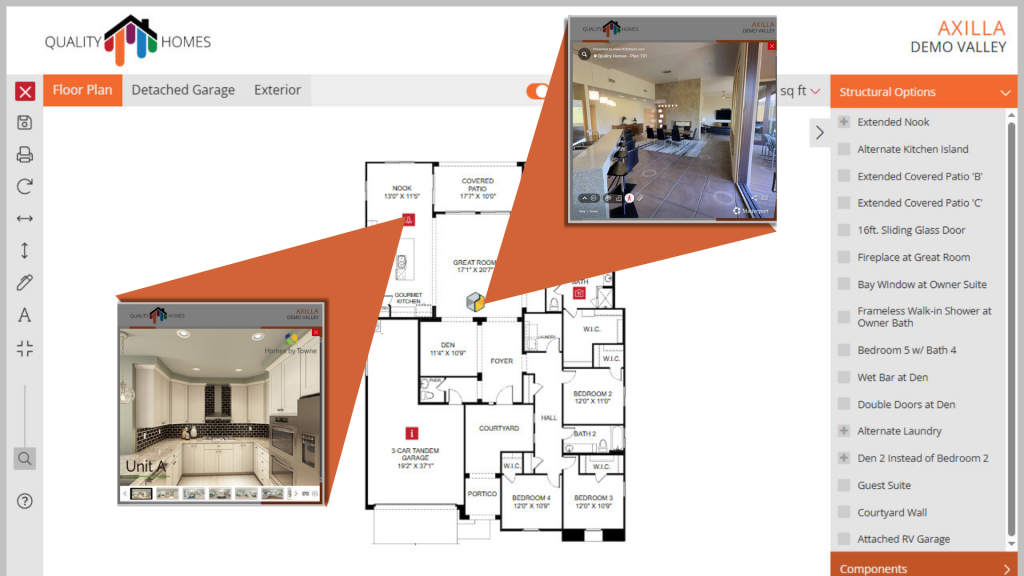
Interactive Floor Plans (IFPs) have universal appeal, and every builder website should feature them. Buyers of all demographics love to select structural options and customize their living spaces with the interactive furniture planner. 

Interactive floor plan with furniture.
Outhouse’s colorized Interactive Floor Plan

Quality 3D renderings are essential for all builders as well. Black and white stick drawings are never a good option, even for the simplest of homes. Standard 3D (Outhouse Bronze and Silver) renderings are perfectly acceptable for most homes, especially those at lower price points. For move-up and luxury homes, you may want to consider 3D photoreal renderings (Outhouse Gold). Luxury and custom builders may want to opt for Platinum renderings that can be further customized.

Should your budget for digital marketing tools be a bit larger, investing in animations and virtual tours pays off in two significant ways. First, they enable homebuyers to digitally explore your homes from anywhere. Second, both are available at a fraction of the cost of constructing a model home. Your target buyer should be the top consideration when choosing which format to offer. Younger buyers prefer user-controlled virtual tours. Buyers over 50 often gravitate towards video format animations.

Visualizer showing a before and after kitchen
Visualizer’s allow home buyers to customize interiors and exteriors

Another online tool appealing to home buyers at all price points is the Visualizer. With both interior and exterior versions available, buyers can mix and match colors and finishes to achieve the desired look and feel. The visualization process is so much easier than making selections for an entire house based on one-inch paint chips and tiny floor, counter, and cabinet samples. It also removes some of the pressure and stress from the design center visit.

Here are a couple more ideas to help you connect with your appropriate audience:

Elevate your brand with distinguished print marketing. Consider the hotel industry when investing in print—the swankier the property, the more excellent the print collateral. The manager of the high-end hotel presents you with a “folio” at checkout in lieu of a bill. Although print appeals greatly to buyers in the luxury home market, even younger homebuyers like to walk away from the sales center with a brochure featuring their preferred floor plan and elevations, at a minimum. In today’s digital world, consumers still appreciate a tangible marketing piece when making one of their biggest life purchases. Why not present them with something sophisticated or fun, and memorable?         

Printed brochure showing families participating in various activities
A great print piece makes a lasting impression!

Today, the most progressive builders are transforming their websites with artificial intelligence (AI) to better understand and target their audience. Like that provided by openhouse.ai, AI offers home buyers a personalized shopping experience and predicts where your unique market is going with more accuracy.

So take some time during this evolving housing market to understand your homebuyer and determine if your current marketing strategy is meeting their needs. If not, consider working with online marketing experts to determine which digital and on-site tools will move the needle most with your target audience to increase your new home sales.   

The Bots are Coming: Are We Ready for the Disruption Ahead?

Jim Sorgatz · 03/09/2025 ·

Robot with human face

Jimdroid – Created by Tabitha Warren with a little help from A.I,

The past six months have been nothing short of a revelation. Last fall, I experienced an ischemic stroke—an event that was a bit terrifying and life-altering, but also utterly fascinating. While the recovery process has been grueling, it has also given me a rare, firsthand understanding of the intricate connection between the brain and the body—something most people never have to think about.

When a stroke occurs, blood flow to the brain is cut off, damaging nerves and severing their connection to various parts of the body. In my case, I lost control of most of my left side. However, I was fortunate—my face, speech, vision, and cognitive function were largely unaffected. Even more encouraging, my doctors reassured me that I had the potential for full recovery since I could still move my fingers and toes. What they didn’t immediately share, though, was just how difficult that journey would be.

After months of intense physical therapy and relentless effort, I have regained control of most of my muscles. Just last week, I celebrated a significant milestone—full range of motion in my shoulder. Walking, however, remains a work in progress. I can do it, but let’s just say I won’t be winning any style points.

This experience has given me a deep appreciation for something most of us take for granted: the brain-muscle connection. Under normal circumstances, our muscles simply do what they’re supposed to without conscious thought. A stroke doesn’t damage the muscles themselves but disrupts the neural networks that control them. Recovery, therefore, isn’t about healing muscles; it’s about retraining the brain to find new pathways through endless, repetitive exercises.

Army of cartoon robots

What Does This Have to Do with Robotics?

We all know the robots are coming. Many of us have chuckled at videos of Tesla’s Optimus robot tripping down a hill. Skeptics argue that humanoid robots are still decades away from being truly useful, but my stroke recovery has given me a fresh perspective—I now firmly believe they’re coming much sooner than we think.

Why? Because AI learning mirrors stroke recovery in many ways. Just as my brain must repeatedly attempt movements to forge new neural pathways, AI systems refine their capabilities through repetition. The more they practice, the smarter and more autonomous they become, adapting to new tasks without explicit reprogramming. We’ve already seen remarkable advancements in autonomous driving—Tesla’s latest Full Self-Driving (FSD) version 13.2 shows just how close we are to full autonomy.

The Impending Disruption in Homebuilding

It doesn’t take much imagination to picture robots swinging hammers on job sites. But what will push the homebuilding industry toward this reality? Tariffs? Immigration reform? The growing need for affordable housing? The catalyst may not be clear yet, but one thing is certain: innovation is essential for reducing construction costs and ensuring builders can continue to thrive.

Remember Katerra? In 2015, it looked like this technology-driven, off-site construction company would revolutionize the industry. But despite massive funding, the company ultimately collapsed in 2021 due to a combination of overspending, the pandemic, and lender failures. However, Katerra was just the tip of the iceberg. Since then, AI has advanced at an exponential pace, and robotics is poised to play a crucial role in the next wave of construction innovation.

Are We Ready for What’s Next?

Probably not. Most industries are slow to embrace disruption, and homebuilding is no exception. But the shift is inevitable. That’s why homebuilders and trade contractors need to start preparing now—adapting to new technologies and finding ways to integrate AI and robotics into their processes before they get left behind.

At Outhouse.net, we’ve always been at the forefront of innovation. From launching our first interactive floor plan over 20 years ago to developing interactive site maps, kiosks, animations, virtual tours, and visualizers, we’ve continually pushed the boundaries of what’s possible in digital marketing technology. And we’re not stopping anytime soon. We, too, understand the need to stay ahead of the curve.

The future is coming fast—are you ready?

Don’t Retire Print Marketing – Reimagine It

Jim Sorgatz · 02/24/2025 · Leave a Comment

Brochure of a K. Hovnanian Homes house

People often ask us why a print company specializing in print for home builders is necessary. Heck, today, builders sometimes ask us if print marketing is still a valuable sales tool! The answer to both questions is a resounding “Yes!” We explain why in this post.

The Role of Print in New Home Sales

In a recent episode of the Digital Velocity Podcast, co-hosts Erik Martinez of Digital Velocity and Tim Curtis of NaviStone talk with Alex Kupski and Jake Hoffman, co-hosts of the Millennials in Print Podcast, about the Power of Print in the Digital Age. They conclude, “The more channels you’re present on and the more channels you’re marketing to people on, ultimately, the more effective you’re going to be. Print, just like social, just like email, just like your website, just like a commercial on TV, is a channel for you to market on. It’s another arrow in the quiver. It’s another way to reach people you might not have before.”

…the ubiquity of digital media has given print media a strange new power.” –Brandon Ortiz, Salesforce.com

Print marketing works best when paired with digital marketing. Digital marketing is often the most effective way to draw people in. With interactive site plans, interactive floor plans, renderings, virtual tours, visualizers, and Matterport tours, your website is arguably a home builder’s most potent marketing tool. But it is only effective for a home buyer’s few precious moments on your website. Print collateral, on the other hand, has a much longer life span. Brochures and floorplan/elevation minis often sit on a potential buyer’s countertop or table for weeks or months, a lasting reminder of your homes and communities. Not every prospect immediately purchases a home, so print is a great way to keep them focused on yours. 

David Weekley Homes brochure with cactus front cover, and homes on the back

Data shows that print used in tandem with digital marketing is one of the most effective sales strategies as the two mediums strengthen and reinforce each other. A study by InfoTrends found that 66% of direct mail is opened, and 56% of consumers who respond to direct mail go online or visit a physical store. A recent article in SFGate offers some great tips to sync your print and digital marketing efforts:

  • Place QR codes on print materials.
  • Provide digital opt-ins for direct mail.
  • Include social media reviews and comments on print materials.
  • Include hashtags and calls to action on print materials.

Although digital and print marketing take different forms, They work together to engage customers and keep your brand at the top of their minds.

It isn’t game over for print marketing. The game has only changed.”

The game has changed regarding print marketing strategies. When you discover the power of fusing “low-tech with high-tech,” you will separate yourself from the homebuilders who made the mistake of transitioning to 100% digital marketing.

Print is particularly effective where there is a physical customer presence – In industries where customers interact in person, such as model home sales offices, print materials provide tangible takeaways. Homebuilders can leverage brochures, direct mail, and high-quality printed floor plans to keep their homes top of mind for buyers who may not be ready to purchase immediately.

Print Remains Relevant in the Digital Age – As digital marketing becomes more saturated, print marketing offers brands a way to cut through the noise. As digital marketing becomes more easily ignored, physical marketing materials command attention, creating a lasting impression.

Moreover, print campaigns should be fully integrated with digital efforts. Rather than treating print as an afterthought, homebuilders can maximize impact by designing campaigns that blend the strengths of both mediums. Brochures, mailers, even print ads should include QR codes, personalized URLs, or augmented reality elements that direct potential buyers to interactive experiences online. Instead of evaluating print and digital separately, builders should use KPIs that measure how both contribute to lead generation and engagement.

Why Use a Builder-Specific Printing Company?

The challenge builders face that is unique to our industry is the weekly sales cycle. From week to week, home prices may change, lot availability changes, and options may vary. The typical strip-mall printer is not equipped to automate this process. Outhouse built their business to serve a single industry – HOME BUILDING. We do all work in-house, from CAD for your construction documents to print materials for your sales centers. This allows all teams, including architectural, rendering, graphics, interactive, and print, to work in tandem. By doing so, we create accurate, up-to-date print materials that are consistent and coordinated with your digital marketing assets. Utilizing the latest technologies, we print and deliver materials on time every week, on the builder’s schedule. Challenge solved – you send us your edits, and we coordinate these changes across all platforms.  

Professional Artwork Creation: Outhouse provides clients with the considerable advantage of having drafting and rendering services on-site, allowing coordination with the development of their artwork for all printed materials. This coordination offers clients superior accuracy, faster turnaround times, and lower overall costs.

Coordinated File Management:  Another advantage is the ease of managing and coordinating all created artwork with professional digital file and asset management. All artwork is kept up-to-date, consistent, and coordinated between city design reviews, printed sales materials, large format displays, and interactive web products and services.  

Superior Print Quality:  Superior brand standard quality and consistency every time on every product is only possible with the coordination, color calibration, and production of all graphics, printing, and display under one roof. Unlike a mass-market printer like Vista Print, Outhouse is not a WYSIWYG (What You See Is What You Get) printer. We believe that good enough is never good enough, and we have the magnifying glasses to prove it! On rare occasions when colors are incorrect or print quality is not up to snuff the first time off the press, we recalibrate and rerun the job.

Builder-Specific Delivery:  Unlike many industries, home building has a weekly sales cycle, and having your print delivered on time is critical. Outhouse understands this. We meet your deadlines your way on your weekly sales cycle.

Woodside Homes brochure with three homes

The bottom line is print marketing still plays an integral role in new home marketing and sales. There’s a reason the Outhouse Interactive Floor Plan has a save button. It allows prospective homebuyers to save their customized floor plans and print them out for further review. 

What about younger generations? Retail Focus Magazine tells us that print is 30% more memorable than digital. This applies to all age groups. You need look no further than nightclubs which hand out leaflets advertising upcoming events, and university welcome packs to know that print still appeals to young people. The magazine also notes the best campaigns are when print and digital work alongside each other instead of trying to compete. A younger audience may be digitally savvy, but they still appreciate a well-thought-out hard copy campaign.  

Although any printer can give you a halfway decent brochure, only a company like Outhouse coordinates your CAD, rendering, and interactive projects with your print materials and sales office displays. Even if our print pricing is a bit higher, you will save significantly more overall through efficiencies in coordination.     

Woodside Homes floor plan
When you update a plan, Outhouse coordinates the changes across CAD, print, and all digital marketing assets.

Is 2025 the Year to Break Out of the “Home Builder Box?”

Jim Sorgatz · 02/07/2025 ·


There are many brilliant people here at Outhouse, and one of them is our content creator and social media manager, Tabitha Warren. An enthusiastic advocate for the FIRE (Financial Independence, Retire Early) movement, Tabitha made the bold decision to leave her full-time job as a tax accountant in her mid-thirties. But instead of retiring, she pivoted to a new career in digital marketing, joining our team at Outhouse while also helping other companies build websites. It wasn’t an easy transition, but through determination, hard work, and a relentless drive to learn new skills, she made it happen. Today, she’s a Canva expert, crafting stunning graphics and managing social media for most of our marketing efforts. What’s even more inspiring is her constant quest for the “next big thing.” Her curiosity and drive to adopt cutting-edge technologies push me, the old guy, to keep learning and reaching for more.

Tabitha Warren in front of husband Anthony

Tabitha Warren, enjoying some free time with husband Anthony

In a way, Tabitha’s journey mirrors the challenges the home building industry faces. As she mentioned in her January 10th post, “Navigating Labor and Supply Chain Issues,” the industry enters another year trying to stay ahead. It’s not a lack of demand—there are plenty of families looking for new homes—but labor and supply chain bottlenecks, coupled with sticky inflation, that are driving home prices higher (thank you, pandemic). And let’s not forget the high interest rates that persist even after a couple of Fed rate cuts (thanks, lenders).

Builders and contractors who adapted quickly survived.

The housing crash of 2008-2010 showed us that builders and contractors who adapted quickly survived. For many, that meant streamlining operations, letting go of staff (not-so-affectionately called “right-sizing”), and embracing new, cost-saving techniques. Some even chose to be acquired by other companies. Many long-time construction workers faced similar crossroads, and those who were willing to adapt to new careers—sometimes temporarily—are the ones who have thrived today.

The reality is, like the stock market, the home building industry is volatile. It’s a constant roller coaster ride with high highs and low lows, and rare are the moments when things are smooth sailing. The key to surviving and thriving? Being agile. Builders who can pivot quickly, streamline processes, adopt new methods and technologies, or even revert to time-tested strategies when necessary will be the ones who come out on top.

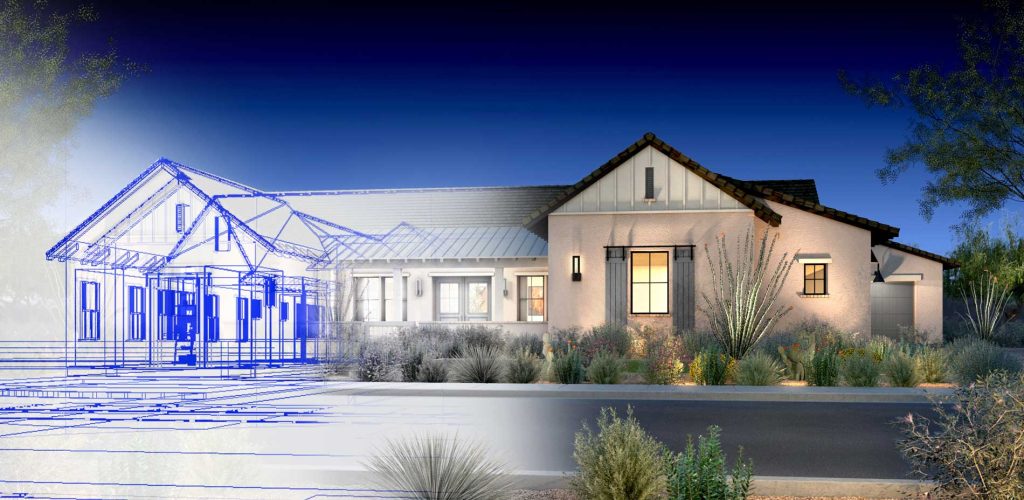
Image of a house blueprint transitioning to 3D exterior rendering

This is exactly why we built the Outhouse CAD department with this roller coaster in mind. Many homebuilders already rely on us for renderings and interactive tools, so it only makes sense to put our 30+ years of CAD expertise to work and help with drafting services. Here’s how outsourcing your drafting to us can benefit you:

• Uniformity for the Field Crew: Our approach ensures that your plans maintain a consistent look and feel across the board, no matter who the designer is.
• Compatibility is Key: Our 2D plans integrate seamlessly with other Outhouse services or external consultants—no hassle, just smooth collaboration.
• You Own the CAD Files: Whether you build one home or a hundred from a single set of plans, the CAD files are yours to keep.
• Accelerated Delivery of Marketing Assets: We can produce your interactive floor plans, site maps, virtual tours, visualizers, renderings, and brochures simultaneously, allowing you to hit the market faster and more cost-effectively.

Embrace the future (or more precisely, the present) with 3D photorealistic renderings, 360-degree virtual tours, and interactive floor plans.

If your website still sports black-and-white stick drawings and static floor plans and site maps, it’s well past time to think outside the box. Embrace the future (or more precisely, the present) with 3D photorealistic renderings, 360-degree virtual tours, and interactive floor plans. Interactive tools are far more engaging than static images—they allow homebuyers to digitally add structural options, rearrange furniture, and even take virtual walks through rooms with integrated VR hotspots. These experiences help families emotionally connect to your homes, turning casual browsers into serious buyers. Plus, interactive features are proven to increase the time visitors spend on your site, which often leads to more sales. In today’s tech-savvy market, these tools aren’t just a nice-to-have—they’re essential. Younger homebuyers, especially, love the gamified, interactive experiences.

Outhouse.net excels at providing all the digital and print marketing assets that today’s homebuyers expect when shopping for new homes, including 3D renderings, virtual tours, visualizers, interactive floor plans, and interactive site maps for your website. And we don’t stop there—we also offer interactive kiosks, print materials, large format signage, and display options for sales offices.

Looking for more ways to expand your horizons? The International Builders Show in Las Vegas, happening February 25-27, is a fantastic place to explore the latest in construction technology and trends. If you’re attending, make sure to stop by and say hello to Outhouse principals and our OSC partner Blue Gypsy Inc. in Sales Central, West Hall W311. We’ll be sponsoring coffee and snacks throughout each day, and we’d love to meet you. All are welcome—even if you have a floor pass only!

A La Carte or Package Deal? Lessons Home Builders Can Borrow from Automakers

Tabitha Warren · 01/05/2025 ·

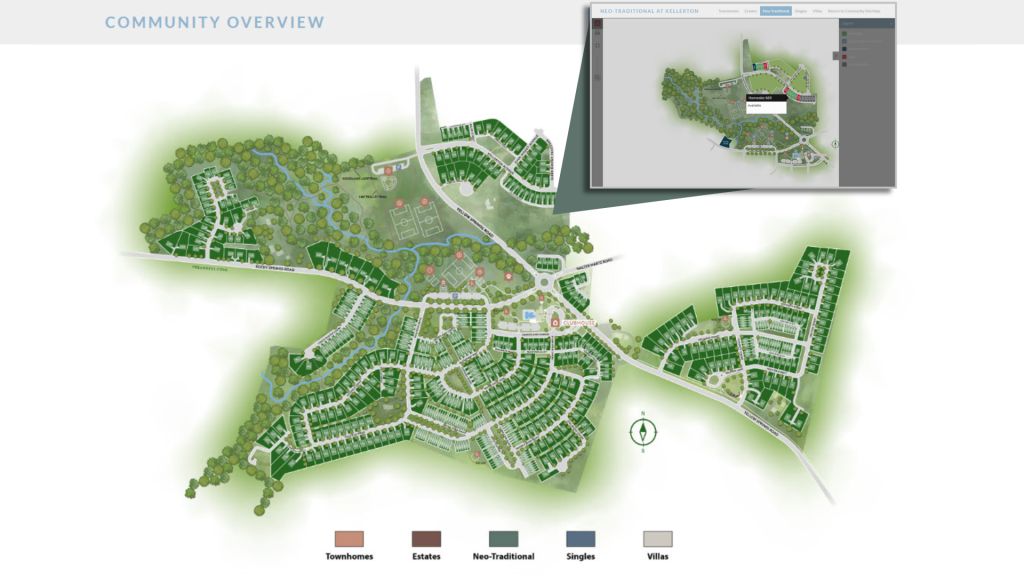
interactive site map zooming in on home site.

When it comes to marketing and visualization tools, home builders often face a familiar question: Should I buy individual products a la carte or go with a bundled package?

At first glance, buying just what you need seems efficient. Maybe you only need renderings right now or just a few virtual tours for your latest community. But over time, a piecemeal approach can lead to higher costs, inconsistent results, and more time spent managing vendors than building homes.

The auto industry figured this out long ago.

Built to Standard, Not to Chaos

When you buy a new car, you don’t choose every nut, bolt, and feature separately. A team thoughtfully designed the trim package you selected to meet your needs, whether it’s an affordable commuter or a luxury performance vehicle.

That’s not just convenience. It’s a strategy. The buyer inherits the cost savings delivered by standardized packages, simplified production, and streamlined quality control.

Home builders can benefit from that same mindset.

When Outhouse tools are created together, design, scale, and branding stay perfectly aligned.

Efficiency Through Bundling

Bundling services, like interactive floor plans, renderings, virtual tours, and interactive site maps, can lower costs in the long run. Procurement in quantity allows teams like Outhouse to offer competitive pricing while ensuring consistent design, branding, and technical accuracy across every asset.

For example:

  • Renderings & Interactive Floor Plans: When the same team creates both, they align perfectly in scale and style, saving time on revisions.
  • Interactive Floor Plans (IFPs) & Virtual Tours: These tools share data and visual assets, which means your buyers see the same details online that they’ll experience in person.
  • Sitemaps & Interactive Floor Plans: When designers create these tools at the same time, your buyers experience a seamless journey, from understanding where a home sits on the site to exploring how they would live inside, reinforcing brand consistency and improving usability.

And just like in the auto industry, bundling creates a smoother, more predictable workflow. You spend less time managing separate vendors and more time focusing on what you do best: building dream homes for your buyers.

Simplifying the Buyer’s Journey

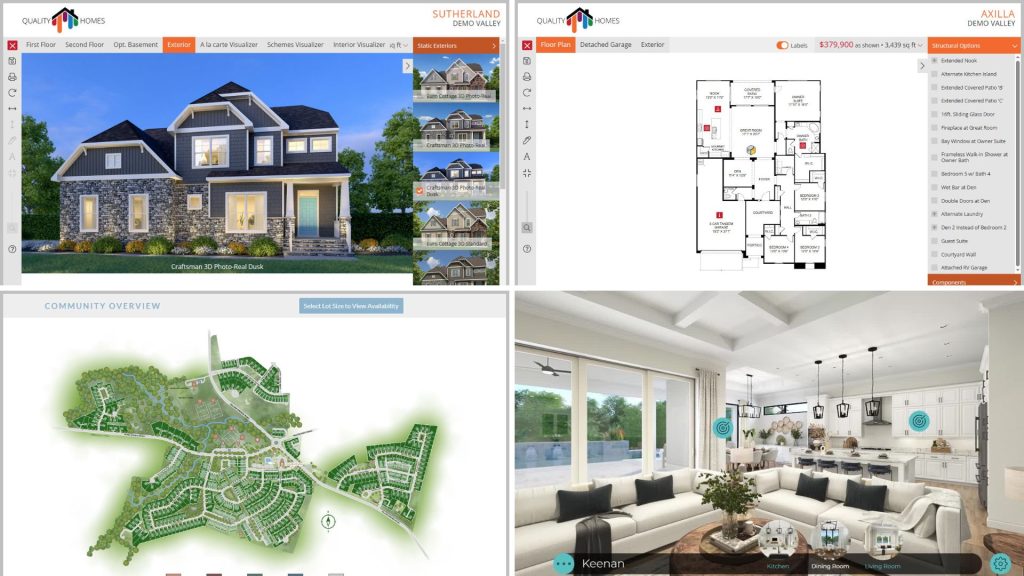
A well-structured package also makes things easier for your customers. When your digital tools, renderings: interactive floor plans (IFPs), interactive site maps, work together seamlessly, buyers can visualize their new home faster and with more confidence.

That consistency builds trust and reduces confusion, helping potential buyers move from browsing to building more quickly.

3D rendering, interactive floor plan, interactive site map

How Outhouse Can Help

At Outhouse, we understand that every builder’s needs are different, but efficiency doesn’t have to mean compromise. Whether you’re ready for a full-service visualization package or want to start small and grow, we’ll help you find the right fit.

We offer bundled solutions that bring consistency, quality, and savings together under one roof, just like the auto industry’s most trusted brands. From renderings to virtual tours to interactive tools, our products work together beautifully.

When you keep your marketing materials built to the same standard, you’ll see better results: faster, smoother, and more affordable.

Want to learn more about choosing the right level of service?

Check out our blog: Good, Better, Best: Finding the Right Fit for Your Builder Marketing Needs.

Contact Outhouse, LLC to find out how we can help with all your home-building website needs

Contact Us

Design Inspiration: The High Line, NYC

Jim Sorgatz · 08/08/2024 · Leave a Comment

Bring Your Home Designs to Fruition at Outhouse

Sculpture by NYC artist Danny Cole.

Have you ever stumbled upon a place so unexpected and exhilarating that it floods your mind with creative ideas and inspiration? That’s exactly what I experienced on a recent trip to New York City while exploring the High Line, an elevated linear park built on a former rail line. This isn’t just any public park; the High Line is a unique blend of art, architecture, and urban design. Stretching 1.45 miles through Manhattan’s West Side it offers stunning views of the city’s skyline and showcases some of its most innovative buildings.

Iconic Architectural Landmarks

From the elevated perch, high above the crowds, the view of iconic buildings, like the Empire State Building, is astonishing. Here are a few of the wonderful buildings you see along the way:

  • The Eleventh (BIG): Designed by the Bjarke Ingels Group, this striking complex features two twisting towers at 76 Eleventh Avenue. Known for its bold geometry and expansive glass walls, The Eleventh offers panoramic views and a modern twist on traditional skyscraper aesthetics​.
The Eleventh – designed by the Bjarke Ingels Group.
  • 520 West 28th Street (Zaha Hadid Architects): A hallmark of contemporary design, this building is noted for its curving metallic façade and futuristic appeal. It is one of the last projects by the legendary architect Zaha Hadid, making it a significant landmark on the High Line​.
Condo designed by Zaha Hadid.
  • Chelsea Market: Originally a factory for the National Biscuit Company, this historic building now serves as a vibrant market with various food vendors and shops. The High Line runs through the building, showcasing its blend of old and new architectural elements​.
The High Line making it’s way through Chelsea Market.
  • 10 Hudson Yards (Coach Building): This skyscraper marks the northern terminus of the High Line and is a central part of the Hudson Yards development, a massive urban revitalization project often compared to Rockefeller Center in scale and impact​.
10 Hudson Yards building in the distance.

Unique Experiences and Sights

Walking along the High Line offers more than just architectural wonders. The park itself is a showcase of landscape design, featuring over 500 species of plants. Areas like the Gansevoort Woodland and the Washington Grasslands offer serene green spaces amidst the urban hustle​

Gansevoort Woodland

The High Line also functions as an outdoor art gallery. With installations like Paola Pivi’s “You know who I am” and Nina Beier’s “Women & Children,” the park provides a continuous rotation of thought-provoking art that enhances the visitor experience​.

Mural by renowned Brazilian street artist Eduardo Kobra.

Although some people don’t love these, beauty is in the eye of the beholder and I found “The Vessel,” and a whimsical sculpture by artist Danny Cole to be quite entertaining as well.

The Vessel – centerpiece of Hudson Yards. This interactive sculpture was imagined by British designer Thomas Heatherwick.

What’s The Connection Here to Home Building?

Wherever you find inspiration for new homes, whether it be the High Line in Manhattan, an out-of-this-world experience elsewhere, or a simple walk in the neighborhood park, Outhouse, the outsource hub for home builders, can help bring your wildest ideas to fruition. Give us a sketch on a napkin, and our architectural team will produce a full set of construction documents.

While plans are in progress, our rendering team will meticulously craft your 3D exterior and interior elevations, virtual tours, and visualizers. Our interactive team works their magic to build digital tools like interactive floor plans and interactive site maps that will engage your homebuyers. We can also coordinate digital assets with your web designer including industry experts Blue Tangerine, Bokka Group, Group Two, Meredith Communications, and Adlanta Creative,

All of this can be accomplished simultaneously in a compressed timeline bringing your homes to market faster, and increasing your ROI. 

The juxtaposition of old and new is striking. The iconic Empire State Building in the background.

Conclusion

The High Line is a testament to New York City’s ability to innovate and adapt, transforming an old rail line into a vibrant public space that seamlessly blends nature, art, and architecture. Whether you’re an architecture enthusiast or just looking for a unique urban experience, the High Line offers a fascinating journey through some of the city’s most captivating sights.

If you visit the High Line, or anywhere else that inspires some fresh design ideas, draw a quick sketch, and send it over to Outhouse.  We will take it from there to bring your idea to life!

Strategies for Staying on Top of Home Builder Software Integration: With Insights from Kevin Weitzel

Jim Sorgatz · 07/22/2024 · Leave a Comment

Outhouse Partner Shares Game-Changing Approaches for Streamlining Operations and Enhancing Customer Experience

In the rapidly evolving world of home building, integrating cutting-edge software solutions has become crucial for success. Kevin Weitzel, a partner at Outhouse, brings his expertise to the forefront, highlighting three key areas where technology integration can significantly impact a home builder’s operations and customer experience. From streamlining lead management to revolutionizing visual asset presentation, Weitzel’s insights offer valuable strategies for home builders looking to stay competitive in today’s market. This blog post explores three critical areas of software integration that can transform how home builders operate and interact with potential buyers.

The CRM Conundrum: Automating Lead Capture

If you have more than a couple leads coming in each day, importing them directly to your Customer Relationship Manager (CRM) is essential… why would anybody want to clerk the consumer given information into their CRM, again, from whatever platform is generating your leads.

–Kevin Weitzel, Outhouse Partner

This is an important point that highlights a critical aspect of efficient lead management and customer relationship management in the home building industry. Here’s why it’s so significant:

Efficiency and Data Integrity: Automatically transferring leads directly into a CRM eliminates the need for manual data entry. This saves time and reduces the risk of human error in transcribing information.

2. Speed of Response: Immediate lead import allows sales teams to respond quickly to potential customers. In the competitive home building market, rapid response times can be crucial in securing a sale.

3. Resource Allocation: By eliminating the need to “clerk” or manually enter consumer information, staff can focus on more valuable tasks like follow-ups and relationship building.

4. Customer Experience: Consumers expect a seamless experience. Having to provide information multiple times can be frustrating and may negatively impact their perception of the builder.

5. Data Consistency: Automated lead imports ensure that all leads are handled consistently, regardless of their source or the time they come in.

6. Scalability: As a home builder’s business grows, manually entering leads becomes increasingly time-consuming and impractical. Automation is essential for scaling operations efficiently.

7. Analytics and Reporting: Direct lead imports allow for more accurate tracking of lead sources and conversion rates, which is crucial for optimizing marketing strategies.

8. Integration Benefits: When leads automatically flow into the CRM, it’s easier to integrate with other systems like marketing automation tools, further streamlining the sales process.

9. Competitive Advantage: Builders who can quickly and accurately process leads are better positioned to outperform competitors who rely on manual processes.

In essence, the statement underscores the importance of streamlining the lead capture process in the home building industry. It emphasizes that in today’s fast-paced, technology-driven market, manual data entry is an unnecessary and potentially detrimental step that can be easily eliminated with proper system integration.

The ERP Challenge: Overcoming Obstacles to Real-Time Pricing

Integrating your Enterprise Resource Planning (ERP) system with your interactive floor plans to achieve real-time pricing is a great idea.  Often easier said than done, the lynch pin in this process is almost always the ERP.  The desire from the home builder is there, but far too often, the ERP itself is intentionally lacking in the ability to feed the data, via an Application Programming Interface (API), into other platforms.  Once implemented, the biggest issue is the ERP provider breaking the feed connections; sometimes regularly.”

Kevin Weitzel, Outhouse Partner

The importance of ERP data for real-time pricing in home building cannot be overstated, and the challenges Kevin highlights are significant. Here’s why his point is crucial:

1. Accurate and Dynamic Pricing: Real-time ERP data enables home builders to adjust pricing instantly based on current costs, market conditions, and inventory levels. This ensures competitive and profitable pricing strategies. [6]

2. Customer Satisfaction: Up-to-date pricing information allows sales teams to provide accurate quotes to potential buyers, improving customer trust and satisfaction. [7]

3. Efficient Resource Management: Real-time data helps with better resource allocation and inventory management, reducing waste and improving profitability. [6]

4. Informed Decision Making: Access to current data allows management to make quick, informed decisions about pricing, promotions, and product offerings. [8]

5. Competitive Advantage: Builders who can offer real-time pricing are better positioned to respond to market changes and competitor actions swiftly. [9]

These issues underscore the need for home builders to carefully evaluate ERP solutions, prioritizing those that offer robust API capabilities and reliable data integration. It also highlights the importance of ongoing dialogue with ERP providers to address these challenges and push for more open, flexible systems that truly support the needs of modern home builders.

Revolutionizing Visual Assets: The Power of Integration

“An easy integration for any homebuilder website is to put all visual home assets on one web page. Why have various assets for a particular home/plan on separate pages?  It is quite easy to integrate all of the home’s assets onto a single page.  As an example, images and/or virtual tours can be linked as hotspots on both Interactive AND static floor plans.  When not linked, a menu of a gallery accessible on a floor plan is easy and garners engagement.”

Kevin Weitzel, Outhouse Partner

Interactive floor plans, renderings, visualizers, and virtual tours for a single home should all be on one page of a homebuilder website for several key reasons:

1. Improved user experience: Combining these elements on a single page allows potential buyers to easily access and navigate between different visualization tools without leaving the page. This creates a seamless, intuitive experience that keeps users engaged. [10][4]

2. Enhanced information retention: By offering multiple visual representations in one place, homebuyers are more likely to retain information about the home. This multi-faceted approach caters to different learning styles and preferences. [10][12]

3. Increased engagement and time on site: Interactive elements like floor plans and virtual tours are known to keep visitors on a website longer. Grouping these features on one page encourages extended exploration, increasing the chances of conversion. [12][13]

4. Streamlined communication: Having all visual tools in one location simplifies the process of sharing information with potential buyers. It reduces the need for multiple meetings or explanations, saving time for both builders and customers.[13]

5. Competitive advantage: Offering a comprehensive, interactive experience on a single page demonstrates a homebuilder’s commitment to innovation and customer service. This can set them apart from competitors and appeal to tech-savvy buyers. [13]

6. Personalization opportunities: Integrated interactive elements allow for easier customization. Buyers can explore different options and visualize changes more effectively when all tools are accessible in one place. [12][13]

By consolidating these features on a single page, homebuilders can create a more effective, engaging, and user-friendly online experience that better serves potential buyers and increases the likelihood of conversions.

Conclusion: Embracing Integration for Future Success

Kevin’s insights underscore the importance of embracing integrated software solutions in the home building industry. By addressing challenges in CRM lead capture, ERP data integration, and visual asset presentation, home builders can significantly enhance their operations and customer experience, positioning themselves for success in an increasingly competitive market.

Citations:

[1] https://subcusa.com/5-reasons-why-construction-companies-need-a-crm-today/

[2] https://blog.velocity23.com/blog/making-home-builder-crm-plan-nhbj

[3] https://www.builderdesigns.com/resources/blog/maximizing-roi-why-a-reliable-crm-system-reigns-supreme-for-homebuilders

[4] https://www.motionops.com/blog/importance-of-crm

[5] https://info.builderfunnel.com/what-is-the-best-crm-for-home-builders

[6] https://www.priority-software.com/blog/how-does-an-erp-real-time-data-support-business-growth/

[7] https://www.silkcommerce.com/epicor/maximizing-the-use-of-erp-data-for-real-time-pricing-for-quotes/

[8] https://www.linkedin.com/pulse/improve-your-reporting-real-time-erp-data-sagesoftware

[9] https://www.vialaurea.com/en/blog/blog-posts-3/the-power-of-real-time-data-in-erp-systems-21

[10] https://truplace.com/real-estate/3-reasons-floor-plans-are-great-virtual-tours/

[11] https://rextheme.com/real-estate-floor-plans/

[12] https://graphiclanguage.net/blog/benefits-of-interactive-floorplans/

[13] https://www.ecisolutions.com/blog/residential-construction/revolutionizing-home-buying-the-power-of-interactive-floor-plans/

Know Your Homebuyer Audience

Jim Sorgatz · 05/31/2024 · Leave a Comment

Are you surprised by the new home construction trends in your own city?

Two homes, one much bigger than the other.
Guess which house is the newbie?!

Having been in the industry for nearly 30 years, it is not often that I am surprised by trends in new home construction. The goal is to sell to anyone who financially qualifies. And, in these times of elevated interest rates and home prices the buzz is all about affordability, which typically translates to smaller homes. So, I am shocked to see the newest homes being built in my “affordable” neighborhood are 50%+ larger and significantly more expensive than my home that was built in the fall of 2022. The families shopping for homes right now are, apparently, looking for space, and have the means to afford a bigger house. And I guess that makes sense. Although there genuine efforts by cities and builders to create affordable housing, with a median price of $430,000 nationally per realtor.com, there really aren’t many homes that are affordable right now for first-time homebuyers. This hammers home the importance of knowing your core audience, building for them, and marketing to them appropriately.

There are many builders who do this well and adapt to the changing environment. One example is Arizona based Meritage Homes whose mission today is, “To design and build homes that are innovative, built with care and superior craftsmanship, which deliver enduring value.” Contrast that with their mission a couple years back, “To build move-in-ready affordable homes for entry-level and first move-up buyers,” and you can see the evolution to better reflect the current new home market.

How can you be sure you are targeting the right audience? Begin with a review of your overall marketing strategy. Do your website, sales offices, and print marketing appeal to the potential buyers you are attempting to attract? Although first-time and luxury home buyers are both seeking out their dream homes, the marketing for these two distinct groups looks very different. This is where consultation with marketing experts like Denim Marketing, Blue Tangerine, Adlanta Creative, and Bokka Group to name a few, can be highly beneficial.      

Next, review your digital marketing tools, and upgrade them if necessary. If you are still using static floorplans and stick renderings, think again. Interactive floor plans, renderings, virtual tours, animations, and visualizers all play an integral role in engaging homebuyers and selling homes.

Interactive Floor Plans (IFPs) have universal appeal, and every builder website should feature them. Buyers of all demographics love to select structural options and customize their living spaces with the interactive furniture planner. 

Interactive floor plan with furniture.
Outhouse’s new colorized Interactive Floor Plan

Quality renderings are essential for all builders as well. Black and white stick drawings are never a good option, even for the simplest of homes. Standard 3D (Outhouse Bronze and Silver) renderings are perfectly acceptable for homes at lower price points. For move-up and luxury homes, you will want to implement 3D photoreal renderings (Outhouse Gold). Luxury and custom builders may want to opt for Platinum renderings that can be further enhanced and customized.

Should your budget for digital marketing tools be a bit larger, investing in animations and virtual tours pays off in two significant ways. First, they enable homebuyers to digitally explore your homes from anywhere. Second, both are available at a fraction of the cost of constructing a model home. Your target buyer should be the top consideration when choosing which format to offer. Younger buyers prefer user-controlled virtual tours. Buyers over 50 typically gravitate towards video format animations.

Visualizer showing a before and after kitchen
Visualizer’s allow home buyers to customize interiors and exteriors

Another online tool appealing to home buyers at all price points is the Visualizer. With both interior and exterior versions available, buyers can mix and match colors and finishes to achieve the desired look and feel. The visualization process is so much easier than making selections for an entire house based on one-inch paint chips and tiny floor, counter, and cabinet samples. It also removes some of the pressure and stress from the design center visit.

Here are a couple more ideas to help you connect with your appropriate audience:

Elevate your brand with distinguished print marketing. Consider the hotel industry when investing in print—the swankier the property, the more excellent the print collateral. The manager of the high-end hotel presents you with a “folio” at checkout, not simply hands or emails you a bill. Although print appeals greatly to buyers in the luxury home market, even younger homebuyers like to walk away from the sales center with a brochure featuring their preferred floor plan and elevations at a minimum. In today’s digital world, people still appreciate a tangible marketing piece when making one of their biggest life purchases. Why not present them with something sophisticated or fun, and memorable?         

Printed brochure showing families participating in various activities
A great print piece makes a lasting impression!

Today, the most progressive builders are transforming their websites with artificial intelligence (AI) to better understand and target their audience. Like that provided by openhouse.ai, AI offers home buyers a personalized shopping experience and predicts where your unique market is going with more accuracy.

So take some time during this evolving housing market to understand your homebuyer and determine if your current marketing strategy is meeting their needs. If not, consider working with online marketing experts to determine which digital and on-site tools will move the needle most with your target audience to increase your new home sales.   

Optimizing the Design-Market-Sell Continuum: Tips for Home Builders – Part 2

Jim Sorgatz · 03/16/2024 · Leave a Comment

In the dynamic world of homebuilding, a term that often echoes through the corridors of innovation is “value engineering.” Investopedia defines it as a strategic method aimed at delivering essential project functions at the minimum possible cost. This approach champions swapping out materials and methods for more cost-effective alternatives while maintaining the integrity of functionality—and, we’d argue, quality, too.

At Outhouse, this principle is at the heart of our Design-Market-Sell methodology. Our suite of services—from drafting to visual aids and digital innovations to print solutions—caters to builders across the spectrum. Yet production home builders crafting anywhere from 30 to 3,000 homes annually, stand to gain the most from our holistic approach. By integrating our seasoned Computer-Aided Design (CAD) expertise, builders can forego the hefty expense of maintaining an in-house drafting team. As our CAD wizards work their magic, our graphics and rendering teams get cracking on interactive floor plans, site maps, virtual tours, and much more, paving the way for a seamless transition to print media and sales office displays. This cohesive strategy not only accelerates your market entry but does so with significant cost efficiency. And therein lies the secret to mastering the Design-Market-Sell continuum.

In the first chapter of this series, we unpacked the foundational tools every builder needs to design, market, and sell new homes. Now, let’s dive into the digital realm that captivates homebuyers and enriches their purchasing journey.

Crafting Emotional Connections: The Power of Interactive Floor Plans and Site Maps

Outhouse has been at the forefront of Interactive Floor Plans (IFPs) and Interactive Site Maps (ISMs) for over two decades, boasting a portfolio that’s as robust as it is innovative. Optimized for mobile use, these tools work like a dream on any device, aligning perfectly with the preferences of over 70% of today’s homebuyers.

Headshot of Outhouse VP of National Accounts Erin Kearney against a wood plank backdrop with the words, "Helpful Tips - Visualizers"
Erin Kearney, VP of National Accounts

Erin Kearney, our VP of National Accounts, emphasizes the importance of understanding buyer needs and adopting a personalized sales narrative. The ability to swiftly capture and analyze consumer preferences sets a builder apart in a market brimming with competition. IFPs and ISMs are more than mere marketing gimmicks; they are bridges to potential buyers’ hearts and minds, allowing them to visualize and tailor their future homes. This emotional engagement is akin to the bond formed during a car’s test drive, transforming a potential purchase of “your house” into “my home.”

Moreover, ISMs offer a comprehensive view of available lots, linking directly to elevations, IFPs, virtual tours, and more, thus streamlining the journey from lot selection to home customization.

Marrying market insights with interactive tools is critical to truly excel in sales. These technologies elevate customer interaction and deepen the emotional bond with their future homes, positioning builders as pioneers in their field.

Sketch of Marilyn Monroe against a wood plank backdrop with the words, "Helpful Tips - Interactive"

Maximizing Engagement with IFPs and ISMs

Success with IFPs and ISMs hinges on precise construction documents and strategic website placement. Marcy Smith, our incredibly talented but media-averse Graphic Department Production Manager, shares invaluable tips for optimizing these tools:

  • Ensure clarity and accuracy in your CAD files before engaging with a digital tools provider. Autodesk offers a free ‘DWG TrueView’ for this purpose.
  • Incorporate a PDF version of your CAD files for ease of reference.
  • For IFP projects, detailed CAD files minimize back-and-forth, saving time and resources.
  • Clearly delineate desired lots for ISMs, especially in master-planned communities, to avoid unnecessary costs.
  • The placement of these tools on the website is crucial; they should be prominently displayed for easy access by potential buyers, enhancing engagement and site retention.
Headshot of Outhouse partner Stuart Platt against a wood plank backdrop with the words, "Helpful Tips - Visualizers"
Outhouse partner Stuart Platt

Virtual Reality: The Frontier of Digital Engagement

Virtual Reality (VR) stands as the latest marvel in digital homebuilding tools, offering virtual tours, animations, and visualizers that transport the model home experience to buyers worldwide. Stuart Platt, an Outhouse partner, advises:

  • For interior VR projects, consider selecting from Outhouse’s extensive library of interior designs to save on costs, unless custom designs are necessary.
  • Utilize color and material visualizers to give buyers a comprehensive view of their customization options, though it’s wise to limit exterior color schemes to maintain community aesthetics.

As a quick VR refresher: Virtual Tours are user-controlled tours – buyers click from room to room. Animations are essentially a video tour. And, Visualizers are customization tools that allow buyers to select options, colors, and finishes whether it be interior cabinets and countertops, or exterior roofing, stone, and siding.

In Summary

The key to optimizing the design-market-sell continuum is to work with a sole provider like Outhouse – the outsource hub for home builders. Whether launching a new community or seeking innovative cost-saving strategies, Outhouse is here to guide you through optimizing your design, market, and sell process. Reach out today to explore how we can transform your homebuilding journey.

What a Move to Small Town America Taught Me About the Marketing Potential of Small Volume Builders

Jim Sorgatz · 01/27/2024 · Leave a Comment

a caboose in snow hosing the Railway Cafe
Railway Cafe. One of the first places you see when you enter downtown Blaine.

When my spouse and I decided to leave the hustle and bustle of Phoenix, Arizona and head to the Pacific Northwest, we were pretty clueless about where exactly we wanted to settle down. It was a couple of our long-time friends who suggested we check out Bellingham, WA, a city of around 100,000 people that I knew absolutely nothing about. This city, tucked away in the northwestern corner of Washington State, is primarily known for its vibrant brewery scene and its closeness to Vancouver, BC. I found the idea intriguing, especially since our friends had also moved here from a big city and were loving every moment of it. My main concern was whether I’d miss the conveniences I’d gotten used to during my 45 years in a bustling metropolis.

Soon enough, I realized that Bellingham has a surprising cosmopolitan flair for a city of its size. This is partly due to its proximity to Canada and the presence of Western Washington University, both of which add a certain liveliness to the place. Bellingham has quite a lot going for it, including a multiplex movie theater, Costco, Target, Trader Joe’s, Whole Foods, Home Depot, Lowe’s, Macy’s, Dick’s Sporting Goods, a decent dining scene, and an impressive farmers market. This makes it feel much bigger than many cities of similar size. The only thing missing from Phoenix is Sprouts! The stunning ocean views and the abundance of nature sealed the deal. Or so I thought!

two small dogs, one tan and one white in front of a Canadian obelisk sign
My pups walking across the US/Canadian border in Peace Arch State Park.

As fate would have it, we ultimately fell head over heels for Blaine, a cozy town of just 6,000 people located a mere 18 miles further north, right on the Canadian border; and that is where we settled. Was it a culture shock? Absolutely, but when you’re used to driving in Phoenix, a 20-minute commute to the “big city” is a walk in the park. We chose this area because of its breathtaking surroundings and a home in a neighborhood that stole our hearts. Blaine is nestled around Drayton Harbor and is adjacent to Birch Bay, both of which are absolutely unique. Every time I make the drive between the two, I can’t help but appreciate how fortunate we are to live in this picturesque seaside community.

a loaf of chive dill pickle sourdough bread
Anna’s Sourdough Bread which comes in some interesting flavors!

Despite not having all the amenities of a big city, Blaine has its own charm that makes it an amazing place to live. We’ve got L & L Bakery with some of the most scrumptious cakes and macaroons you’ll ever taste, Anna’s Bread that comes in the most unusual flavors (Dill Pickle or Taco Tuesday anyone?), and The Vault Wine Bar with a wine list that rivals most big-city fine-dining establishments. There’s even a trendy speakeasy that recently opened in the lower level of the 1890 Taphouse. The Semiahmoo Resort is located on a picturesque spit reaching out into the bay. And then there’s the Railway Cafe, housed inside a caboose, which is one of the cutest and most meticulously designed spots I’ve ever seen. Adding to Blaine’s uniqueness is Peace Arch State Park, the only park in the country where you can stroll freely between two countries, Canada and the USA. And remember, we’re just a short 20-minute drive away from all those big-city conveniences in Bellingham, and 30 minutes to Vancouver B.C.

a walkway of paves in front of boats in a harbor
Blaine Harbor.

Now, you might be wondering, what does all of this have to do with home building? Well, the lesson here is that you can be a small builder and still pack a punch. For starters, smaller builders often have more control over the quality of their homes. The biggest challenge I see for both small and some larger builders is in the online sales and marketing department. It mainly boils down to a lack of staff and the misconception that having a comprehensive digital marketing strategy is prohibitively expensive. This is where it really pays to seek help from the experts.

Did you know that for as little as $2,700, plus subscription fees, you can have a top-notch digital marketing firm like Blue Tangerine design and manage a professional, high-performing website for you? It’s a website that seamlessly integrates Search Engine Optimization (SEO) tools and comes with ongoing support. Since your website is frequently the first point of contact for potential buyers, investing in one that’s done right and generates leads is crucial. As Greg Bray, President of Blue Tangerine, puts it, “A website visitor’s first goal is to eliminate you! A cluttered website with too much information and a lack of focus can easily turn them away.” Never underestimate the power of your website when it comes to selling new homes.

bar with a rack of bottles wall in front of a wall of windows
Packers Bar at the Semiahmoo Resort.

While you’re upgrading your website, don’t forget to incorporate digital marketing tools like interactive floor plans, site maps, 3D photorealistic renderings, virtual tours, and visualizers. These are engagement tools that bigger builders already have on their websites. The good news is that these assets don’t have to break the bank. Interactive floor plans from Outhouse, LLC, the most robust in the industry, start at just $285 per plan. Virtual tours of pre-built homes kick off at $2,800. Compare that to the cost of constructing a physical model, and virtual tours and visualizers become a no-brainer.

In today’s digital age, with homebuyers doing most of their research online, another tool that larger builders use is AI chatbots, such as those provided by AtasRTX, or human-powered live chat services from providers like CommVersion. You don’t necessarily need to hire additional sales personnel to answer homebuyer questions around the clock. As more and more buyers turn to the internet to purchase homes, having an exceptional Online Sales Counselor (OSC) is crucial. To ensure success, you might want to consider training from a consultant like Blue Gypsy, Inc., or outsourcing the role of OSC entirely to a provider like Shared Drive.

old stone bridge over a stream
Whatcom Falls Bridge in Bellingham.

The bottom line is this: being a smaller builder with a limited budget doesn’t mean you have to settle for an inferior online marketing program. If you prioritize digital marketing and invest a bit upfront, you’ll likely recoup the costs with the sale of just one or two homes. With the rapid advancements in artificial intelligence, it’s essential to bring your website and online marketing tools into the digital age if you want to thrive in the world of new home sales.

horse pulling carriage down street in a small town
Carriage rides at Blain’s downtown holiday celebration.

The Importance of a Digital Marketing Ecosystem: A Lesson from Tesla

Jim Sorgatz · 09/18/2023 · Leave a Comment

 Blue Electric Vehicle charging at Tesla Station.
Tesla Image Adobe Stock

When you think of leaders in the electrical vehicle movement, I believe even the Elon haters would have to give props to Tesla. They have moved into a position of power that is rare. One of the chief reasons for this is their self-contained ecosystem. From batteries to auto parts to charging stations and software, Tesla is in control. There is little that is outsourced. 

This streamlined approach makes them significantly more profitable than other auto manufacturers. They also have one of the most powerful computer systems in the world, enabling drivers to control everything from a sleek touchscreen. Tesla also gathers data from their vehicles. Paired with AI, the data from every mile driven gives them the lead in autonomous driving. No one knows when robo taxis will make their grand entrance, but the probability of it happening in my lifetime is exciting!

Tesla Touchscreen Controls
Tesla Touchscreen Controls Adobe Stock

The Ecosystem

What does all this have to do with homebuilder sales and marketing, you ask? It all comes down to the ecosystem. While some builders use individual vendors for renderings, interactive floor plans, print materials, etc., savvy builders understand the benefits of working with a full-service provider like Outhouse. In addition to digital marketing assets like interactive floor plans (IFPs), interactive site plans (ISPs), renderings, virtual tours, visualizers, animations, and digital kiosks, we also have an in-house print and signage shop and a full-service computer-aided design (CAD) department. Clients who use all our services benefit from significant time and cost savings. When you make changes in CAD, those edits carry across our entire ecosystem.  

Our “Touchscreen” – the Interactive Control Center

Like Tesla, Outhouse now has a slick “touchscreen,” our new Interactive Control Center. With the launch of this intuitive administrative back end for our interactive platform, we are setting the stage for a new future in interactive control. A few of the features include:

  • A new look with upgraded graphics for ease of use and improved navigation
  • A clean template with easy-to-see project permissions
  • Choice between light and dark themes, similar to our IFPs
  • The ability to personalize by setting your home page – perhaps a specific community or your interactive floor plan list
  • No more pagination. The plan list is fluid. While not a huge issue for builders with only a few IFPs, builders with dozens will appreciate this time-saver
  • Seamless movement between IFPs and ISPs in the same community. No more toggling between lists of IFPs and ISPs
  • Simplified self-serve reports and the ability to export data in Excel, CSV, JSON, and XML
  • A search box and filters to make it easy to find what you are looking for.

Also coming soon to the Control Center are a dashboard, and everyone’s favorite – widgets. Everything is designed to simplify the management of your interactive tools and data collection from potential clients. 

Tesla’s Super Chargers in a line Adobe Stock

Integration

Integration makes life easier. Ask the owners of EVs manufactured by companies other than Tesla. There’s a reason the most prominent auto manufacturers are signing contracts to access Tesla’s Supercharger network. Constructed in secret, Tesla unveiled their first six Supercharger stations in 2012. From there, they have continued building a Supercharger network nationwide. They understood the need for a strong network of Superchargers for EVs to compete with gas-fueled vehicles. Tesla also fixes and improves their cars simply by issuing a software update. Their ecosystem is fully integrated, from construction to batteries to software to charging stations.

In recent years, Outhouse has enhanced our interactive products to achieve full integration with each other. Starting with our interactive site plan, your home buyers can click on a lot to reveal renderings of the available homes. Click on a rendering, and it opens an interactive floor plan. While engaging with the IFP, home buyers can also view virtual tours and select colors and finishes with interior and exterior visualizers. All of our interactive tools can be neatly packaged into an interactive kiosk for potential homebuyers to peruse while at your sales center.

Outhouse Interactive Site Plan

Before you start your next community, consider how your company might benefit from implementing a complete interactive ecosystem rather than just a few pieces and parts. Today’s home buyers are shopping online; your website should make it easy for them to decide your homes and communities are the right fit for their families. As the EV market grows, you may also want to consider where to place a Supercharger!

Print Marketing Sells New Homes

Jim Sorgatz · 03/08/2023 · Leave a Comment

Brochure of a K. Hovnanian Homes house

People often ask us why a print company specializing in print for home builders is necessary. Heck, today, builders sometimes ask us if print marketing is still a valuable sales tool! The answer to both questions is a resounding “Yes!” We explain why in this post.

The Role of Print in New Home Sales

In a recent episode of the Digital Velocity Podcast, co-hosts Erik Martinez of Blue Tangerine and Tim Curtis of CohereOne talk with Alex Kupski and Jake Hoffman, co-hosts of the Millennials in Print Podcast, about the Power of Print in the Digital Age. They conclude, “The more channels you’re present on and the more channels you’re marketing to people on, ultimately, the more effective you’re going to be. Print, just like social, just like email, just like your website, just like a commercial on TV, is a channel for you to market on. It’s another arrow in the quiver. It’s another way to reach people you might not have before.”

Print marketing works best when paired with digital marketing. Digital marketing is often the most effective way to draw people in. With interactive site plans, interactive floor plans, renderings, virtual tours, visualizers, and Matterport tours, your website is arguably a home builder’s most potent marketing tool. But it is only effective for a home buyer’s few precious moments on your website. Print collateral, on the other hand, has a much longer life span. Brochures and floorplan/elevation minis often sit on a potential buyer’s countertop or table for weeks or months, a lasting reminder of your homes and communities. Not every prospect immediately purchases a home, so print is a great way to keep them focused on yours. 

David Weekley Homes brochure with cactus front cover, and homes on the back

Data shows that print used in tandem with digital marketing is one of the most effective sales strategies as the two mediums strengthen and reinforce each other. A study by InfoTrends found that 66% of direct mail is opened, and 56% of consumers who respond to direct mail go online or visit a physical store. A recent article in SFGate offers some great tips to sync your print and digital marketing efforts:

  • Place QR codes on print materials.
  • Provide digital opt-ins for direct mail.
  • Include social media reviews and comments on print materials.
  • Include hashtags and calls to action on print materials.

Although digital and print marketing take different forms, They work together to engage customers and keep your brand at the top of their minds.

Why Use a Builder-Specific Printing Company?

The challenge builders face that is unique to our industry is the weekly sales cycle. From week to week, home prices may change, lot availability changes, and options may vary. The typical strip-mall printer is not equipped to automate this process. Outhouse built their business to serve a single industry – HOME BUILDING. We do all work in-house, from CAD for your construction documents to print materials for your sales centers. This allows all teams, including architectural, rendering, graphics, interactive, and print, to work in tandem. By doing so, we create accurate, up-to-date print materials that are consistent and coordinated with your digital marketing assets. Utilizing the latest technologies, we print and deliver materials on time every week, on the builder’s schedule. Challenge solved – you send us your edits, and we coordinate these changes across all platforms.  

Professional Artwork Creation: Outhouse provides clients with the considerable advantage of having drafting and rendering services on-site, allowing coordination with the development of their artwork for all printed materials. This coordination offers clients superior accuracy, faster turnaround times, and lower overall costs.

Coordinated File Management:  Another advantage is the ease of managing and coordinating all created artwork with professional digital file and asset management. All artwork is kept up-to-date, consistent, and coordinated between city design reviews, printed sales materials, large format displays, and interactive web products and services.  

Superior Print Quality:  Superior brand standard quality and consistency every time on every product is only possible with the coordination, color calibration, and production of all graphics, printing, and display under one roof. Unlike a mass-market printer like Vista Print, Outhouse is not a WYSIWYG (What You See Is What You Get) printer. We believe that good enough is never good enough, and we have the magnifying glasses to prove it! On rare occasions when colors are incorrect or print quality is not up to snuff the first time off the press, we recalibrate and rerun the job.

Builder-Specific Delivery:  Unlike many industries, home building has a weekly sales cycle, and having your print delivered on time is critical. Outhouse understands this. We meet your deadlines your way on your weekly sales cycle.

Woodside Homes brochure with three homes

The bottom line is print marketing still plays an integral role in new home marketing and sales. There’s a reason the Outhouse Interactive Floor Plan has a save button. It allows prospective homebuyers to save their customized floor plans and print them out for further review. 

What about younger generations? Retail Focus Magazine tells us that print is 30% more memorable than digital. This applies to all age groups. You need look no further than nightclubs which hand out leaflets advertising upcoming events, and university welcome packs to know that print still appeals to young people. The magazine also notes the best campaigns are when print and digital work alongside each other instead of trying to compete. A younger audience may be digitally savvy, but they still appreciate a well-thought-out hard copy campaign.  

Although any printer can give you a halfway decent brochure, only a company like Outhouse coordinates your CAD, rendering, and interactive projects with your print materials and sales office displays. Even if our print pricing is a bit higher, you will save significantly more overall through efficiencies in coordination.     

Woodside Homes floor plan
When you update a plan, Outhouse coordinates the changes across CAD, print, and all digital marketing assets.
  • Page 1
  • Page 2
  • Go to Next Page »

Ready to get started, want more info?

Contact Us
  • Facebook
  • Instagram
  • LinkedIn
  • YouTube

Outhouse

11048 N 23rd Ave #103
Phoenix, AZ 85029

602-371-4394

© 2026 All rights reserved