• Skip to primary navigation
  • Skip to main content
Outhouse logo

Outhouse

The Outsource Hub for Home Builders

  • Home
  • Products & Services
    • Architectural/CAD
    • Rendering
    • Virtual Reality
    • Interactive Floor Plans
    • Interactive Site Maps
    • Interactive Kiosks
    • Print Marketing
    • Sales Office Displays
  • Partners
  • News
    • Events
    • Blog
    • Podcast
  • About Us
  • Contact Us
  • Show Search
Hide Search

home builder

The Scalability Shift: Why High-Tech Sales Centers are No Longer Only for Luxury Communities

Tabitha Warren · 05/11/2026 ·

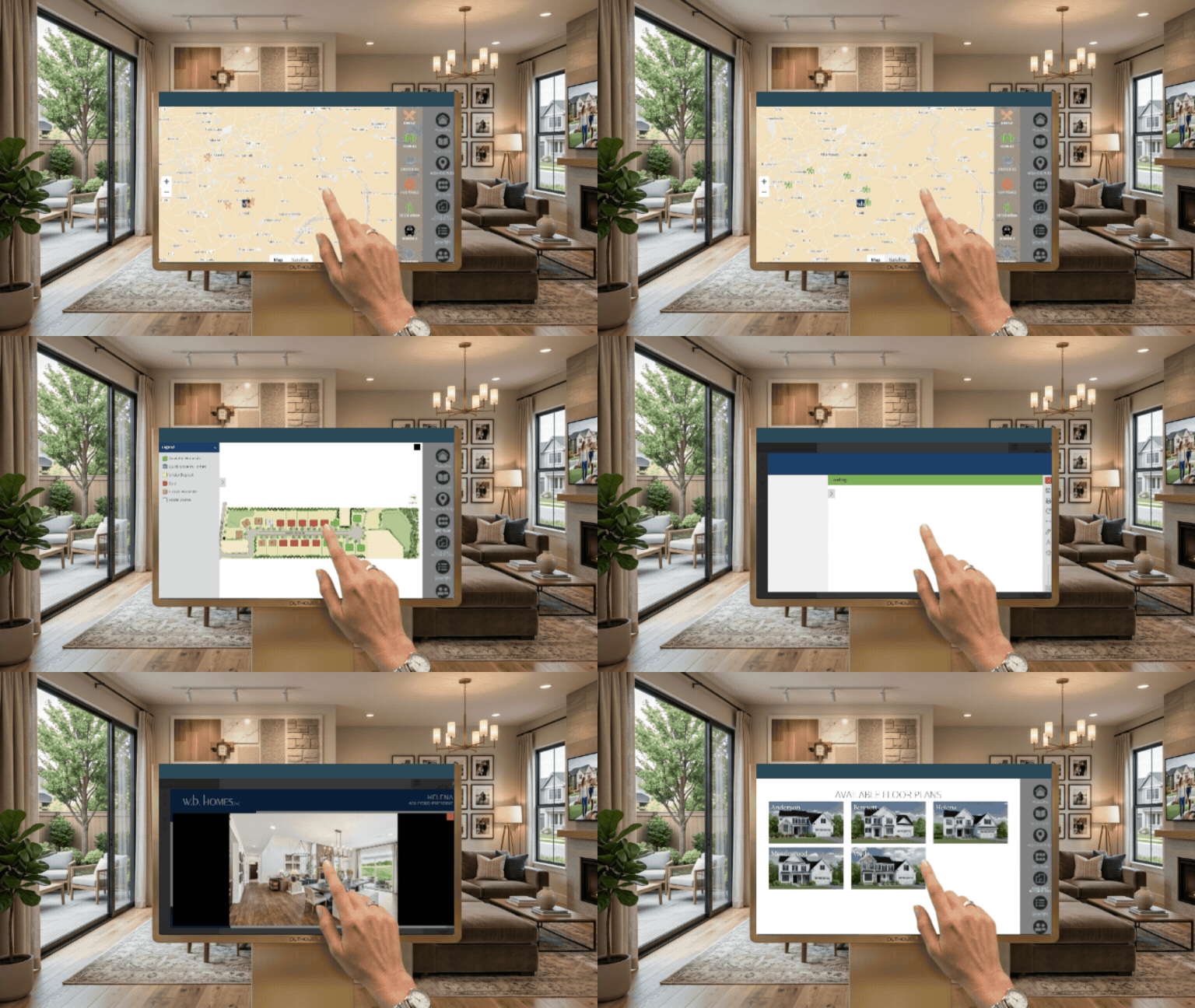
Man flipping through kiosk in front room.

The Democratization of Sales Technology

Historically, interactive kiosks were the crown jewel of a builder’s flagship community. Due to high production costs and complex setups, these high-spec tools were often reserved for luxury developments, while smaller or mid-market communities were left with paper brochures and static foam-core boards.

However, as we move through 2026, the industry is witnessing a significant shift. Smarter Production has democratized technology, making it possible to provide a premium digital experience across every community in a builder’s portfolio, regardless of the price point.

Why Scalability Matters Now

1. Consistency is King

The modern homebuyer does not lower their digital expectations based on the price of the home. Whether they are looking at an entry-level townhome or a custom estate, they expect the same immersive, self-guided experience. Providing a consistent digital interface across all communities strengthens your brand’s reputation for innovation and transparency.

2. The “Silent Salesman”

In smaller communities where a sales office might be lightly staffed, an interactive kiosk acts as a 24/7 virtual assistant. It allows buyers to explore floor plans, community maps, and site availability autonomously, ensuring no lead is lost even when your team is busy with other clients.

3. Future-Proofing the Budget

While static displays seem cheaper upfront, they are “one-and-done” investments. Every time a phase sells out or pricing changes, those boards become obsolete. Digital kiosks allow for instant updates across your entire fleet, offering radical savings over the lifecycle of the project.

A Reimagined Process

At Outhouse, we’ve completely reimagined how our Interactive Sales Kiosks are built. By streamlining production without sacrificing the high-spec quality your brand deserves, we’ve made high-end tech more accessible for every 2026 budget.

Ready to upgrade your fleet?

Let’s Build Something Together

Great Home Builder Social Media Accounts and Posts

Tabitha Warren · 06/16/2025 ·

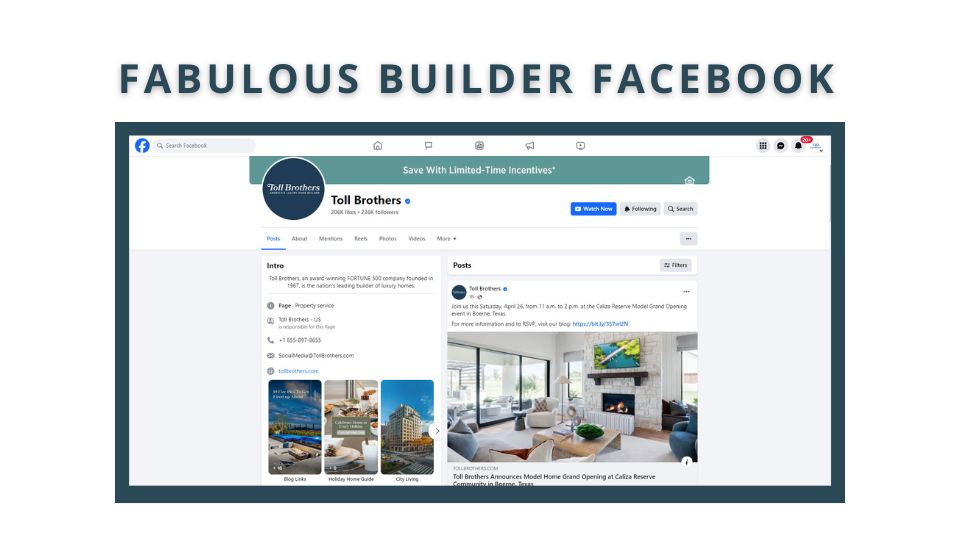
Image of Toll Brothers Facebook page

In reply to a recent blog, a reader wrote into us and asked us for a few examples of great home builder social media. First, we were flattered to be asked this question, and we are happy to give our opinion. If you’d like expert advice, you might want to check out this post by Carol Morgan and this podcast featuring Carol Morgan. I think many of us are always trying to keep current. We read the blogs of several amazing Home Builder Marketers, such as Denim Marketing, Bokka Group, and Meredith Communications, to stay current ourselves. What we’ve learned at Outhouse is that there are quite a few things that make home builder social media great and inspiring at different levels.

The bottom line is a strong social media presence is a crucial tool for brand building, lead generation, and fostering connections with potential homeowners. After years of scouting social media, there are some home builders and related personalities who are truly knocking it out of the park with their engaging and high-performing accounts.

Whether you’re a home builder looking for inspiration or a prospective homeowner wanting to see what’s out there, these examples showcase the power of a well-crafted social media strategy in the home building industry.

Home Building Companies with a Powerful Platform Presence

Larger home building companies are also leveraging social media to showcase their homes, communities, and connect with potential buyers. Here are a few examples of companies that consistently demonstrate a strong platform presence:

  • Abrazo Homes (@abrazohomes): Known for their dynamic social media presence across various platforms like Facebook, Abrazo Homes consistently shares engaging content that resonates with their audience. Their commitment to storytelling is clearly a key to their success. In fact, you can hear directly from their “Chief Story Teller,” Shane Austin, in this insightful episode of the Home Builder Digital Marketing Podcast.**
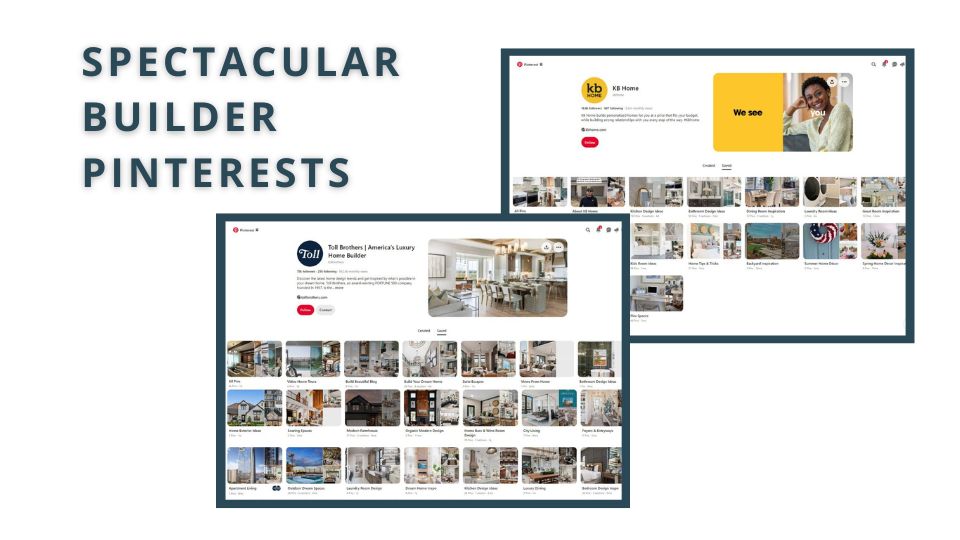
  • Toll Brothers (@tollbrothers): Known for their luxurious homes, Toll Brothers excels on Instagram with stunning, high-quality visuals of their properties and sophisticated design elements. Their Pinterest presence is also noteworthy, offering a wealth of aspirational home inspiration. You can find their well-organized Facebook page here.
  • Lennar (@lennar): As one of the nation’s largest home builders, Lennar maintains a significant following across platforms like Facebook, Instagram, and Pinterest. They effectively use these channels to showcase their diverse range of home models, highlight community features, and share updates with their audience.
  • David Weekley Homes (@davidweekleyhomes): Historically recognized for their strong Instagram presence, David Weekley Homes consistently shares beautiful, high-quality photographs of their thoughtfully designed homes. Their visual content often emphasizes architectural details and inviting living spaces.
  • Meritage Homes (@meritagehomes): Meritage Homes stands out for its engaging and varied content on Facebook. They effectively blend community updates, customer stories, and behind-the-scenes glimpses into their building processes, creating a well-rounded online presence.
  • KB Home (@kbhome): KB Home frequently utilizes Facebook to share important updates, company news, and valuable customer success stories. They also provide helpful home buying tips and resources, positioning themselves as a knowledgeable partner in the homeownership journey.

Individual Builders and Influencers Setting the Standard

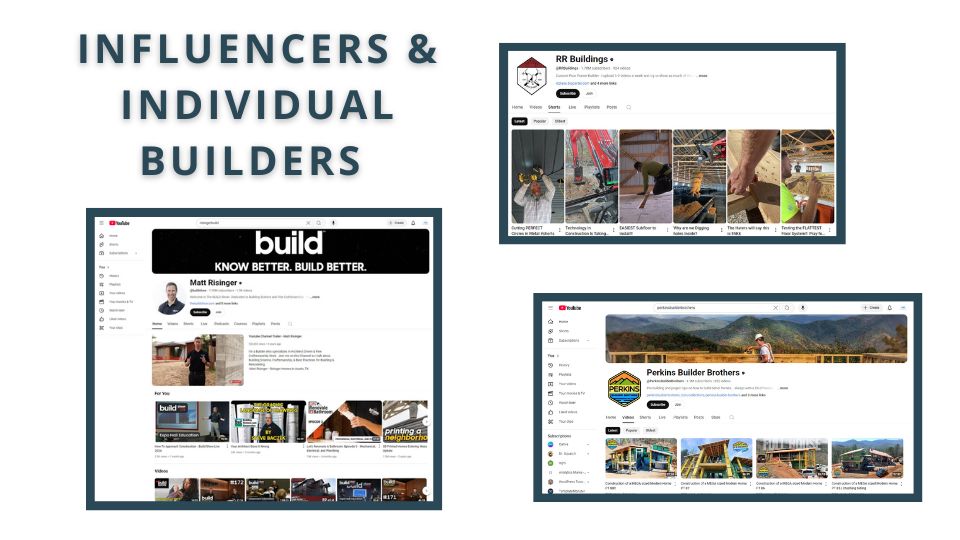
Image of Matt Risinger's, RR Buildings', and Perkings Builder Brother's YouTube accounts

Sometimes, the most compelling stories come directly from the individuals shaping the industry. These builders and influencers have cultivated strong followings by sharing their expertise, passion, and behind-the-scenes glimpses into the world of construction and renovation:

  • Matt Risinger (@risingerbuild): If you’re interested in the science behind high-performance building, look no further than Matt Risinger. His Instagram account and incredibly popular YouTube channel, “The Build Show,” are treasure troves of information on building science principles, meticulous craftsmanship, and the latest construction technologies. Expect in-depth explanations, on-site demonstrations, and a focus on quality and durability.
  • Kyle Stympenhorst / RR Buildings (@rrb_buildings): Specializing in post-frame construction, Kyle’s presence across YouTube, Instagram, and Facebook offers a deep dive into this specific building method. His content is often practical, providing valuable tips and insights for those interested in or involved in post-frame projects.
  • Perkins Builder Brothers (@perkinsbuilderbrothers): Get a genuine behind-the-scenes look at home building and renovation projects with the Perkins Builder Brothers. Their engaging “Builder Brothers” series on YouTube, Instagram, and Facebook provides a relatable and often entertaining perspective on the challenges and triumphs of construction.

What Makes Their Social Media Shine?

These high-performing accounts share several key characteristics that contribute to their success:

  • Stunning Visuals: They understand the importance of high-quality photography and videography to showcase the beauty and craftsmanship of their homes.
  • Consistent Engagement: Regular posting keeps their audience interested and coming back for more.
  • Diverse Content: They go beyond just showcasing homes, offering project updates, behind-the-scenes peeks, client testimonials, and informative tips.
  • Active Interaction: They actively respond to comments, answer questions, and foster a sense of community among their followers.
  • Platform Optimization: They tailor their content to suit the strengths of each platform. These builders use visuals on Instagram and Pinterest, community on Facebook, and in-depth videos on YouTube.
  • Strategic Use of Hashtags: They utilize relevant keywords to increase the discoverability of their content.
  • Compelling Storytelling: They connect with potential buyers on an emotional level by sharing the journey of building a home and highlighting the benefits of homeownership.

Staying Ahead of the Curve

The world of social media is constantly changing and evolving. To find the most current top performers, it’s always a good idea to explore these platforms yourself and see which accounts are generating the most engagement on their recent posts. Keep an eye on those with high levels of likes, comments, and shares. These metrics are often indicators of a strong and active audience.

By studying these successful examples, home builders can gain valuable insights into creating their own compelling social media strategies and connecting with their target audience in meaningful ways.

**Shane Austin has since moved on from a brilliant career at Abrazo Homes, but his thoughts and wisdom still ring very true.

Got questions about home builder digital assets? Call us today for a chat!

Contact Us

Strategies for Staying on Top of Home Builder Software Integration: With Insights from Kevin Weitzel

Jim Sorgatz · 07/22/2024 · Leave a Comment

Outhouse Partner Shares Game-Changing Approaches for Streamlining Operations and Enhancing Customer Experience

In the rapidly evolving world of home building, integrating cutting-edge software solutions has become crucial for success. Kevin Weitzel, a partner at Outhouse, brings his expertise to the forefront, highlighting three key areas where technology integration can significantly impact a home builder’s operations and customer experience. From streamlining lead management to revolutionizing visual asset presentation, Weitzel’s insights offer valuable strategies for home builders looking to stay competitive in today’s market. This blog post explores three critical areas of software integration that can transform how home builders operate and interact with potential buyers.

The CRM Conundrum: Automating Lead Capture

If you have more than a couple leads coming in each day, importing them directly to your Customer Relationship Manager (CRM) is essential… why would anybody want to clerk the consumer given information into their CRM, again, from whatever platform is generating your leads.

–Kevin Weitzel, Outhouse Partner

This is an important point that highlights a critical aspect of efficient lead management and customer relationship management in the home building industry. Here’s why it’s so significant:

Efficiency and Data Integrity: Automatically transferring leads directly into a CRM eliminates the need for manual data entry. This saves time and reduces the risk of human error in transcribing information.

2. Speed of Response: Immediate lead import allows sales teams to respond quickly to potential customers. In the competitive home building market, rapid response times can be crucial in securing a sale.

3. Resource Allocation: By eliminating the need to “clerk” or manually enter consumer information, staff can focus on more valuable tasks like follow-ups and relationship building.

4. Customer Experience: Consumers expect a seamless experience. Having to provide information multiple times can be frustrating and may negatively impact their perception of the builder.

5. Data Consistency: Automated lead imports ensure that all leads are handled consistently, regardless of their source or the time they come in.

6. Scalability: As a home builder’s business grows, manually entering leads becomes increasingly time-consuming and impractical. Automation is essential for scaling operations efficiently.

7. Analytics and Reporting: Direct lead imports allow for more accurate tracking of lead sources and conversion rates, which is crucial for optimizing marketing strategies.

8. Integration Benefits: When leads automatically flow into the CRM, it’s easier to integrate with other systems like marketing automation tools, further streamlining the sales process.

9. Competitive Advantage: Builders who can quickly and accurately process leads are better positioned to outperform competitors who rely on manual processes.

In essence, the statement underscores the importance of streamlining the lead capture process in the home building industry. It emphasizes that in today’s fast-paced, technology-driven market, manual data entry is an unnecessary and potentially detrimental step that can be easily eliminated with proper system integration.

The ERP Challenge: Overcoming Obstacles to Real-Time Pricing

Integrating your Enterprise Resource Planning (ERP) system with your interactive floor plans to achieve real-time pricing is a great idea.  Often easier said than done, the lynch pin in this process is almost always the ERP.  The desire from the home builder is there, but far too often, the ERP itself is intentionally lacking in the ability to feed the data, via an Application Programming Interface (API), into other platforms.  Once implemented, the biggest issue is the ERP provider breaking the feed connections; sometimes regularly.”

Kevin Weitzel, Outhouse Partner

The importance of ERP data for real-time pricing in home building cannot be overstated, and the challenges Kevin highlights are significant. Here’s why his point is crucial:

1. Accurate and Dynamic Pricing: Real-time ERP data enables home builders to adjust pricing instantly based on current costs, market conditions, and inventory levels. This ensures competitive and profitable pricing strategies. [6]

2. Customer Satisfaction: Up-to-date pricing information allows sales teams to provide accurate quotes to potential buyers, improving customer trust and satisfaction. [7]

3. Efficient Resource Management: Real-time data helps with better resource allocation and inventory management, reducing waste and improving profitability. [6]

4. Informed Decision Making: Access to current data allows management to make quick, informed decisions about pricing, promotions, and product offerings. [8]

5. Competitive Advantage: Builders who can offer real-time pricing are better positioned to respond to market changes and competitor actions swiftly. [9]

These issues underscore the need for home builders to carefully evaluate ERP solutions, prioritizing those that offer robust API capabilities and reliable data integration. It also highlights the importance of ongoing dialogue with ERP providers to address these challenges and push for more open, flexible systems that truly support the needs of modern home builders.

Revolutionizing Visual Assets: The Power of Integration

“An easy integration for any homebuilder website is to put all visual home assets on one web page. Why have various assets for a particular home/plan on separate pages?  It is quite easy to integrate all of the home’s assets onto a single page.  As an example, images and/or virtual tours can be linked as hotspots on both Interactive AND static floor plans.  When not linked, a menu of a gallery accessible on a floor plan is easy and garners engagement.”

Kevin Weitzel, Outhouse Partner

Interactive floor plans, renderings, visualizers, and virtual tours for a single home should all be on one page of a homebuilder website for several key reasons:

1. Improved user experience: Combining these elements on a single page allows potential buyers to easily access and navigate between different visualization tools without leaving the page. This creates a seamless, intuitive experience that keeps users engaged. [10][4]

2. Enhanced information retention: By offering multiple visual representations in one place, homebuyers are more likely to retain information about the home. This multi-faceted approach caters to different learning styles and preferences. [10][12]

3. Increased engagement and time on site: Interactive elements like floor plans and virtual tours are known to keep visitors on a website longer. Grouping these features on one page encourages extended exploration, increasing the chances of conversion. [12][13]

4. Streamlined communication: Having all visual tools in one location simplifies the process of sharing information with potential buyers. It reduces the need for multiple meetings or explanations, saving time for both builders and customers.[13]

5. Competitive advantage: Offering a comprehensive, interactive experience on a single page demonstrates a homebuilder’s commitment to innovation and customer service. This can set them apart from competitors and appeal to tech-savvy buyers. [13]

6. Personalization opportunities: Integrated interactive elements allow for easier customization. Buyers can explore different options and visualize changes more effectively when all tools are accessible in one place. [12][13]

By consolidating these features on a single page, homebuilders can create a more effective, engaging, and user-friendly online experience that better serves potential buyers and increases the likelihood of conversions.

Conclusion: Embracing Integration for Future Success

Kevin’s insights underscore the importance of embracing integrated software solutions in the home building industry. By addressing challenges in CRM lead capture, ERP data integration, and visual asset presentation, home builders can significantly enhance their operations and customer experience, positioning themselves for success in an increasingly competitive market.

Citations:

[1] https://subcusa.com/5-reasons-why-construction-companies-need-a-crm-today/

[2] https://blog.velocity23.com/blog/making-home-builder-crm-plan-nhbj

[3] https://www.builderdesigns.com/resources/blog/maximizing-roi-why-a-reliable-crm-system-reigns-supreme-for-homebuilders

[4] https://www.motionops.com/blog/importance-of-crm

[5] https://info.builderfunnel.com/what-is-the-best-crm-for-home-builders

[6] https://www.priority-software.com/blog/how-does-an-erp-real-time-data-support-business-growth/

[7] https://www.silkcommerce.com/epicor/maximizing-the-use-of-erp-data-for-real-time-pricing-for-quotes/

[8] https://www.linkedin.com/pulse/improve-your-reporting-real-time-erp-data-sagesoftware

[9] https://www.vialaurea.com/en/blog/blog-posts-3/the-power-of-real-time-data-in-erp-systems-21

[10] https://truplace.com/real-estate/3-reasons-floor-plans-are-great-virtual-tours/

[11] https://rextheme.com/real-estate-floor-plans/

[12] https://graphiclanguage.net/blog/benefits-of-interactive-floorplans/

[13] https://www.ecisolutions.com/blog/residential-construction/revolutionizing-home-buying-the-power-of-interactive-floor-plans/

Optimizing the Design-Market-Sell Continuum – Tips for Home Builders – Part 1

Jim Sorgatz · 02/25/2024 · Leave a Comment

As the 2024 NAHB International Builders Show gears up to roll out the red carpet this week, it’s the perfect backdrop for a little fireside chat on elevating your home building game. With the industry’s brightest minds converging in one spot, buzzing with the latest trends and innovations, we at Outhouse are seizing the moment to sprinkle some of our own seasoned advice into the mix. Let’s dive into the art of perfecting the design-market-sell trifecta, shall we? 

With so much information, this post is being broken into two parts. In Part 1 we cover CAD, Rendering, and Print Marketing – the essentials every builder must have. These are what we would call the more physical items, the ones used for design review, neighborhood presentations, in your design centers, and for the construction of your homes. In Part 2 we will discuss website tools. Although renderings fall into both categories, our second post focuses on digital tools that are more interactive. 

Part 1: The Essentials – CAD, Rendering, and Print Marketing 

In the realm of home building, there are a few non-negotiables: CAD, rendering, and print marketing. These are the bread and butter, the tools that transform a blueprint dream into a sticks-and-bricks reality.

VP of Operations Darin Keezer with CAD tips
Darin Keezer, VP of Operations

CAD (COMPUTER AIDED DESIGN) 

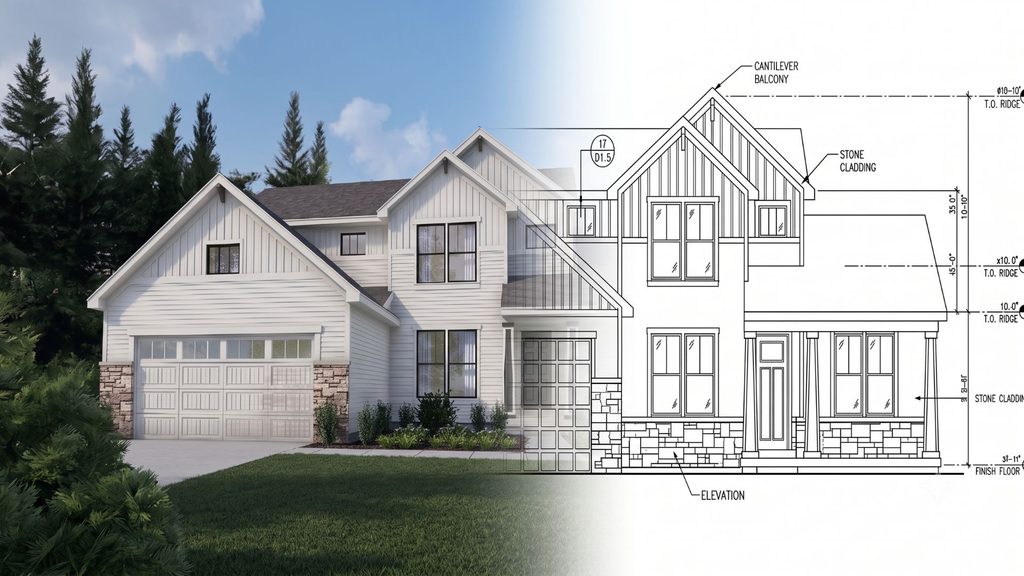
Imagine having a magic wand that ensures your construction documents are flawless, a foundation as solid as the homes you build. That’s what good construction documents do for you. Here at Outhouse, under the guidance of our VP of Operations, Darin Keezer and his cadre of seasoned pros with over 30 years of experience working exclusively with production home builders, we offer CAD services that are a cut above. Here’s why: 

  • Uniformity for the Field Crew: Our approach ensures that regardless of the designer, the plans maintain a consistent look and feel, making life easier (and error-free) for those on the ground. 
  • You’re the Boss: The files? They’re yours. Whenever you want them, wherever you need them sent, consider it done. 
  • No Nickel-and-Diming: We’re all about transparency. No per-lot-use or other hidden fees, just straightforward billing for the time spent on your plans. 
  • Compatibility is Key: Our 2D plans play well with others, making them a breeze to integrate with additional Outhouse services or other consultants. 

While the CAD magic happens, why not simultaneously kickstart your marketing with some stunning renderings, virtual tours, visualizers, interactive floor plans, interactive site plans, and print collateral? It’s all about multitasking. 

Outhouse partner Stuart Platt

RENDERINGS – A WEBSITE STAPLE

A well-crafted rendering can speak volumes, turning the intangible into something almost touchable. In today’s market, where digital home tours are gaining ground, the allure of a beautifully rendered image remains undiminished. While virtual tours and visualizers are becoming more mainstream, renderings are still the essential source of product visualization. Colored renderings should be a staple for every home builder website. Black/white stick drawings are a huge turnoff. For as little as $195, Outhouse can create a very nice 2D rendering. For a bit more, most builders opt for 3D photorealistic renderings, as they provide a far superior picture of a home. With realistic landscaping and the ability to include special lighting like dusk shots, the renderings are often more appealing than a photo of a newly constructed home, which is frequently on a dirt lot with a couple of “twigs” for trees. Today’s home buyers expect the essential marketing tools, and renderings fall into this category.  Here’s how we make your projects pop: 

  • From Meh to Marvelous: Ditch the bland for the grand with colored renderings that capture the imagination of your buyers. 
  • The Devil’s in the Details: Outhouse partner, Stuart Platt, swears by the golden rule: the more accurate your CAD, the more stunning the rendering. It’s that simple. 
Outhouse Partner Bill Gelbaugh with print media tips
Outhouse partner Bill Gelbaugh

PRINT MARKETING – YOUR PROJECT IN THE SPOTLIGHT 

In an era where digital is king, print marketing retains its crown for creating tangible connections. With an onsite print department dedicated to print media for production home builders, here at Outhouse, LLC, we understand the importance of every stage of production home building printing and the vital steps to making your project a success. This includes on-time delivery to your sales centers. Bill Gelbaugh, our print guru, knows the ins and outs of making your projects shine on paper. Here’s his blueprint for success: 

  • Plan with Precision: Like laying a foundation, choosing the right quantity, size, and type of print material sets the stage for everything that follows. 
  • Choose Wisely: Not all printers are created equal. Opt for one that knows the ins and outs of the home building industry. 
  • Attention to Detail: A single typo can throw a wrench in the works. Proofread like your project depends on it (because it does). 
  • Clear as Day: When it comes to special requests or concerns, communication is key. The right printer will make your vision a reality. 

That is our humble advice to ensure your print media materials turn out just as you envisioned and on budget. Remember, at Outhouse, LLC, we have more than 25 years of experience in specialized homebuilder printing. 

MEET US AT IBS! 

And there you have it, folks. A sneak peek into the alchemy of blending design, marketing, and sales into a seamless continuum. But wait, there’s more! Swing by IBS this week for a cup of joe on us at Sales Central in the West Hall, Room 311. Outhouse and our friends at Blue Gypsy Inc. can’t wait to meet you. 

Stay tuned for Part 2, where we’ll dive into the digital deep end with website tools that make your projects not just seen, but experienced. Until then, happy building! 

Unlocking Success in the Competitive Home Sales Market: How Interactive Tools and Incentives Make New Builds a Smart Choice

Tabitha Warren · 10/09/2023 · Leave a Comment

Architect checking house floor plan for new build on tablet device
Architect checking new build floor plan on tablet courtesy of Envato Elements

For the past few years, potential homeowners have been facing a challenging scenario – soaring mortgage rates that threaten to make their dream of owning a home harder and harder to reach. The low supply of existing inventory due to families not moving from their low-interest-rate homes is making the situation even worse. The financial waves of the housing market have left many potential buyers contemplating their options.  Is it still feasible to dive into the deep waters of mortgage loans when the rates are riding too high? Or should they seek the calmer shores and consider a different route altogether?

In this blog, we’ll explore why the alternative path that more and more prospective homeowners are setting their sights on, purchasing a new build home, might be a better option. We’ll also talk about some of the most alluring incentives that home builders can leverage to take advantage of this market. Finally, we’ll talk about the need for home builders to have an effective website with engaging digital tools to set themselves apart from their competitors.

New builds come with some advantages to existing properties. Among these advantages might be the ability to customize the home, energy efficiency, warranty coverage for the initial year of ownership, and lower immediate maintenance costs. Builders that can market these advantages as cost saving advantages might just win prospective buyers from the resale market.  What home buyer doesn’t want to save on every aspect possible of homeownership?

So, what home builder incentives are the most attractive to new home buyers? As mortgage loan interest rates soar, there are two stand out incentives.  First, closing cost assistance can reduce the financial burden of a new home buyer at the time of closing.  This makes homeownership much more attainable to buyers at these heightened rates. The second is interest rate buydowns! Some builders are offering to buy down the buyers’ mortgage rate to get the prospective buyer to a more manageable monthly mortgage payment. From this writer’s logic, this frees the buyer to only need finances for one of the two things themselves. They either need enough money for a down payment or an interest rate buy down if they want a nice low payment for the term of their dream home.

Housing market affordability is so strained that this Fortune 500 homebuilder is offering a fixed 4.25% mortgage rate in some communities

Check out this article from Forbes!

Builders have a myriad of other incentives aside from these two.  They can offer base price discounts on specific homes. This usually happens with the first few homes in a new development.  They can offer free or discounted upgrades, customizations, or appliance packages.  They can also offer to pay HOA fees for the first year. These are just a few of the incentives available that can make new construction more financially attractive than purchasing an existing home.

Never Underestimate the Value of a Good First Impression.”

You’re with me this far. You’re a builder. You offer some of these incentives, but you want to know how to set yourself apart from other builders when marketing to potential homebuyers. Interactive tools may be key in the real estate market.  These tools offer a more engaging and informative experience to potential buyers, making it easier for them to visualize themselves in a potential new home. It can also make sure they clearly understand what the properties have to offer. 

Don’t believe us?  Here’s some statistical proof provided by the Content Marketing Institute:

  • 88% of marketers say interactive content differentiates them from competitors giving them a significant advantage in a crowded market.
  • 93% of marketers agree that interactive content is effective in educating buyers as compared to 70% for static content.
  • Interactive content attracts 2x the engagement of similar static content.

Those numbers are hard to refute, and they are just some highlights. If you want more information, head over to the Content Marketing Institute’s website to read more of their studies.

Some of the best interactive tools come in a few different categories: visualization, personalization, and lead generation, to name a few. When it comes to visualization, the most useful tools for new home buyers tend to be interactive floor plans, virtual tours, and real-time online booking and scheduling. Interactive floor plans (IFPS) allow buyers to customize layouts and explore different design options. Buyers can visualize a space and personalize it to their needs.  This can be a powerful selling point for new construction homes where there are often many customization options.

Interactive Floor Plans Top New Buyers’ Useful Tools Lists

Virtual tours or 3D tours allow a homeowner to experience a home, whether it is real or 3D rendered, from the comfort of their own home.  Builders can showcase the home in detail. This is incredibly important in times when physical access may be limited or just plain inconvenient.

Further, websites can integrate features that allow buyers to schedule appointments, book showings, or attend virtual open houses. This is a convenience for both the buyer and the home builder!

Once the potential buyer is interested in a builder, the best interactive tools need to be personalized; this can be achieved with real-time updates on available homes, pricing, and promotions. After all, everything else on the builder’s site hooked this potential home buyer; the builder will want to keep them interested! A great addition after purchase might be online sales tools. Many websites allow buyers to complete the purchase process online, including signing contracts and making payments.

Finally, lead generation might be the final piece of the interactive tool puzzle. Home builders can use website analytics to gain insights into user behavior. A data-driven approach can help them refine their marketing strategies and help them understand what features are most appealing to buyers. They might use this information to improve their sales tactics. Moreover, valuable data about user engagement and preferences can be provided to builders from their interactive tools. When potential buyers engage with these tools, builders can collect information and follow up with targeted marketing and sales efforts specific to individual buyers.  

Modern websites can capture leads and integrate with customer relationship management (CRM) systems. Sales teams can use this information to effectively nurture leads and follow-up. The best way to turn a potential buyer into a homeowner is with timely and personalized information. Search Engine Optimization (SEO) and social media integration might be the bow on the package. A well-optimized website can rank higher in search and make it easier for potential buyers to find and explore a builder’s properties.  SEO strategies can drive organic traffic to the builder’s site.  With the addition of well-thought-out social media integrations, builders can leverage social networks for marketing and referrals.

To sum it up, modern website assets empower homebuilders to provide a superior online experience, engage potential buyers effectively, and leverage data to optimize their sales strategies.  By staying up-to-date with the latest web technologies and user experience trends, homebuilders can gain a competitive edge in this competitive home sales market. There is definitely room for new home sales to outpace resale with the proper online strategies!

If all of this sounds a little mind blowing to you, a great place to learn about all of these digital tools, and the corresponding analytics would be from the experts at The Home Builders Digital Marketing Summit, and some of the amazing companies sponsoring and hosting the event.

http://buildermarketingsummit.com

Tabitha Warren was an Income Tax Accountant for 15+ years.  In the first months of the pandemic, she took a chance and re-careered to freelance in Marketing.  She currently, and very happily, works with video and photo editing, social media marketing, and now blog writing.

Visualization Sells

Jim Sorgatz · 07/07/2021 · Leave a Comment

Lessons Learned from Zillow + a Trip to Croatia

Mural Of Women and Child on side of pink building
A mural at the market in Zagreb, the largest city and capital of Croatia.

With its ancient towns, incredibly detailed architecture, and pops of color, the country of Croatia a sight to behold.  If you haven’t been, this is one place that should be on your must-see travel list.  The country is a visual feast, and the great walled cities like Dubrovnik and Split are spectacular! As you sail along the Dalmatian Coast and between the islands dotting the Adriatic Sea, the first glimpse of each city or town reveals a mass of limestone buildings with terra cotta tile roofs.

Korcula Island, a historic fortified town.

Although a bit similar, each is wonderful and breathtaking in its own way.  Color and texture play a vital role in bringing out the unique personality of each island and the coastal area in general.  Fantastic murals, light installations, brightly painted pottery, and fun, colorful yachts and boats stand in sharp contrast to the deep blue sea and off-white buildings.  “A picture paints a thousand words” certainly applies to this amazing country, and that is why Croatia draws travelers from around the world.

Imagery and Engaging Tools are Vital to New Home Sales

The same holds true for your homes when it comes to painting a picture for potential buyers. Describing a “beautiful bedroom with tray ceiling and a pair of windows” is one thing. And then there is this rendering.

Which bedroom is most appealing to you? The one in the description, or the one in this beautiful rendering?!

A recent report by Zillow shows nearly half (49%) of new construction buyers under age 40 (Gen Z and millennials) say they feel very or extremely confident about making an offer on a home solely after seeing it virtually.  The same holds true for 36% of buyers between the ages of 41 and 55 (Gen X).“

2020 brought some unique challenges to the home building industry. With Americans staying home in droves, builders were forced to rethink online marketing strategies. As the abundance of time people spend online continues in 2021, we see a growing contingent of sophisticated buyers who are making most purchases online; and retailers are spending billions of dollars engaging them.  When it comes to their search for a new home, these same buyers seek out and expect a similar, interactive experience.  Outdated 2D renderings and static floor plans are not enough to capture their attention. They are looking for tools like Interactive Floor Plans (IFPs) and Interactive Site Maps (ISMs). These tools are incredibly engaging and build emotional connections, especially the IFPs with their furniture planners, pricing tools, and structural options selectors. Statistics show that home buyers spend 2-3 minutes on the typical builder website. This time increases by 13-20 minutes, on average, with an Outhouse IFP.

Click to engage the Outhouse Interactive Site Plan and Floor Plans.

Statistics show that home buyers spend 2-3 minutes on the typical builder website. This time increases by 13-20 minutes, on average, with an Outhouse IFP.“

Also playing a huge role in online sales are virtual tours and animations, which allow home buyers to walk or fly through homes not yet constructed. These can be so lifelike with running water, crackling fireplaces, and more, they may even look better than the Matterport tours of your model homes. A massive benefit to builders is the cost, which is substantially less than building and furnishing a model.

Click to see our animation in action – bubbling fountains included!

Virtual Tours and Visualizers Bring Maximum Engagement 

Kicking it up a notch are interior and exterior Visualizers, enticing home buyers to select color palettes, materials, and finishes for their new homes.  In addition to clear, vivid images, the Outhouse Visualizer offers builders the choice between predetermined color schemes and a la carte selections.

Yes, model home traffic will gradually continue to grow, but the move to greater interaction online is here to stay. The pandemic has accelerated the widespread acceptance of new technologies. Even people who typically are later adopters have learned to use and appreciate the convenience of interactive online tools (can anyone say Zoom!). Visualizers, Virtual Tours, Animations, Interactive Floor Plans, and Interactive Site Plans are crucial for builder websites. All of these tools are designed to capture buyers. They market and sell your homes from anywhere in the world, even when your sales centers are closed.

New Year – New Front Door!

Jim Sorgatz · 01/24/2021 · Leave a Comment

“There’s a new front door, and it’s online.” This quote from new home sales expert Kerry Mulcrone of Kerry and Co., on changes in the buying process, sums up how much the world has evolved in less than a year. The significant shift to online new home sales was the main topic of discussion at home builder marketer Meredith Oliver’s January Builder Town Hall. For a growing number of buyers, the journey to a new home doesn’t even include a sales center trip. And that is why having a well-designed website with engaging, interactive platforms is critical. As noted by Meredith, Interactive Floor Plans, quality renderings, and virtual tours are no longer luxuries; they are cost-of-entry items for home builder websites.

Door set on computer keyboard, opening, with Interactive Floor Plan in background
Open your front door to online new home sales.


With the housing market booming across the U.S., now is the time to review your online marketing strategy and website and make the changes needed to swing your front door wide open. A recent audit of the Outhouse website by digital marketing firm Blue Tangerine is leading us to invest in Search Engine Optimization (SEO). We are also revamping our home page to showcase our products better “above the fold.” Updates of demos and product samples are on the agenda as well. Styles change and technology changes, so it is critical for us to spotlight our newest and most innovative virtual tours, visualizers, interactive platforms, and print materials.

Many builders rebuild their website every two years! That’s how rapidly styles and technologies change.

A builder panel featuring Ashley DeYoung from DeYoung Properties, Michelle Smallwood from Holiday Builders, and Chris Hartley from K. Hovnanian Homes at our November Home Builder Digital Marketing Summit discussed the importance of fresh website content and staying relevant with the latest technology. One surprising fact that came up is many builders rebuild their website EVERY TWO YEARS! Wow! That is how rapidly styles and technologies change.

Colored Interactive Site Plan with pop up showing home renderings
Click on the Site Plan to see how engaging it is, integrating with Interactive Floor Plans, Renderings and Hotspots.

Where will you start with online marketing and website upgrades to open your front door to homebuyers? Perhaps hiring an experienced Online Sales Counselor if you don’t already have one is at the top of the list. Then consider something as simple as a home page refresh to increase functionality and showcase your homes to their fullest. Adding Interactive Floor Plans to engage homebuyers and capture leads from their saved plans is a must. How about taking it to the next level and creating WOW with Visualizers and Virtual Tours? Invest the time today reviewing and considering all the options. Then implement those that make sense. By doing so, you will stay ahead of the competition and lead buyers through the front door to your new homes.

Growing Sales with Bitmojis – a Lesson for Home Builders from Ralph Lauren

Jim Sorgatz · 12/21/2020 · Leave a Comment

How resilience, agility, and focusing on what matters most lead to success in both retail and in home building.

Ralph Lauren Bitmojis on Snapchat
Ralph Lauren Bitmojis on Smapchat

Who knew Ralph Lauren had their own Bitmojis? In a recent webinar featuring Matthew Shay, President & CEO of the National Retail Federation, and Patrice Louvet, President & CEO of Ralph Lauren, the two men discuss the importance of resilience and agility in 2020. Hired in 2017, Patrice is a brand guy and was brought on board to, “write the next great chapter of the iconic brand.” How the company interacts and engages with consumers is where Patrice centers his attention. And that is why, when the pandemic hit, this rather traditional brand stepped outside the box and designed their own Bitmojis for Snapchat. Launched in August, there have already been more than 3 million downloads. Building amazing partnerships with social media in recent years is one of the company’s greatest strengths.


An “opportunity in crisis,” the shift to digital moved light-years ahead in 2020.


Heavily focused on what the digital age wants, Patrice believes digital will become like electricity – we won’t notice it, but it will be everywhere, and it will power everything. An “opportunity in crisis,” the shift to digital moved light-years ahead in 2020.

What was most interesting about this webinar is how retail and home building share many of the same challenges and goals. To move the company forward in the Twenties, Patrice has 5 primary areas Ralph Lauren is targeting:

  1. Elevate and energize the brand – bring in a new generation of consumers.
  2. Shift to direct-to-consumer. Stores will continue to play an important role, but online sales are growing.
  3. Digital
  4. International expansion
  5. Develop high-potential, under-represented categories
Robot finger touching house icon - a symbol of the digital revolution
A tech-savvy generation of home buyers has accelerated the digital revolution.

In the homebuilding industry, the pandemic along with a tech-savvy generation of home buyers has accelerated the digital revolution. Sales centers will still play an integral role, but much of the interaction between builders and buyers will take place virtually. International barriers are being toppled as builders crisscross “the pond.” Landsea Homes and Sekisui House (Woodside Homes) are just a couple of examples. And, builders are constantly working to develop under-represented categories – affordable housing for one.

Also needing attention are four areas affected by Covid that Patrice believes are here to stay:

  1. Health and safety have become a huge factor in human behavior and will continue to be for quite some time, if not indefinitely.
  2. The move to connectivity – people are not going to quit using apps and having home deliveries. Mom and grandpa just learned how to do all that!
  3. Consumers are looking for a personalized experience.
  4. Importance of values and purpose, “What difference will we make?” Consumer response to companies focusing on these has been amazing. Authenticity is a core Ralph Lauren brand value.

With the world staying home, resilience, agility, and focusing on what matters most have become critical to the success of every business.


Three valuable lessons Patrice learned from Covid:

  1. Focus on what matters most
  2. Resilience
  3. Agility

Companies who quickly learned these lessons and adapted have survived and even done well.

This insightful webinar brings home the importance of your brand, company culture, and marketing. As home builders, our industry tends to not be on the cutting edge. We have been building and selling homes the same way for 100+ years. Builders have been making strides forward, but nothing prepared us for the events of this year. With the world staying home, resilience, agility, and focusing on what matters most have become critical to the success of every business. Engaging with consumers online is key. This is where Zoom, Online Sales Counselors, CRMs like TopBuilder and Lasso, chatbots like those powered by AtlasRTX, and online marketing tools including Interactive Floor Plans, Virtual Tours, Matterport Tours, and Visualizers play an integral role. Focusing on what the digital age wants, and thinking outside the box (Snapchat Bitmojis anyone?) to write the next great chapter of your iconic brand are keys to success.

Interactive Floor Plan
Drive engagement on your website with the Outhouse Interactive Floor Plan.

On a final note, Patrice talks about citizenship and sustainability. Companies like Ralph Lauren cannot be successful if they don’t take the lead. Consumers and partners expect it. “People will remember you for what you did and the way you behaved.” These words hold true for home builders as well.

5 Tips for Selecting the Right Digital Marketing Agency for Your Home Building Company

Bill Gelbaugh · 10/20/2020 · Leave a Comment

As a successful home builder, you know that the home buyers in today’s world begin their home buying journey online.  They are searching for homes and evaluating builders’ new home communities and floor plans via their websites long before they ever decide to make contact with a salesperson and visit a community.  

Lady checking out builder website.
An engaging website is critical to new home sales.

You know you need to have a home builder website that generates quality sales leads, and you also want to grow the number of qualified home buyers that visit your site. 

You know it would be terrific to have a trusted partner agency to help you navigate the increasing complexities and options that are available in today’s digital marketing toolset.  But let’s be honest.  You are not an expert in digital marketing techniques and technologies, and you don’t have the time to become one.   You are also working with limited marketing resources and can’t afford to waste money on selecting the wrong partner.

We all fear making mistakes, especially when those mistakes will cost us time and money.  So how can you move forward with more confidence to find the digital marketing agency that is right for you and will help you sell more homes?

Here are some key questions to consider to help you evaluate a digital marketing agency that you are considering as a partner.

1.) Do they understand the home building industry?

There are a lot of agencies out there that are very good digital marketers but don’t have specific experience in working with home builders.  Your local agency down the street may be very good at understanding the nuances of SEO, paid search, email marketing, and more, but do you want to pay them to learn the difference between a floor plan and an elevation, or between a model and an inventory home?  

If you are looking for a partner who can help you execute on the tactical level, and will simply take your direction and implement it, then this type of agency may be a good fit for you.  

However, if you are not sure what the best steps are to move forward online and you are also looking for strategic advice and guidance and an understanding of what others in the industry are successfully doing, then you will want a digital marketing agency who has not just worked with a few other home builders as clients but is also participating in industry events and sharing ideas on industry best practices.

2.) Can they explain the technical things they do in a way that you can understand and be comfortable with?

Just because digital marketing can be technical in nature, doesn’t mean that you must work with an agency purely on blind trust.  It is important that you are comfortable with the direction and tactics that your agency partner is implementing on your behalf.  While it is not necessary for them to train you to become a digital marketing expert yourself, they do need to be able to communicate the details of what digital marketing activities they are doing and why they are doing them and do that in such a way that you can understand and be comfortable.  

These communication skills will continue to be important well beyond the initial sales discussions when you are deciding whether to work together.  While fancy charts and graphs can look pretty and impressive, as the agency reports their progress periodically, ensure they will not just send a canned report but will explain the data and the implications of that report.  With every report should come an understandable answer to the question: “Therefore, what’s next?”

Building blocks

3.) Can they describe their process and demonstrate that they understand where to start and how to get you where you want to go?

You feel like your business and the homes you build are unique and special, and they are.  But usually, those differences, while important, are a relatively small part of the overall picture of what you do and the homes you sell.  This means that an experienced agency is going to be able to see the commonalities between their clients across the services that they offer and define and create their process or framework for successfully serving you. 

Having a process to follow does not mean that you will get a cookie-cutter service or that the solutions provided will not be customized to your needs.  It does mean that you will get consistency in what they deliver for you and it demonstrates a deeper understanding of how the execution of digital marketing services can help you sell more homes, even when your homes are in a different location or target a different buyer demographic than someone else that the agency has worked with previously.

4.) Does the agency claim to be an expert in everything?

Confidence is great, arrogance is not.  It is very challenging in today’s environment for a single agency to be an expert in everything.  Be sure to ask where the agency draws the line of which services they will offer for you.  For example, at Blue Tangerine, we recognize that we are not experts in helping our clients with their core branding or with logo design, so we have established relationships with several other branding agencies so that we can provide referrals if our clients have a need for those particular services.

5.) Will the agency clearly measure success in a way that you are comfortable with?

When working with your digital marketing agency, it is very easy to lose sight of the ultimate end goal, which is to increase qualified leads so you can sell more homes.  This happens because agencies feel, often rightly so, that they don’t have the full control to be held accountable for that result.  Instead, they want to focus on metrics like website traffic increases and specific keyword rankings.  These are, of course, important metrics that need to be reviewed and will inform the tactical execution of your digital marketing plan and strategy.  However, if you double the amount of traffic to your website or your website is now ranking number one for your favorite keyword phrase, and you still do not sell more homes, is that really success?  

handshake
Trust between builder and marketing agency is key.

Bonus Tip:  Most importantly, are they someone you can trust?

Regardless of how the digital marketing agency you are considering measures up with whatever criteria that you apply, at the end of the day, it’s all about trust.  No partnership will ever be successful in the long term if both sides are not able to work together from a position of trust.  While trust is something that takes time to develop, here are a few ideas of ways to determine if an agency is trustworthy even before you’ve started working with them:

  • Do they get back to you in a timely manner, the way they promised to when you filled out the form on their website?
  • Do they deliver a proposal or quote within the timeframe that they told you they would, or if not, do they keep you up to date with where things stand?
  • Do they have a demonstrated expertise by working with other home builders?
  • How do their existing clients feel about working with them?

At Blue Tangerine, we recognize that to be trusted as your digital marketing partner is both an honor and a responsibility.  We’d love to earn that trust.  If you are ready to start selling more homes, reach out today and let’s talk. 

Submitted by  

Mila Sorensen, Director of Marketing & Marketing Services
Blue Tangerine.

Blue Tangerine is your website design, development and digital marketing agency all rolled into one – from mobile responsive websites, SEO and PPC to email and social media, we provide full-service solutions to home builders, online retailers, and businesses.

Ready to get started, want more info?

Contact Us
  • Facebook
  • Instagram
  • LinkedIn
  • YouTube

Outhouse

11048 N 23rd Ave #103
Phoenix, AZ 85029

602-371-4394

© 2026 All rights reserved