

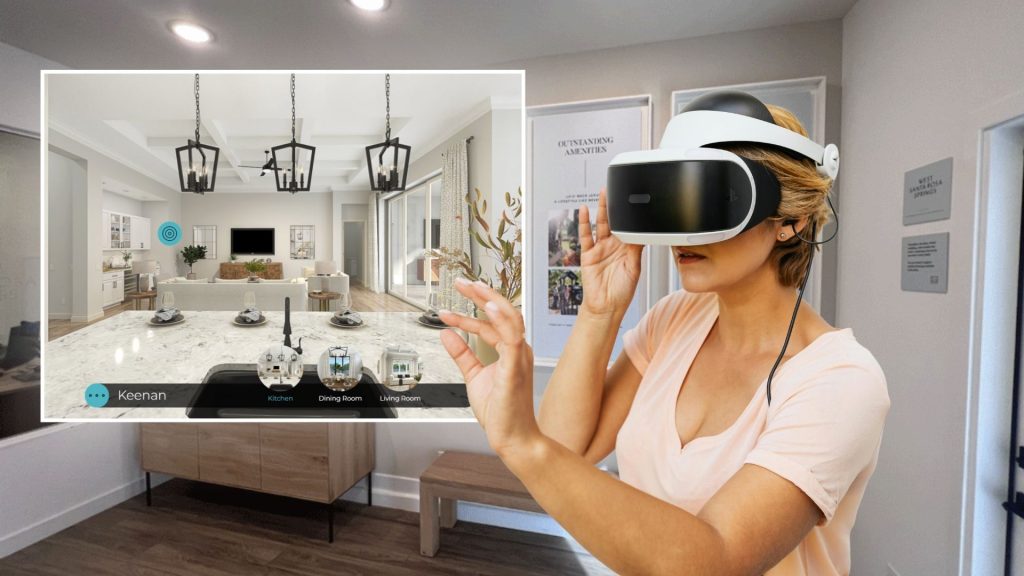
A model home and a VR walkthrough are trying to solve the exact same problem: convince someone to trust a house they haven’t stood inside yet. One does it with lumber, drywall, and a decorator’s budget. The other does it with a headset, a browser tab, or a phone screen. Both cost real money. Only one of them can be finished before the foundation is poured.
We wrote earlier this year about where VR is headed by 2045 (see the post): headsets, avatars, weekend “test drives” of a life not yet built. This post is about where it already is, right now, for a builder deciding whether to spend the money this quarter.
The question that actually matters isn’t “should we do VR.” It’s which format, built from what, delivered to whom, and whether the number on the invoice makes sense for the buyer standing in front of you. Those four questions have real answers. Here they are.
Here’s the short version before we get into the mechanics: the investment pays for itself before you’ve broken ground, across long distances, and at scale; it doesn’t pay for itself everywhere, and we’ll get to exactly where that line falls.
“VR Tour” Means Three Different Things
“VR tour” gets used as a catch-all for at least three distinct technologies, and builders get burned when they buy one thinking they ordered another.
A 360° tour is a set of panoramic photos stitched together at fixed camera positions. A buyer can look around from where the camera stood, but can’t walk anywhere the camera didn’t go; the format carries no real spatial data. It runs on any phone, costs almost nothing, and it’s the right tool for a completed model that just needs to go online.
A Matterport-style 3D scan is a different animal entirely. A LiDAR or depth sensor captures the actual dimensions of a built space and turns it into a navigable digital twin, complete with a measured floor plan and a dollhouse view a buyer can spin around. This is the standard for a finished model home. It needs a real, physical room to scan, which is exactly its limitation.
A true VR walkthrough is the one that matters most for pre-construction sales, because it doesn’t need a finished room at all. It’s built in a real-time engine (Unity or Unreal, most often) directly from the CAD or Revit file your design team already produced. That’s worth sitting with for a second: the drawings you already have are the raw material. A buyer can tour a floor plan that exists only on paper, choose finishes, and walk the layout with a headset or a browser before a single stud goes up.
None of this requires a headset anymore, and that’s the biggest shift since last year. Every major browser now supports WebXR, so a buyer taps a link in a text message and walks through the home right on their phone. Requiring an app download instead of a browser tour cuts engagement by half to two-thirds.1 The headset used to be the entry fee. Now it’s the premium option, reserved for a developer-owned sales gallery rather than something you hand a buyer at home.
What Each Tier Actually Costs
Here’s where the range runs, as of this year. A 360° photo tour costs free to $500 and needs no headset. A Matterport-style scan runs $100 to $1,200 per property, plus a monthly software fee if you’re not outsourcing the capture. A custom VR walkthrough built from your own CAD files runs $20,000 to $50,000 for a single home, more for a full community reused across multiple lots. A custom Apple Vision Pro sales gallery app runs $5,400 to $90,000, depending on how many floor plans and finish options it needs to carry.2
Those aren’t hypothetical numbers. Dennis Ciani at Pacesetter Homes in Austin spent about $14,000 on a VR tour of a brand-new home design when the physical model wouldn’t be framed in time for a grand opening; five competing builders already had furnished models open down the street.3 Santiago Arana at The Agency in Los Angeles worked with an architect who spent $15,000 on a VR tour for a 10,000-square-foot custom oceanfront home. Buyers walked the pool, the landscaping, the ocean view; none of it existed yet.3 Set either number against what a single physical model home costs to build, furnish, and staff for a year, and the math starts to look different.
Does It Actually Work?
The most rigorous answer we’ve seen comes from a 2025 University of Texas at Dallas study of nearly 43,000 properties, published in Information Systems Research. Homes with a VR tour sold in 19 days on average instead of 34, a 44% reduction, after controlling for size, age, and neighborhood. The same study found no bump in final sale price.4 As UT Dallas researcher Dr. Zixuan “Maggie” Meng put it, the tool doesn’t make a house worth more; it makes buyers decide faster.
Sell faster, not higher. That’s the honest claim the data supports, and it’s still a good one. Listings with a 3D tour get 87% more views, per LCP Media’s 2026 figures, and 74% of buyers now say they won’t visit a property at all without seeing a tour first.1 A tour isn’t decorating your listing. It’s the thing deciding whether a buyer shows up in person at all.
When the Investment Earns Itself Back
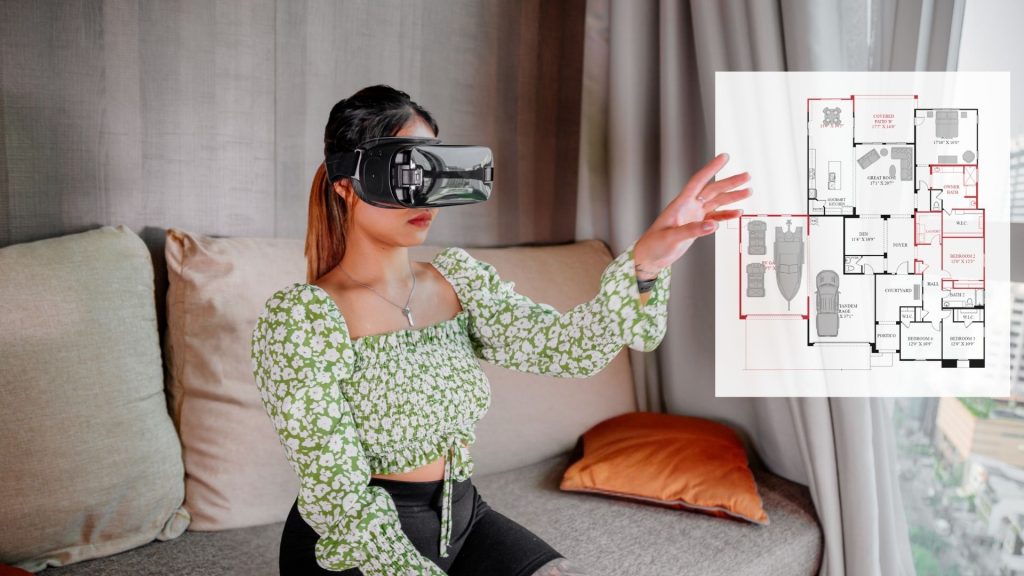
It earns itself back before you’ve broken ground: a pre-sale community, a custom or luxury home, anything where the alternative is asking a buyer to sign based on a floor plan and their own imagination. It earns itself back across distance: an out-of-state buyer, or a family making the decision together from three different cities (we’ve written before about the distributed, multi-generational buyer who needs exactly this kind of tool to close that gap). And it earns itself back at scale: one $30,000 VR build reused across forty lots in a community is a very different number than the same build for a single custom home.
It doesn’t earn itself back everywhere, and it’s worth saying plainly. A production builder running one community, selling mostly to local buyers who can drive to a finished model this weekend, doesn’t need a real-time VR engine. A Matterport scan of the model home, or even a clean 360° tour, does the job for a fraction of the cost. The right tool matches the buyer you actually have, not the buyer a vendor is hoping to sell you.
Three Questions Before You Sign
Ask any vendor three things before you commit budget. Can they build from the CAD or Revit files you already have, or will they charge you to model the house a second time? Does the tour run in a browser without an app or a headset, since that’s where most of your buyers will actually open it? And who updates it when the finish package changes next quarter, because a VR tour showing last year’s cabinets does more harm than no tour at all.
This is the corner of the business we’ve spent thirty years standing in: the space between a set of drawings and a buyer who believes what they’re looking at. We build tours, scans, and animations from the same CAD files your team already has, so the question was never really whether VR works. It’s whether the tour you’d be buying matches the buyer walking through your door today, or the one from five years ago.
See what that looks like:
Quick Answers
A 360° tour is a set of panoramic photos taken at fixed camera positions; a buyer can look around but can’t walk anywhere the camera didn’t go, and it requires a finished, built space to photograph. A true VR walkthrough is built in a real-time engine directly from a CAD or Revit file, so it can show a home that hasn’t been framed yet, and a buyer can walk the full layout rather than view it from fixed points.
Costs range from free for a basic 360° photo tour to $500, $100 to $1,200 for a Matterport-style 3D scan, $20,000 to $50,000 for a custom VR walkthrough built from CAD files, and $5,400 to $90,000 for a custom Apple Vision Pro sales gallery app, depending on scope.
Yes. A 2025 University of Texas at Dallas study of nearly 43,000 properties found homes with a VR tour sold in 19 days on average instead of 34, a 44% reduction, after controlling for size, age, and neighborhood. The same study found no measurable increase in final sale price: the tool speeds up the decision, it doesn’t raise the number.
No. As of late 2025, every major browser supports WebXR, so a buyer can open a VR tour from a link on their phone with no headset and no app download required. Headsets like the Meta Quest 3 and Apple Vision Pro are now used mainly for developer-owned sales galleries, not for tours sent directly to buyers.
Footnotes
1 MadXR, “WebXR and Browser-Based Immersive Experiences,” February 2026; LCP Media, 2026 real estate media engagement data.
2 Frame Sixty, “Virtual Reality Property Walkthroughs: Cost, Technology, and How to Get One Built,” July 2026.
3 Michele Lerner, “Virtual Reality: Visualize Your Way into a Custom Home,” NewHomeSource, April 2026.
4 University of Texas at Dallas and University of Washington, study of 43,000 properties, published in Information Systems Research, September 2025.
Leave a Reply